
DMC palette & hand embroidery notes
Midnight Owl And Autumn Harvest
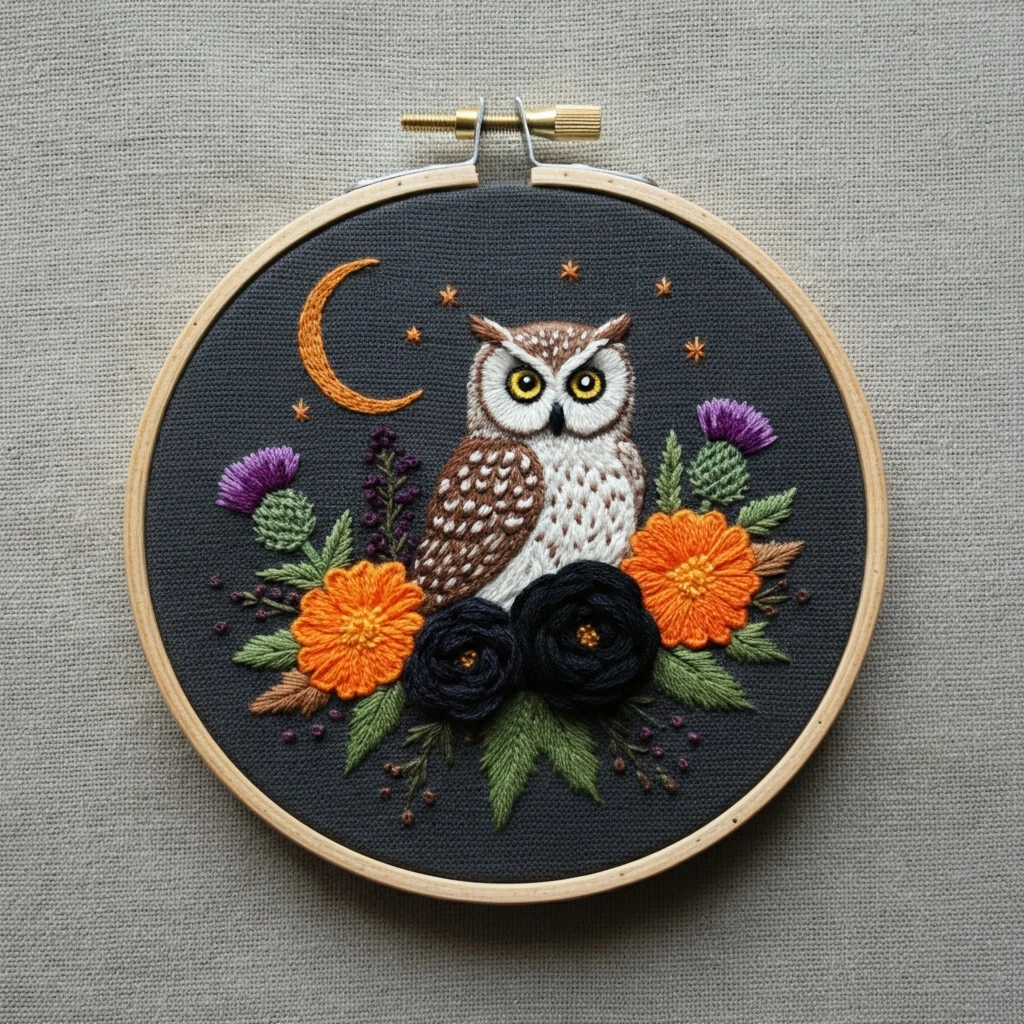
A dramatic dark-fabric hoop with a bright-eyed owl, copper crescent moon, tiny stars, orange harvest flowers, black roses, purple thistles, and layered green leaves. The goal is rich contrast: soft feather shading against a nearly black night ground, with warm autumn accents that glow forward.
Design read
The reference uses a charcoal/black fabric background, a centered brown-and-cream owl, a copper crescent moon and star field, saturated orange harvest blooms, inky black flowers, lavender-purple thistles, sage foliage, and small berry sprays. Keep the owl face crisp and symmetrical, then let the wreath feel more organic with varied leaf lengths and slightly irregular flower petals.
Suggested DMC palette
Use these colors as a practical match to the owl, autumn flowers, moon, night roses, foliage, berries, and small celestial details.
Stitch map by motif
Choose simple stitches with direction changes to create feather, petal, and foliage texture without overcomplicating the piece.
Long-and-short + split stitch
Use 1 strand for facial details and 2 strands for the body. Work wing feathers in short angled rows with DMC 975, 898, 3863, and 3865. Add white speckles as tiny straight stitches or colonial knots.
Satin, backstitch, couching
Satin stitch the golden irises with DMC 972, then place a black pupil. Use split backstitch around the facial discs to keep them clean on dark fabric.
Stem stitch + straight stitch
Build the crescent with curved rows of stem stitch in DMC 922 and 740. Stars work best as 6- or 8-point straight stitches, with a tiny knot in the center.
Fishbone or satin petals
Start each petal at the tip and angle toward the center. Use DMC 740 at the tips, 922 midway, and 920 near the base for autumn depth.
Woven wheel roses
Use DMC 310 for the core and DMC 3799 on outer wraps so the petals are visible against the night fabric. Keep tension relaxed for raised texture.
Leaf stitch + fly stitch
Use fishbone/leaf stitch for broad greenery and stacked fly stitches for ferny edges. Purple thistles can be made with dense straight stitches radiating upward.
Thread-count, blending & shading
Small strand changes will make the owl look detailed while the wreath remains beginner-friendly and full.
Thread-count guidance
- 1 strand: owl eye outlines, beak, feather speckles, star rays, and berry stems.
- 2 strands: most owl feathers, flower petals, moon, leaves, and thistle strokes.
- 3 strands: black rose wraps or flower centers when you want more raised texture.
- 4 strands: only for very bold woven roses on a larger hoop.
Blending ideas
- For owl chest shading, blend one strand DMC 3865 with one strand DMC 3863.
- For warm wing transitions, blend DMC 975 + 435, then deepen with 898 at the outer edge.
- For glowing orange petals, blend DMC 740 + 922 in the middle layer.
- For dimensional leaves, blend DMC 469 + 3012 on top leaves and 469 + 936 underneath.
Outlining details
Outline the owl eyes and beak with 1 strand of DMC 310. Use DMC 898 rather than black around brown wings for a softer natural edge. For the flowers, backstitch only the shadowed lower petals; leaving some petal tips unoutlined keeps the wreath airy.
Texture suggestions
Mix flat satin flowers with raised woven black roses and small knot berries. Add a few detached chain stitches among the leaves to suggest loose autumn greenery. For the owl, vary stitch length rather than adding heavy outlines.
Recommended stitch order
Work from background accents to focal details, saving raised and tiny elements for last.
Transfer and stabilize
Use a light transfer pen, white dressmaker pencil, or water-soluble stabilizer on dark fabric. Keep the owl face and eye circles especially accurate.
Stitch moon, stars, and rear foliage
Complete celestial details first, then the deepest leaves and berry stems behind the flowers so later petals can overlap them naturally.
Build the owl
Start with brown wing areas, then cream chest and face discs. Add eyes, beak, ear tufts, and feather speckles once the main shading is complete.
Add flowers and raised roses
Stitch orange blooms from outer petal tips inward. Work black woven roses after nearby leaves so the raised petals sit cleanly on top.
Finish with highlights
Add gold knots, white feather flecks, thistle tips, tiny berries, and final backstitch. Step back often to avoid overcrowding the dark background.
Beginner-friendly practical tips
These small habits help the dark, detailed design stay neat and readable.
Working on dark fabric
Use good side lighting and a pale cloth on your lap so needle holes are easier to see. Shorten working lengths to about 14–16 inches to reduce fuzz and keep light colors clean.
Keeping the owl symmetrical
Mark the center line lightly through the beak and between the eyes. Finish one eye, then mirror the other before filling surrounding feathers.
Managing dense flowers
Do not pack every wreath space with thread. Leave small slivers of dark fabric between leaves and petals; this creates contrast and prevents the design from becoming muddy.
Finishing polish
After stitching, steam from the back through a towel, never pressing raised roses flat. Mount with even tension so the dark fabric remains smooth inside the hoop.