
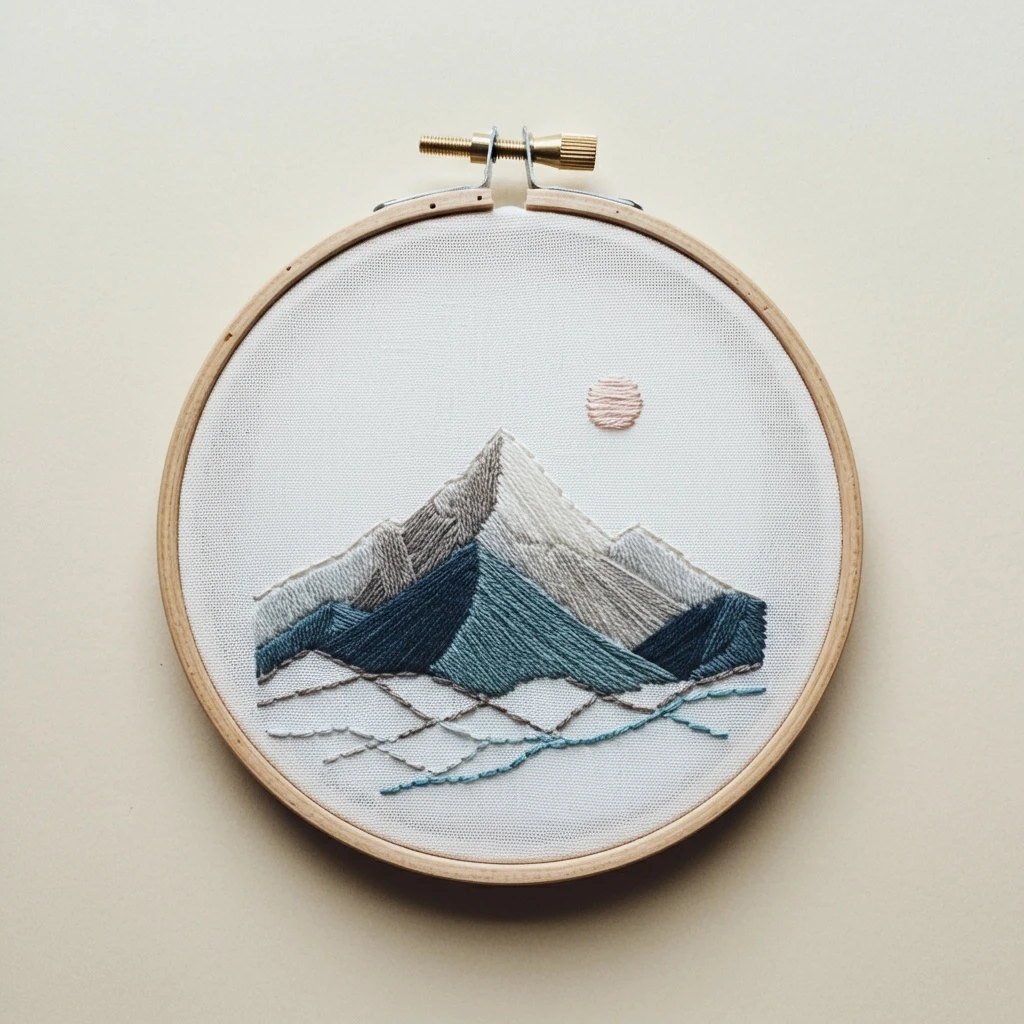
DMC palette & embroidery guide
Minimalist Mountain Landscape
A calm modern landscape with layered peaks, slim evergreen silhouettes, soft sky space, and a warm sunrise accent. The stitching approach below keeps the design clean and graphic while adding just enough texture to make the mountains feel dimensional.
Color read from the design
This pattern is best treated as a restrained nature palette: cool blue-gray sky, muted green slopes, darker pine lines, creamy snow highlights, warm ochre sun, and a few earth tones for foreground grounding. Keep the colors slightly dusty rather than neon so the finished hoop stays serene and modern.
Stitch map by design element
| Area | Recommended stitches and floss notes |
|---|---|
| Mountain ridges | Use split stitch or back stitch with 1 strand of DMC 535 for sharp peaks. For softer distant ridges, switch to DMC 413 and make slightly longer, relaxed back stitches. |
| Snow caps | Work tiny satin stitches or short-and-long stitches with DMC 3865. Leave small fabric gaps between snow and rock lines so the peaks do not look heavy. |
| Sun and sky | Satin stitch the sun with 2 strands of DMC 3820. Add optional single-strand straight rays, or blend 1 strand DMC 3820 with 1 strand DMC 922 for a warmer sunset edge. |
| Evergreen trees | Use detached fly stitch, stacked straight stitches, or fishbone-style angled stitches. Start trunks with DMC 895, then add branch tips in DMC 936 for a lively two-tone pine. |
| Rolling slopes | Use stem stitch for curved hill lines and small seed stitches for texture. Alternate DMC 3052 and 3051 so the greens feel layered without becoming busy. |
| Foreground base | Use couching or whipped back stitch for a smooth grounding line. DMC 922 adds warmth; DMC 895 makes the composition feel bolder and more graphic. |
Blending, shading & texture
Use 1 strand of DMC 927 or 413 for background contours, then 535 for nearer ridges. This creates depth without heavy fill.
Thread 1 strand DMC 895 with 1 strand DMC 936 for mid-dark trees. Use pure 895 only at the bases and lower branch shadows.
Follow the slope angle for mountain fills and the branch angle for trees. Directional stitching gives the minimalist shapes a professional finish.
Instead of filling the entire background, add a few pale DMC 927 arcs or dots and leave most of the fabric open for a clean airy look.
Outlining details
A minimalist landscape depends on tidy edges. Use the darkest green only where the viewer should focus: foreground trees, the lowest slope, and occasional crisp accents. Mountain outlines should be softer and cooler.
- Back stitch: best for straight peak edges and simple horizon lines.
- Split stitch: ideal for smoother curves and slightly raised mountain contours.
- Whipped back stitch: use on the final lower border if you want a smooth graphic line.
- Tiny straight stitches: add short marks along slopes to suggest grass, stones, or trail texture.
Practical order of stitching
Use a fine water-soluble pen or heat-erasable pen. Mark only essential ridge lines, tree trunks, and the sun circle so the fabric stays clean.
Begin with sky accents and pale mountain lines, then move forward through darker ridges, slopes, and foreground trees.
Outline the sun and snow caps before satin stitching them. This gives filled areas a neat boundary and reduces wobble.
Add seed stitches, tiny grass marks, and snow highlights last. Stop while the design still looks open and calm.
Beginner-friendly finishing tips
For a polished display, press the finished embroidery face-down on a towel, then mount it with the mountains centered slightly below the hoop midpoint. This leaves breathing room above the peaks and enhances the peaceful landscape composition.