
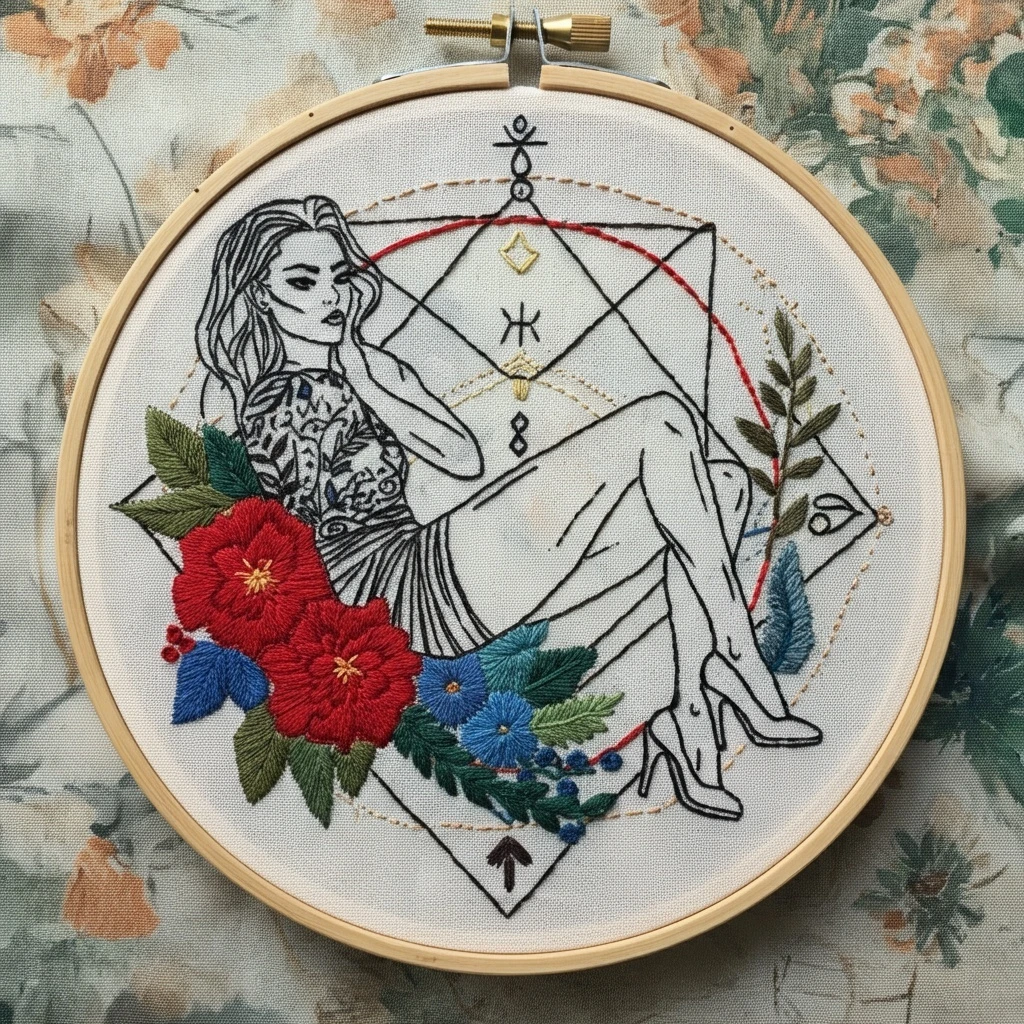
DMC palette & embroidery notes
Modern Mystic Portrait
A polished stitching guide for a contemporary celestial portrait: flowing facial lines, mystical hair shapes, moonlit accents, soft botanicals, and ornamental details that benefit from clean outlines, gentle satin fills, and luminous metallic-style highlights.
Palette direction: deep plum outlines, warm skin neutrals, dusty rose lips and flowers, golden moons/stars, smoky blues, muted sage leaves, and ivory highlights.
Design color analysis
The reference reads as a modern mystical portrait with elegant line work, a calm face, celestial symbols, ornamental floral elements, and a balanced mix of warm flesh tones and cool night-inspired accents. Keep the face airy and refined, then let the moon, stars, hair ornaments, and florals carry the richer color.
Main visual zones
- Face and neck: soft peach-beige shading with minimal fill so the portrait stays light.
- Hair and outline work: deep plum, charcoal brown, and smoky blue for graceful graphic lines.
- Celestial details: antique gold, pale yellow, and ivory for moon, stars, dots, and sparkles.
- Flowers and decorative motifs: dusty rose, mauve, lavender, sage, and muted teal for a mystical botanical feel.
Overall stitching mood
- Use smooth, confident outlines rather than heavy filled areas.
- Blend warm and cool neutrals sparingly for dimensional facial shading.
- Use tiny French knots and seed stitches to make stars and magical specks sparkle.
- Reserve the brightest colors for focal points around the eyes, moon, and floral crown areas.
Suggested DMC floss palette
These colors are selected to capture the mystical portrait’s soft skin, dusky florals, celestial golds, and deep modern outlines. Use fewer colors for a simplified version, or blend neighboring tones for painterly shading.
Use for the crispest facial features, eyelashes, hairline edges, and the darkest ornamental details.
Excellent for hair sweeps, decorative linework, and a softer alternative to black.
Blend with plum for smoky hair shading, cheek-adjacent ornament curves, and lavender petals.
Use in tiny satin areas, flower tips, and soft reflected highlights around celestial motifs.
Ideal for lips, blush hints, flower centers, and warm pink accents without becoming too bright.
Add to upper petal edges, lip shine, and gentle cheek warmth with one or two strands.
Use sparingly for face contours, neck shadows, and warm transitions in skin areas.
Works well for light satin stitches on cheeks, nose bridge, and small hand/neck highlights.
Use for the moon, stars, halos, jewelry-like accents, and warm celestial outlines.
Place on star centers, moon highlights, and small radiant stitches near gold details.
Use for cool shadow leaves, eye accents, and mystical background curls.
Perfect for calm botanical foliage, tiny leaf fills, and balancing the pink-violet palette.
Add barely-there shadows to the face, moon edge, and pale decorative shapes.
Use for eye glints, star tips, bright dots, and tiny highlights on lips or moon edges.
Stitch plan by design area
| Area | Best stitches | Thread guidance | Practical notes |
|---|---|---|---|
| Face outline and features | Back stitch, split stitch, whipped back stitch | 1 strand for delicate facial lines; 2 strands only for outer silhouette | Shorten stitches around curves. Work eyes, nose, and lips slowly so expression stays soft and symmetrical. |
| Hair and flowing graphic shapes | Stem stitch, split stitch, long-and-short stitch | 2 strands for bold curves; 1 strand for internal hair texture | Alternate DMC 154, 3042, and 924 in adjacent rows for a smoky, magical effect. |
| Moon, stars, and celestial dots | Satin stitch, French knots, straight stitch, couching | 2 strands for moon fills; 1 strand or metallic accent for fine rays | Use DMC 3820 as the antique gold base and 744/3865 for small glowing highlights. |
| Flowers and petals | Satin stitch, lazy daisy, fishbone stitch | 2 strands for petals; 1 strand for inner veins | Shade each petal from 3722 at the base to 761 or 3041 at the tip for soft dimension. |
| Leaves and botanical curls | Fishbone stitch, detached chain, stem stitch | 2 strands for leaves; 1 strand for stems | Mix 3013 with 924 in shadowed leaves so the greens feel modern rather than bright garden green. |
| Background magical texture | Seed stitch, tiny straight stitches, scattered French knots | 1 strand for all small marks | Keep spacing irregular. Concentrate details near the portrait and fade outward for a soft aura. |
Blending, shading & texture suggestions
Soft skin shading
- Use DMC 3770 for the lightest skin accents and DMC 945 only where the drawing suggests shadow.
- For an ultra-soft transition, thread the needle with one strand of 3770 and one strand of 945.
- Avoid filling the entire face unless the pattern calls for it; modern portrait embroidery often looks cleaner with selective shading.
Mystic hair blending
- Blend one strand DMC 154 with one strand DMC 3042 for smoky violet curves.
- Add DMC 924 in occasional lines for cool night depth.
- Finish with a few single-strand 3865 highlights only where light would catch the hair.
Celestial glow
- Work the moon in satin stitch with 3820, then add 744 along the upper-left edge.
- Scatter French knots in 744 and 3865 around the face to create a constellation effect.
- For extra shimmer, couch one strand of gold metallic thread beside DMC 3820 rather than replacing cotton entirely.
Floral accents
- Use 3722 at flower bases, 761 on petal tips, and 3041 where petals turn cool in shadow.
- Make centers with two-wrap French knots in 3820 or 154.
- Keep stitches directional: petals radiate from the flower center; leaves angle out from the stem.
Beginner-friendly embroidery tips
Practical finishing idea: If the portrait will be displayed in a hoop, wrap the outer hoop with a muted plum or antique gold ribbon. It will echo the mystical palette without distracting from the delicate face.
Quick reference: strand counts
| Use | Recommended strands | Why it works |
|---|---|---|
| Fine facial features | 1 strand | Keeps eyes, lips, nose, and brows elegant and not bulky. |
| Hair curves and main outlines | 1–2 strands | Allows contrast while preserving graceful line-art movement. |
| Flowers, moon, and leaves | 2 strands | Provides good coverage for small filled shapes without overpowering the portrait. |
| Stars, dots, and aura texture | 1 strand | Creates delicate sparkle and avoids clutter in open background space. |
| Decorative border or hoop title | 2–3 strands | Gives the outer design enough presence to frame the central face. |