
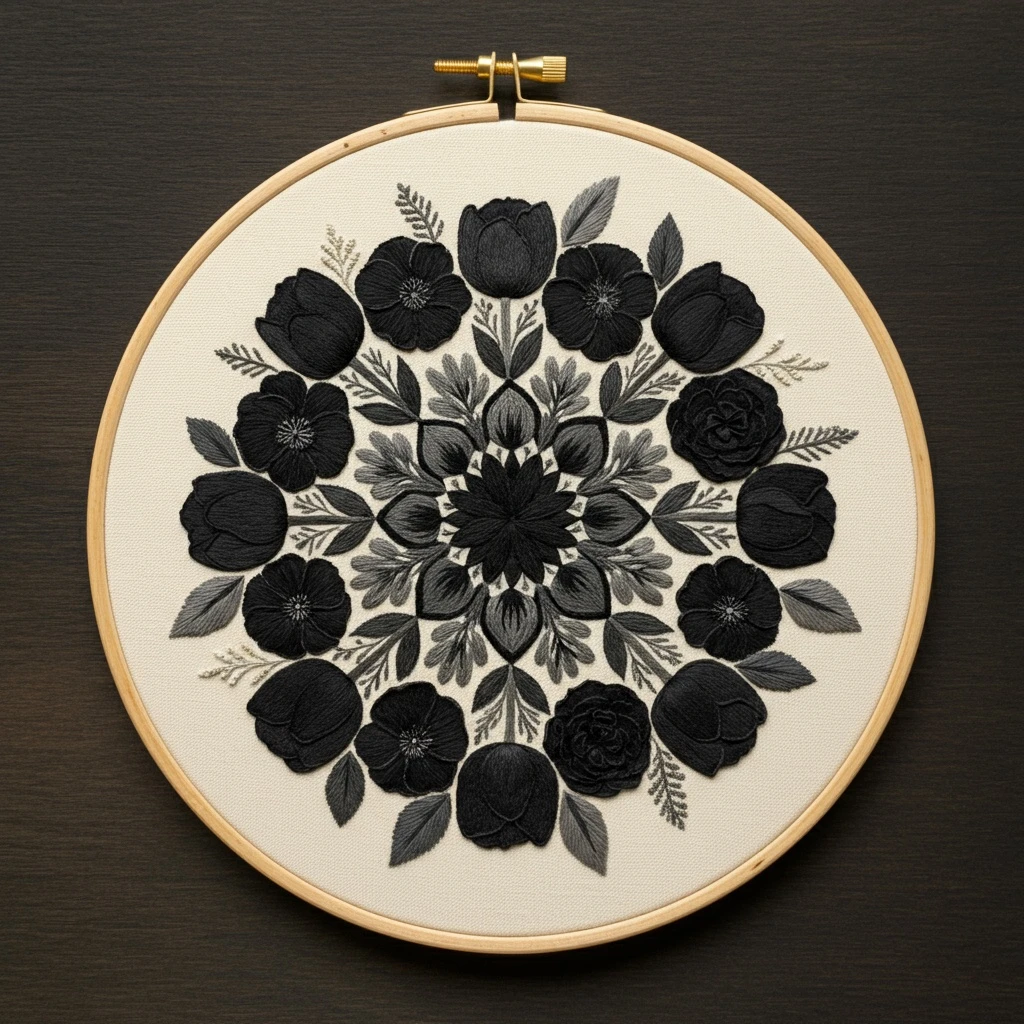
Monochrome Garden Rose & Tulip Mandala
Design #15 · Floral Mandalas & Monochrome Botanicals
Colors estimated from the visible embroidery hoop preview and matched to close DMC embroidery floss shades. This design appears to use a restrained black-to-gray palette with layered roses, tulips, simple blossoms, leaves, and fine fern-like sprigs arranged in a balanced circular mandala.
Preview
Likely DMC Color Palette
Palette based on the black flowers, charcoal tulip shading, gray leaves, fine botanical sprigs, central mandala petals, and pale highlight details visible in the preview.
| DMC | Approx. Hex | Official-style Thread Name | Estimated Coverage | Where It Appears |
|---|---|---|---|---|
| 310 | #000000 | Black | 38% | Deep rose and tulip petals, bold flower outlines, central dark mandala petals, outer floral silhouettes. |
| 3799 | #424242 | Pewter Gray Very Dark | 17% | Dark shading inside tulips, rose fold shadows, heavier leaf veins, inner petal contour lines. |
| 413 | #565656 | Pewter Gray Dark | 13% | Medium-dark leaves, side petal shadows, small oval buds around the center, darker fern stems. |
| 414 | #737373 | Steel Gray Dark | 10% | Layered leaf fills, softer shading on large leaves, gray flower accents, transition areas between black and light gray. |
| 317 | #8F8F8F | Pewter Gray | 8% | Mid-gray botanical leaves, fine feathered sprigs, softer highlights in the circular foliage ring. |
| 318 | #ABABAB | Steel Gray Light | 6% | Light leaf strokes, small radiating flower-center stitches, subtle petal highlights. |
| 415 | #C7C7C7 | Pearl Gray | 4% | Pale details in flower centers, small highlight lines on leaves, delicate contrast in the inner mandala ring. |
| 762 | #E6E6E6 | Pearl Gray Very Light | 2% | Lightest glints and tiny seed-like accents where the preview shows pale stitches against dark petals. |
| 3865 | #F9F7EF | Winter White | 2% | Optional bright sparkle points in flower centers or the small triangular highlights near the central mandala. |
Stitching Suggestions
| Design Element | Recommended Stitch Type | Practical Stitching Notes |
|---|---|---|
| Outer black roses | Long and short stitch with split-stitch outlines | Build the darkest petal masses first, then use very dark gray for curved inner folds so the roses do not become flat solid circles. |
| Tulip-shaped blossoms | Satin stitch or long and short stitch | Follow the natural vertical curve of each petal. Keep black on the outer edges and blend toward charcoal or pewter gray inside. |
| Simple round flowers | Blanket stitch, satin stitch, or long and short stitch | Work petals from the outside toward the center. Leave space for a small textured center so the flower remains readable. |
| Flower centers | French knots and tiny straight stitches | Use light gray or pearl gray for contrast against black petals. Vary knot size slightly for a natural seed-like texture. |
| Central mandala flower | Satin stitch with backstitch accents | Stitch opposite petals in pairs to keep the center balanced. Add pale highlights last so the geometric ring stays crisp. |
| Large gray leaves | Fishbone stitch or satin stitch | Angle the stitches toward the center vein. Use darker gray at the base and lighter gray along the outer edges if blending. |
| Small inner leaves and buds | Lazy daisy stitch, detached chain, or padded satin stitch | Keep these neat and compact; they are important for the mandala rhythm between the larger flowers. |
| Fine fern-like sprigs | Stem stitch with short straight stitches | Use one strand for the finest stems and small side strokes. Lighter grays help these sprigs stay delicate rather than heavy. |
| Petal fold lines and veins | Backstitch or split stitch | Add linework after the fill stitches are complete. Choose a shade just lighter or darker than the petal fill for subtle dimension. |
Where to Start
Start at the center of the mandala so the design stays symmetrical. Stitch the central black petals and the small light accent shapes first, then move outward to the ring of buds and gray leaves. After the middle is stable, work the largest outer flowers one at a time, spacing the dark blooms evenly around the hoop. Finish with the fine fern sprigs, leaf veins, and flower-center knots.
Helpful Notes
Thread Weight
- Use 2 strands for most filled petals, tulips, roses, and medium leaves.
- Use 1 strand for fern sprigs, petal fold lines, tiny veins, and delicate highlight strokes.
- Use 2 or 3 strands only where a bold black outline needs extra weight.
Monochrome Shading
- Separate black areas with dark gray linework so the individual petals remain visible.
- Keep pale gray accents sparse; too much light thread can soften the dramatic monochrome look.
- Save French knots and tiny highlight stitches for the end to avoid snagging them while filling larger areas.