
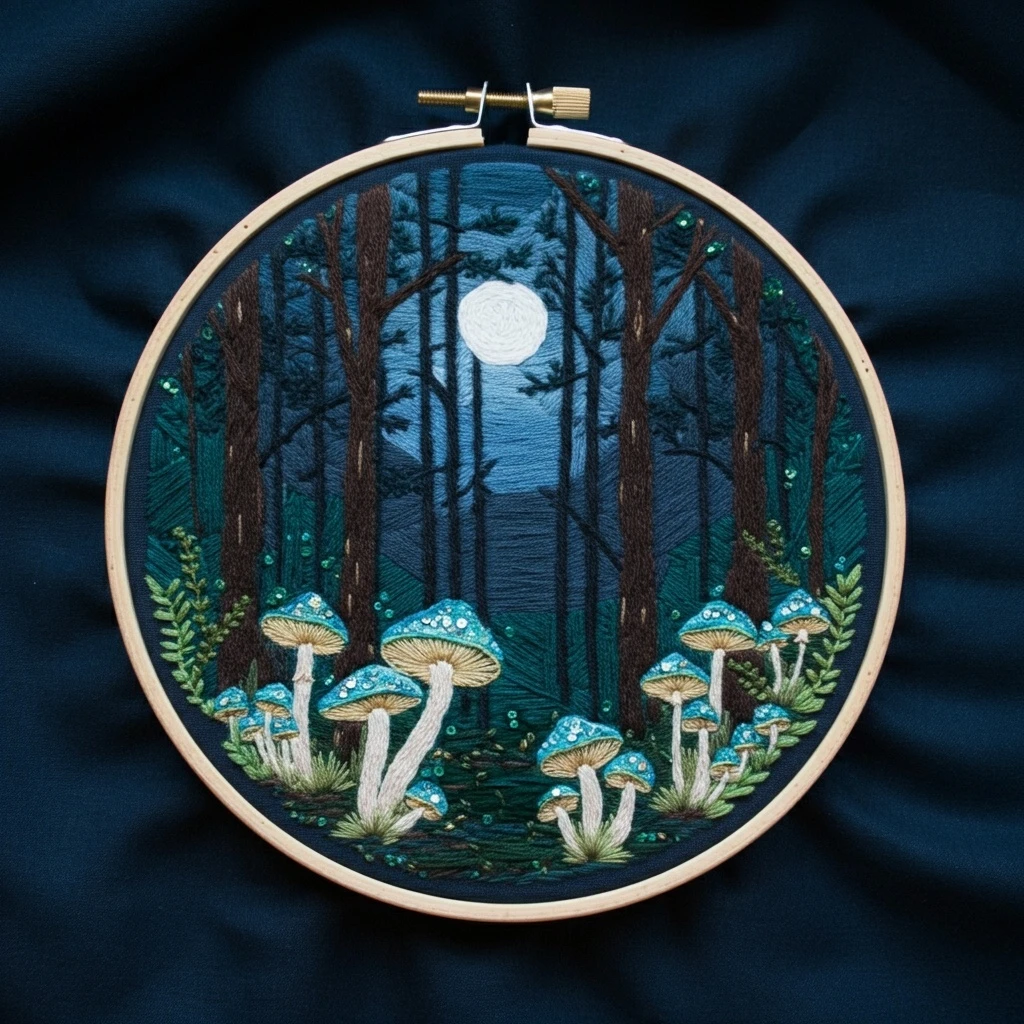
Moonlit Forest With Glowing Mushrooms
A deep blue woodland hoop with tall silhouetted trunks, layered pine needles, a bright full moon, and clusters of luminous turquoise mushrooms. The palette below keeps the scene nocturnal while giving the mushroom caps, moon, beads, and fern tips a magical glow.
Color reading from the design
The image is built from a dark blue-black base, slightly brighter teal forest layers, chocolate-brown tree trunks, cream mushroom stems and gills, vivid cyan caps, and small minty highlights that read like glowing spores. Keep most background stitches matte and dark, then reserve the lightest threads for the moon, mushroom spots, stem edges, and tiny firefly-like accents.
Thread-count guidance
Blending map
Blend two strands in the needle when you need a smooth transition but do not want many separate color changes.
Moonlit sky
1 strand 823 + 1 strand 924 for the blue haze between tree trunks. Use lighter blends closer to the moon.
Cap glow
1 strand 3844 + 1 strand 3845 for the luminous top surface of the blue mushroom caps.
Soft stems
1 strand 746 + 1 strand 762 for cool, moonlit mushroom stems; switch to 746 alone on the lit edge.
Stitch suggestions by design element
| Area | Suggested stitches | Practical notes |
|---|---|---|
| Full moon | Spiral split stitch, stem stitch rings, tiny satin stitches | Work from the center outward. Keep stitches short so the circle stays round; finish with a few B5200 surface stitches for a crisp lunar highlight. |
| Distant forest | Single-strand straight stitch, back stitch, seed stitch | Use thin vertical lines in 939, 823, and 924. Let some dark fabric show through to create depth and avoid a flat wall of thread. |
| Large trunks | Split stitch fill, stem stitch, couching for heavy outlines | Fill trunks vertically with 3371. Add uneven 938 lines and a few 739 slivers only where moonlight catches bark. |
| Mushroom caps | Satin stitch, long-and-short stitch, French knots for dots | Angle stitches over the dome shape. Keep lower cap edges darker and place the brightest 3845/B5200 accents on top-left edges. |
| Gills | Straight stitch rays, fly stitch, back stitch rim | Stitch gill lines from the stem outward using 739 and 746. Vary stitch length to make the underside look ribbed and delicate. |
| Fern fronds | Stem stitch, detached chain, fishbone stitch | Use 3363 for stems and 3346 for leaflets. Add a few 964 stitches near mushrooms where the foliage catches glow. |
| Floating spores | French knots, colonial knots, seed beads if desired | Use one wrap for tiny dots and two wraps for foreground glow. Concentrate dots near mushroom clusters and fade them upward. |
Outlining, shading & texture plan
For the clearest finished hoop, build depth from dark to light: background first, trees second, ground and foliage third, mushrooms last. Save all white, pale turquoise, metallic, bead, or glow-thread details until the fabric is no longer being handled heavily.
Beginner-friendly order of work
Helpful finishing tips
- Needle choice: use a size 7–9 embroidery needle for stranded cotton; switch to a beading needle for seed beads.
- Hoop tension: keep the dark fabric drum-tight so satin stitches on the mushroom caps remain smooth.
- Thread length: use shorter 12–15 inch lengths for dark thread, which shows fuzz and wear more quickly.
- Glow effect: do not overuse bright turquoise. One bright stitch beside several dark stitches looks more luminous than a large block of pale color.
- Back neatness: avoid carrying pale threads behind dark open areas; they can show through navy fabric.
- Optional sparkle: substitute a few cap dots with clear, aqua, or iridescent seed beads, but keep them sparse so they read as dew rather than glitter.
Suggested shopping list
Core floss: DMC 939, 823, 924, 3768, 3808, 3844, 3845, 964, 3371, 938, 739, 746, B5200, 762, 3363, and 3346. Optional: DMC E940 glow-in-the-dark for moon and spores, plus a small packet of clear or aqua seed beads for the glowing dots.