
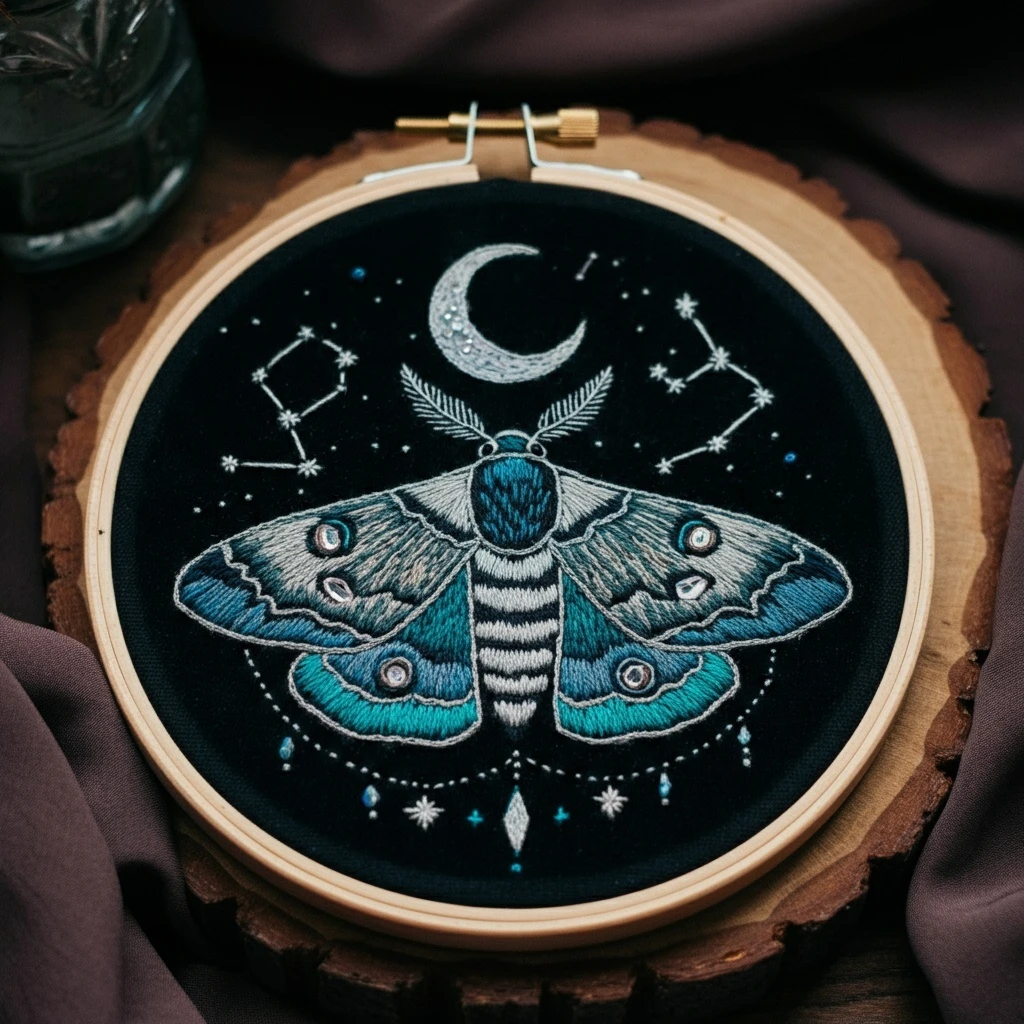
Moonlit Moth Constellation
A celestial moth worked on deep black fabric, with silver-white wings, turquoise lower wing bands, glowing eyespots, a crescent moon, dotted constellations, and tiny starbursts. The palette below keeps the design crisp and moonlit while giving the moth body and wing tips a luminous blue-green shimmer.
Color reading from the design
The artwork relies on a dark open background, pale stitched linework, cool gray wing fills, deep teal wing shadows, bright turquoise accents, and tiny white constellation dots. Keep the night fabric visible around the moth and stars. The strongest light should be concentrated in the crescent moon, star knots, wing veins, and the turquoise lower-wing bands.
Thread-count guidance
Blending map
Two-color needle blends are useful on this design because the wings need soft shifts from silver to shadow and from teal to glow.
Silver wings
1 strand 3865 + 1 strand 762 for a pearly moth-wing base that is bright but not stark white.
Wing shadow
1 strand 414 + 1 strand 3799 for charcoal-gray shaded panels beside the pale veins and outer edges.
Teal glow
1 strand 3844 + 1 strand 3845 for luminous lower wings; add one or two 3846 stitches only at the highlight peaks.
Stitch suggestions by design element
| Area | Suggested stitches | Practical notes |
|---|---|---|
| Crescent moon | Split stitch fill, tiny seed stitch, whipped back stitch edge | Fill with 762 and 3865, then place B5200 on the outer rim. A few short 453 stitches inside the crescent create crater-like texture without darkening it too much. |
| Constellations | Back stitch, couching, French knots, star stitch | Use one strand for connecting lines so they stay delicate. Stars can be French knots for dots and straight-stitch bursts for larger points. |
| Antennae | Stem stitch centerline, detached straight stitches or fly stitch barbs | Stitch the center stems first in 762, then add one-strand angled barbs. Keep the spacing airy so the antennae look feathery rather than solid. |
| Moth body | Long-and-short stitch, split stitch grooves, satin highlights | Shade the body with 3810 at the sides, 3844 through the center, and small 3845 strokes on raised ridges. Use 310 or 3799 for the narrow underside shadows. |
| Upper wings | Long-and-short stitch, back stitch veins, stem stitch borders | Begin with broad gray fill, then stitch pale veins on top so they remain crisp. Angle stitches outward from the body to the wing tips. |
| Eyespots | Satin stitch rings, split stitch circles, French knot centers | Use 3779 and 453 for the soft warm rings, 938 for the narrow dark ring, and B5200/762 for the small reflective center. |
| Lower turquoise bands | Satin stitch, fishbone-style directional fill, whipped outline | Darken the inner edge with 3810, brighten the outer rim with 3845, and add a few 3846 stitches where the band curves upward. |
| Dotted arcs & charms | Running stitch dots, colonial knots, lazy daisy drops | Keep decorative dots small and evenly spaced. The diamond charm can be satin stitched in 3865 with a B5200 center line. |
Outlining, shading & texture plan
Work from quiet, broad areas to bright raised details: pale wing fills first, teal bands second, body and eyespots third, then constellations, moon rim, knots, and any metallic or glow-thread accents last. On dark fabric, over-stitching with white can look fuzzy, so use short, confident stitches and reserve B5200 for the points that should sparkle.
Beginner-friendly order of work
Helpful finishing tips
- Fabric choice: a non-stretch cotton, linen, or cotton-linen blend in black or midnight navy gives the pale stitches the best contrast.
- Needle choice: use a size 7–9 embroidery needle for stranded cotton; switch to a size 10 needle for single-strand star details.
- Thread length: use 12–15 inch lengths for white and pale gray floss so it stays clean and smooth on dark fabric.
- Clean whites: wash hands before stitching moon and stars; pale thread picks up lint quickly when worked over black fabric.
- Glow control: bright turquoise should appear in small clusters. A few light stitches beside dark teal will look more luminous than filling everything with the lightest shade.
- Back neatness: avoid carrying white floss across open black fabric. Travel under existing stitches or end the thread and restart nearby.
- Optional sparkle: replace a few star knots with tiny silver-lined clear beads, but keep them sparse so the moth remains the focal point.
Suggested shopping list
Core floss: DMC 310, 939, 3799, 414, 762, B5200, 3865, 453, 3810, 3844, 3845, 3846, 3779, 938, 3765, and 747. Optional: DMC E940 glow-in-the-dark for selected stars and moon highlights, plus a few silver-lined clear or aqua seed beads for the brightest constellation points.