
DMC palette & stitching guide
Mountain Cabin Landscape
A serene hoop landscape with snow-tipped blue-gray mountains, a bright reflective lake, dense evergreen forest, a tiny log cabin, winding stone path, and meadow flowers in red, pink, purple, and cream.
Use this guide as a practical companion for balancing crisp outlines, painterly long-and-short shading, reflective water, and beginner-friendly texture without overworking the fabric.
Design read: what to preserve
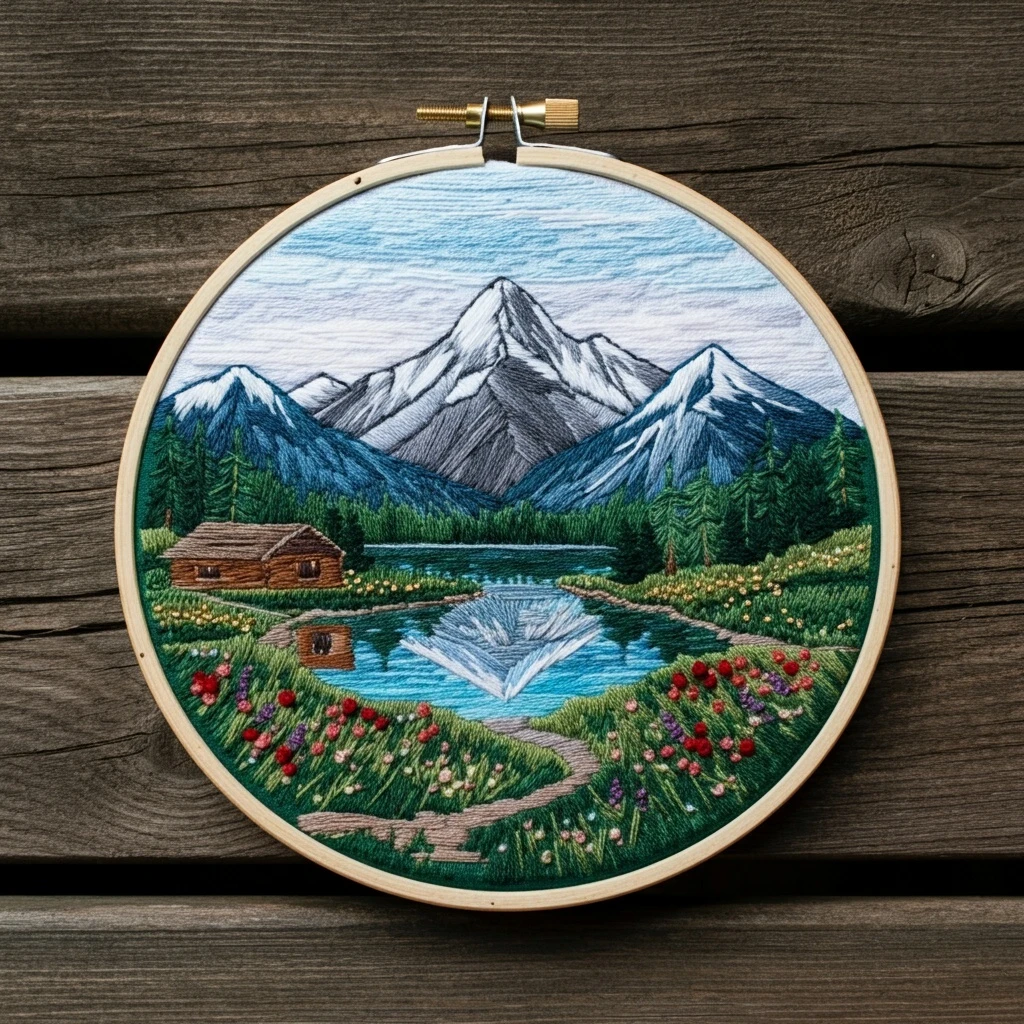
Layered distance
The image works because the pale sky, snowy peaks, blue side mountains, dark pines, lake, cabin, and foreground flowers each sit in a clear depth layer. Keep background stitches smoother and foreground stitches more raised.
Cool mountain light
The mountains are mostly icy white, steel gray, slate blue, and deep navy. Use small directional changes in stitch angle to separate snow faces, rocky ridges, and shadowed valleys.
Warm cabin contrast
The tiny brown cabin is the main warm note. Reserve golden window stitches and log texture for late in the project so they remain crisp against the surrounding greens.
Suggested DMC palette
This palette matches the visible color families in the reference: icy sky, blue-gray mountains, dark pine forest, turquoise lake reflections, rustic cabin browns, meadow greens, and bright flower accents.
Snow caps, bright lake glints, tiny flower centers; use sparingly for the highest highlights.
Soft snow shadows and pale cloud transitions; blend with Blanc for smoother peaks.
Mid mountain planes, reflected peak edges, and cool rock breaks.
Rocky ridges and deeper folds on the central mountain.
Final mountain creases, cabin underside, and selective deep linework.
Pale sky wash and soft lake highlights; good for 1-strand horizontal strokes.
Clear sky blue and sparkling lake bands near the center foreground.
Stronger lake ripples and blue mountain slopes; alternate with darker teals.
Lake shadow bands, distant tree reflections, and cool side-mountain shadows.
Deepest pine masses and shaded bases behind the cabin.
Evergreen needles, mid forest layer, and dark meadow contours.
Brighter grass tufts and lit pine tips; use in broken stitches, not solid blocks.
Sunlit meadow blades, tiny stems, and foreground color lift.
Cabin log shadows, roof underside, and doorway details.
Main cabin logs and warm reflection in the water.
Log highlights, path edges, and small dry grasses around the cabin.
Cabin window glow and a few warm flower centers.
Large red meadow blossoms; 2-wrap French knots make them pop.
Dark red flower shading and berry-like knots in the foreground.
Purple flower spikes and shadow touches among grasses.
Small pink blossoms and softer meadow dots.
Creamy wildflowers and tiny highlights in grass clusters.
Stone path, shoreline stitches, and neutral transitions between greens and water.
Use as the final, thinnest outline only where contrast is essential.
Stitch plan by area
Sky and pale atmosphere
Stitches: split stitch, long-and-short, and very loose horizontal satin accents.
Threads: 1 strand for most sky strokes; 2 strands only near the horizon if coverage is needed.
Keep the sky airy. Leave small breathing gaps between blue strokes so it reads like delicate shading rather than a filled block.
Mountains and snow
Stitches: directional long-and-short, split stitch ridges, and tiny straight stitches for cracks.
Threads: 1 strand for ridge lines and distant slopes; 2 strands for broad shaded faces.
Work each mountain face in its own angle. Blend Blanc + 762 for snow, 318 + 414 for mid rock, and 3799 only in the deepest creases.
Pine forest
Stitches: fishbone stitch, stacked straight stitches, fern stitch, and small fly stitches.
Threads: 2 strands for front trees; 1 strand for distant tree line.
Use 890 at the base, 895 through the body, and touches of 699 or 3347 on branch tips. Do not outline every tree; let grouped silhouettes create depth.
Lake and reflection
Stitches: horizontal straight stitch, split stitch ripples, and couching for a few clean shine lines.
Threads: 1 strand for reflected mountain details; 2 strands for bright turquoise bands.
Mirror the mountain colors upside down with shorter, broken stitches. Keep all water stitches nearly horizontal so the lake stays calm.
Cabin
Stitches: satin stitch roof, backstitch log lines, stem stitch trim, and small satin rectangles for windows.
Threads: 2 strands for the cabin body, 1 strand for log separation and window outlines.
Stitch the cabin after the background greens. A single strand of 977 in each window gives the cozy focal detail without making the cabin too large.
Meadow, path, and flowers
Stitches: straight-stitch grasses, stem stitch path edges, French knots, lazy daisy, and detached chain petals.
Threads: 2 strands for foreground grass and path; 2 strands for flower knots; 1 strand for tiny stems.
Place flowers irregularly. Cluster reds and purples in the foreground, then switch to smaller pale knots as they move toward the cabin.
Thread-count and blending guidance
| Area | Best strand count | Blend suggestion | Practical note |
|---|---|---|---|
| Sky wash | 1 strand | 3756 with occasional 3846 | Use light pressure and long spacing; avoid dense filling above the mountains. |
| Snow peaks | 1 to 2 strands | Blanc + 762, then 318 where shadow begins | Keep Blanc for the highest ridges so the peaks stay crisp. |
| Rock shadows | 1 strand detail over 2 strand base | 318 + 414, with tiny 3799 accents | Change stitch direction for each plane instead of relying only on darker color. |
| Distant forest | 1 strand | 890 + 895 | Use short verticals and triangular tops; distant trees should be suggested, not fully detailed. |
| Foreground pines | 2 strands | 895 base, 699/3347 tips | Add brighter tips last so the forest does not become flat. |
| Lake | 1 strand details, 2 strand color bands | 3756 + 3846 for shine, 3843 + 3765 for depth | Break ripples into uneven lines. Continuous stripes can look mechanical. |
| Cabin logs | 2 strands base, 1 strand linework | 433 + 436 highlights, 801 shadows | Backstitch log grooves after the cabin body is filled. |
| Flowers | 2 strands | 321 with 815, 3716 with 744, 3837 for purple clusters | Use French knots for dots and lazy daisy for the few larger petals near the front. |
Recommended stitching order
Transfer simply
Mark the mountain silhouette, cabin, lake edge, main path, and large flower clusters. Skip drawing every blade of grass.
Build the distance
Work sky first, then mountains, then distant tree line. Keep these layers low and smooth.
Add middle ground
Stitch lake reflections, cabin, shoreline, and side pines. Check that horizontal water lines remain level.
Finish foreground
Add path texture, grasses, flowers, final outlines, and a few bright highlights only at the end.
Outlining, shading, and texture details
Keep outlines fine
Use 1 strand of 3799, 3765, 801, or 310 depending on the area. Black is useful for the strongest mountain cracks and cabin openings, but colored darks look softer and more natural around the lake and trees.
For the hoop-style look, outline the mountain ridges with split stitch rather than heavy backstitch. It gives a stitched-pencil effect similar to the reference image.
Create painterly texture
Let thread direction do the shading work. Mountain strokes should run down the slope; lake strokes should run sideways; tree stitches should angle outward from the trunk; foreground grass should lean in varied directions.
For extra dimension, add a few raised French knots in the flower meadow and keep the lake flatter so the surface feels calm by comparison.
Beginner-friendly practical tips
Use a limited first pass
Start with only one light, one mid, and one dark color per area. Add extra shades after the main shapes are clear.
Test water lines
Before stitching the lake, draw two or three tiny guide lines with an erasable fabric pen. Level ripples make the reflection believable.
Control thread bulk
Large filled areas can pucker. Use shorter lengths of floss, avoid pulling tightly, and hoop the fabric firmly but not stretched out of shape.
Save the flowers
Foreground knots catch the eye, so stitch them last. This prevents bright red and purple knots from being snagged while working the mountains.
Blend gradually
When switching mountain colors, overlap old and new colors by a few stitches instead of ending one shade in a hard line.
Step back often
Landscape embroidery reads from a distance. Check the hoop from arm's length before adding more dark outlines.