
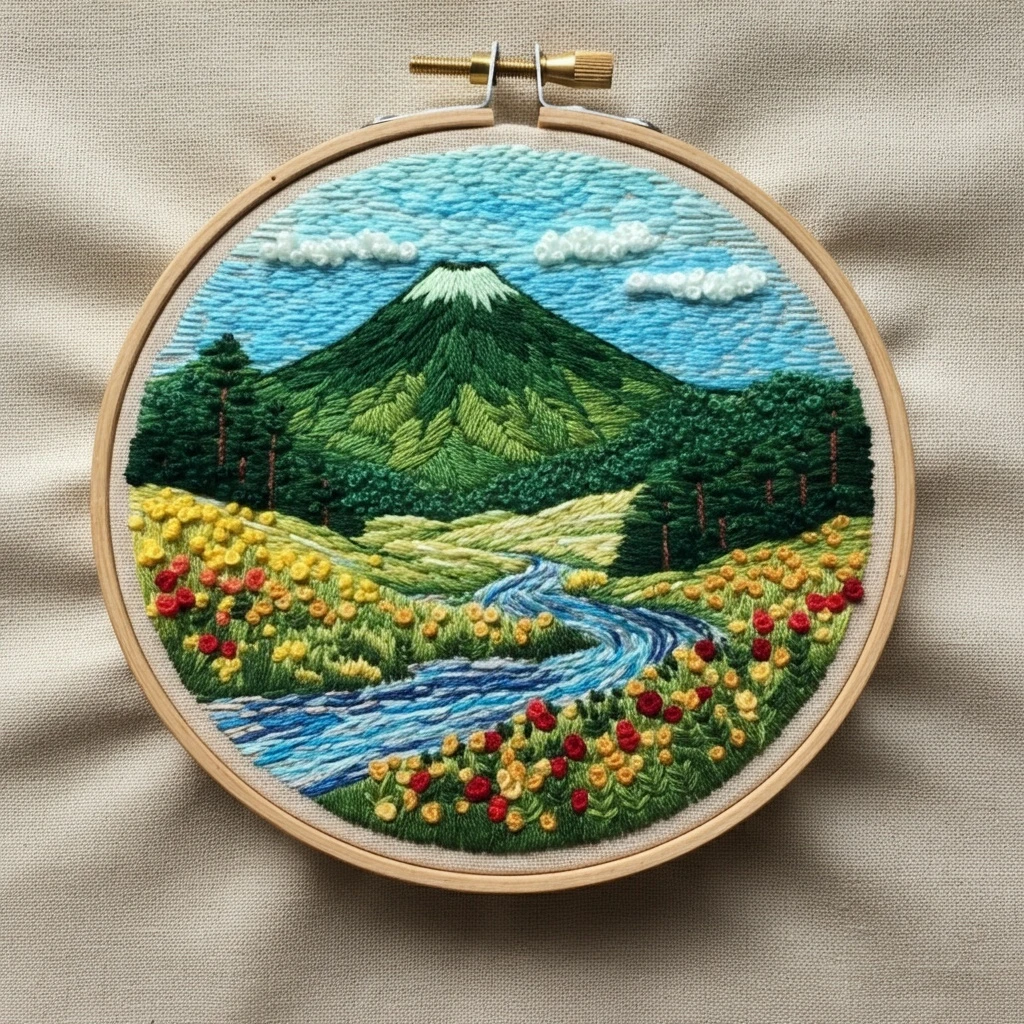
Mountain Landscape with River & Wildflowers

DMC Palette & Stitch Guide: Mountain Landscape with River and Wildflowers
Embroidered Mountain Landscape with River and Wildflowers
DMC Color Palette & Stitching Notes

Mountain Landscape with River & Wildflowers

A practical embroidery guide for a round-hoop alpine scene: bright blue stitched sky, snow-touched green mountain, dark forest, winding river, golden meadow grasses, and cheerful red and yellow wildflowers.

Landscape shadingThread paintingFrench knotsBeginner friendly layers

Design Color Read

The reference image is built around strong natural contrasts: cool turquoise sky and river blues, deep evergreen forest shadows, fresh yellow-green mountain slopes, warm straw meadows, and small but vivid wildflower accents. Keep the background stitches calm and directional, then let the river highlights and raised flower knots provide sparkle.

DMC 3846
Bright Turquoise
Main sky brightness and pale river glints; use 2 strands in long horizontal strokes.
DMC 3845
Bright Turquoise
Mid sky bands and moving water; blend with 3846 for soft transitions.
DMC 3765
Peacock Blue
River bends, deeper ripples, and lower sky texture behind the mountain.
DMC 823
Navy Blue
Darkest river outlines and narrow shadow accents where the water turns.
DMC 890
Ultra Dark Pistachio Green
Mountain shadow planes, forest base, tree silhouettes, and lower outline depth.
DMC 895
Very Dark Hunter Green
Dense pine clusters and dark valleys; place sparingly to avoid a flat block.
DMC 699
Green
Mid mountain slopes, meadow leaves, and softened forest edges.
DMC 704
Bright Chartreuse
Sunlit grass strokes and the bright mountain ridges facing the viewer.
DMC 472
Avocado Green
Soft transition between meadow yellows and greens; useful for distant grasses.
DMC 307
Lemon
Yellow wildflowers and high meadow highlights; best as knots or tiny detached stitches.
DMC 3852
Very Dark Straw
Golden flower shadows, warm hillside texture, and seed-head accents.
DMC 321
Red
Foreground poppies or red blossoms; cluster in odd numbers for a natural field.
DMC 902
Very Dark Garnet
Tiny shadow crescent on red flowers and a few deeper buds.
DMC 3865
Winter White
Cloud puffs, snowcap, and brightest river sparkle; use clean short stitches.
DMC 801
Dark Coffee Brown
Thin tree trunks and small grounding lines in the dark forest.
DMC 3828
Hazelnut Brown
Optional hoop-colored border accent or warm dry grass details near the path.

Stitch Plan

Sky: Work rows of long and short stitch horizontally with 2 strands, alternating 3846 and 3845. Leave slight irregular spacing so the sky looks hand-textured rather than striped.
Clouds & Snow: Use French knots, colonial knots, or padded satin stitch in 3865. Keep the snowcap flatter than the clouds so the mountain peak remains crisp.
Mountain: Use directional long and short stitch that follows the slope lines. Start with 890 shadows, add 895 in deep creases, then layer 699, 704, and 472 for bright ridges.
Forest: Combine seed stitch, tiny fly stitch, and short vertical straight stitches. Use mostly 895 and 890, with 699 on the top edge for tree texture.
River: Follow the curve with split stitch or stem stitch lines. Use 823 in the deepest channels, 3765 and 3845 for mid ripples, and 3865 or 3846 for highlights.
Wildflowers: Add French knots, lazy daisies, and tiny woven roses. Use 307 and 3852 for yellow blossoms; 321 with touches of 902 for red foreground blooms.

Thread Count Guidance

AreaSuggested strandsWhy it works
Sky and distant hills1-2 strandsKeeps far-away areas light and prevents bulky coverage.
Mountain and river2 strandsGives smooth coverage while still allowing blended stitch direction.
Forest mass2-3 strandsExtra thickness creates the dense dark tree band seen in the design.
Foreground grass2 strands, varied lengthLoose strokes make the meadow look layered and natural.
Flower knots2 strands for small, 3 strands for raised foregroundCreates depth without overwhelming the landscape scale.
Outlines1 strand for distant, 2 strands for foregroundMaintains perspective: thin far lines, clearer front details.

Blending, Shading & Texture Suggestions

Mountain planes: Blend one strand 699 with one strand 704 for medium sunlit slopes. For shadowed ridges, blend 890 with 895 and stitch downward following the mountain angle.
River motion: Do not fill the river as one flat blue. Stitch narrow curved lines with small gaps; then add 3865 highlights on the outside bends and 823 on inside turns.
Meadow depth: Place darker green grass first, then lay 472 and 704 over it in shorter strokes. Finish with flowers so the knots sit cleanly on top of the field.
Forest texture: Use clustered seed stitches instead of solid satin stitch. A few vertical 801 trunks should peek through, especially at the right and left tree groups.
Cloud dimension: Work the underside with a few pale blue-gray stitches if desired, then top with 3865 knots. Keep cloud edges uneven and soft.
Foreground flowers: Make flowers larger at the bottom edge and smaller toward the river and hill line. This simple scale shift adds strong landscape perspective.

Outlining Details

Use outline sparingly. This design depends on embroidered texture, not heavy cartoon lines. A 1-strand split stitch in 890 can define the mountain silhouette against the sky, while 823 can sharpen the main river curve. For flowers, avoid outlining every blossom; instead add one dark knot or tiny side stitch in 902 or 3852 to imply shadow.

For tree trunks, use 801 in very fine vertical back stitch. Let some trunks disappear into the forest mass so the linework feels natural rather than evenly spaced.

Beginner-Friendly Order

  1. Transfer the main horizon, mountain, river, forest band, and flower-field shapes.
  2. Stitch sky first with relaxed horizontal strokes.
  3. Complete the mountain from dark shadow to light ridge highlights.
  4. Fill the forest and distant grasses before stitching the river.
  5. Add the river curves, then the meadow grass texture.
  6. Finish with clouds, snow highlights, and raised wildflower knots.

Practical Embroidery Tips

Keep the fabric drum-tight in the hoop, especially while filling the sky and river. Long horizontal stitches can pucker if the tension is pulled too firmly, so use small anchoring stitches at the back rather than tugging. Step back often: landscape embroidery reads best from a little distance, and tiny imperfections in grass or clouds usually improve the organic look.

For a polished finish, reserve the brightest colors until the end. A few final stitches of 3865 in the water, 704 on the mountain ridge, and 307 in the flower field will make the whole scene feel sunlit and dimensional.

Leave a Reply

Your email address will not be published. Required fields are marked *