
DMC palette & hand embroidery notes
Mountain Landscape With Sunrise And River
A calm hoop scene built from warm sunrise rays, layered blue-green mountains, deep evergreen banks, and a winding turquoise river. The guide below keeps the embroidery fresh and natural while giving beginners clear thread counts and practical stitch choices.
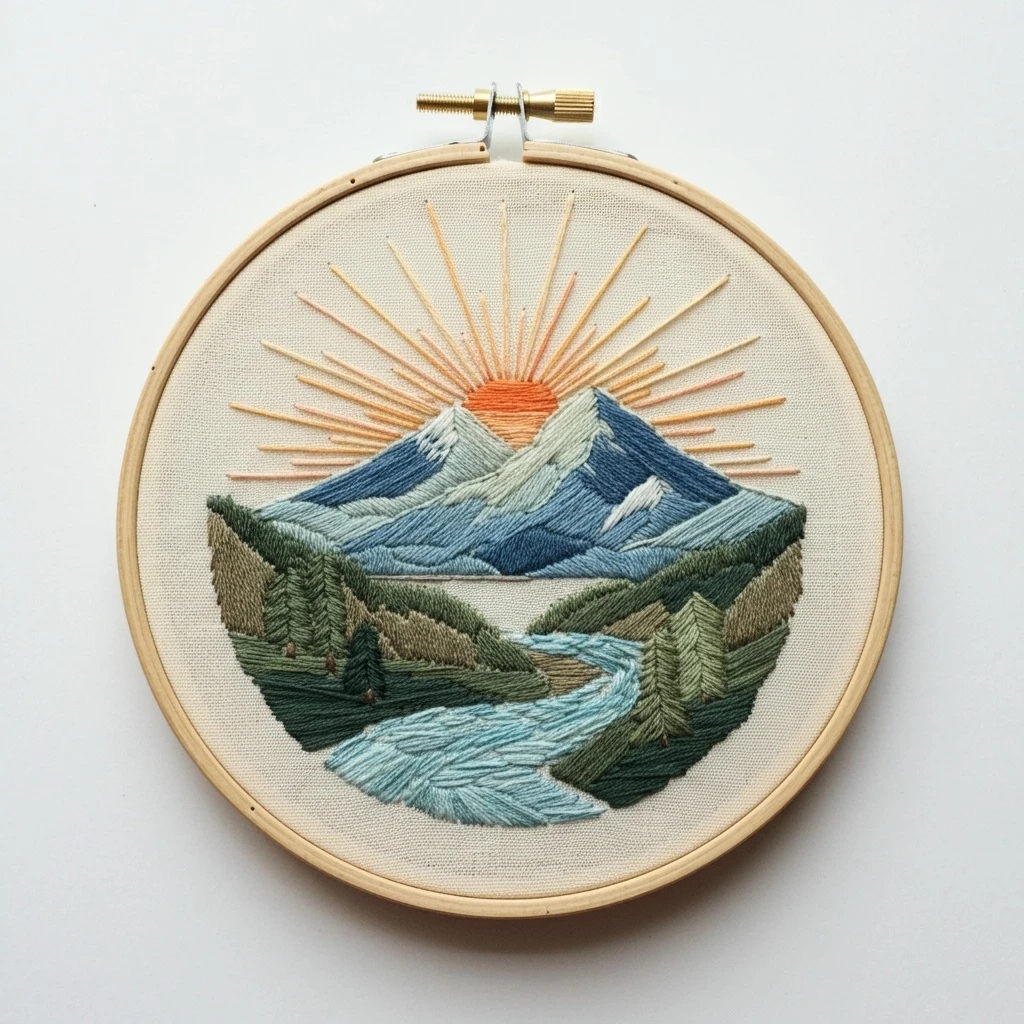
Suggested DMC Color Palette
Use the warm shades sparingly for the sunrise focal point, then let cooler blues, blue-greens, and forest greens carry the mountain and river depth. The palette is intentionally balanced for a natural landscape rather than a cartoon finish.
Stitch Map & Texture Plan
Work the sun in horizontal satin stitch using 900 at the base and 722 toward the top. Use one strand for long straight rays so they stay delicate; couch very long rays with a tiny hidden stitch if they snag.
Use long and short stitch in angled blocks that follow each slope. Blend 930 into 3768 on dark faces and 927 into 926 on snowy or misty faces. Change stitch direction from peak to peak so each ridge reads separately.
Use split stitch or stem stitch curves from the distant center toward the foreground. Keep 598 in the middle of the water path, place 597 beside it, then add a few loose 746 glints only after the main fill is complete.
Fill the foreground banks with angled satin or fishbone-style leaf strokes in 3362 and 3052. Add vertical straight stitches for pine needles and short dark 3371 stitches at trunks or deepest overlaps.
Thread Count Guidance
| Design area | Recommended strands | Why it works |
|---|---|---|
| Fine sun rays | 1 strand | Keeps the rays crisp, airy, and close to the light linework seen in the reference. |
| Sun disk and snow caps | 2 strands | Enough coverage for smooth satin stitch without making small shapes bulky. |
| Mountain faces | 2 strands, occasionally 1 for edge detail | Creates soft painterly shading while preserving sharp ridge angles. |
| River foreground | 2–3 strands | Use 3 strands only in the lower, closest water to give it visual weight. |
| Trees and dark banks | 2 strands for fill, 1 strand for trunk accents | Separates dense greenery from fine branch and needle details. |
| Final outlines | 1 strand | Prevents the landscape from looking heavy; outline selectively, not everywhere. |
Blending, Outlining & Shading Notes
Beginner-Friendly Practical Tips
Choose natural linen or cotton in oatmeal, cream, or pale beige. The warm ground helps the sunrise glow and reduces the amount of background stitching needed.
A size 7 or 8 embroidery needle is comfortable for 2 strands. Switch to a sharper, smaller needle for the 1-strand rays and ridge outlines.
Keep the fabric drum-tight, but do not pull long satin stitches hard. Tugging the rays or river lines can distort the circular hoop composition.
Use shorter floss lengths, about 14–16 inches, for satin and long-and-short stitch. This keeps the mountain faces smoother and reduces fuzzy worn fibers.
Before stitching, draw light guide lines for mountain slopes, river curves, and sun rays. Direction marks matter more here than perfect filled shapes.
Step back after each color family. The design depends on big value groups: bright sunrise, cool peaks, dark banks, and light river.