
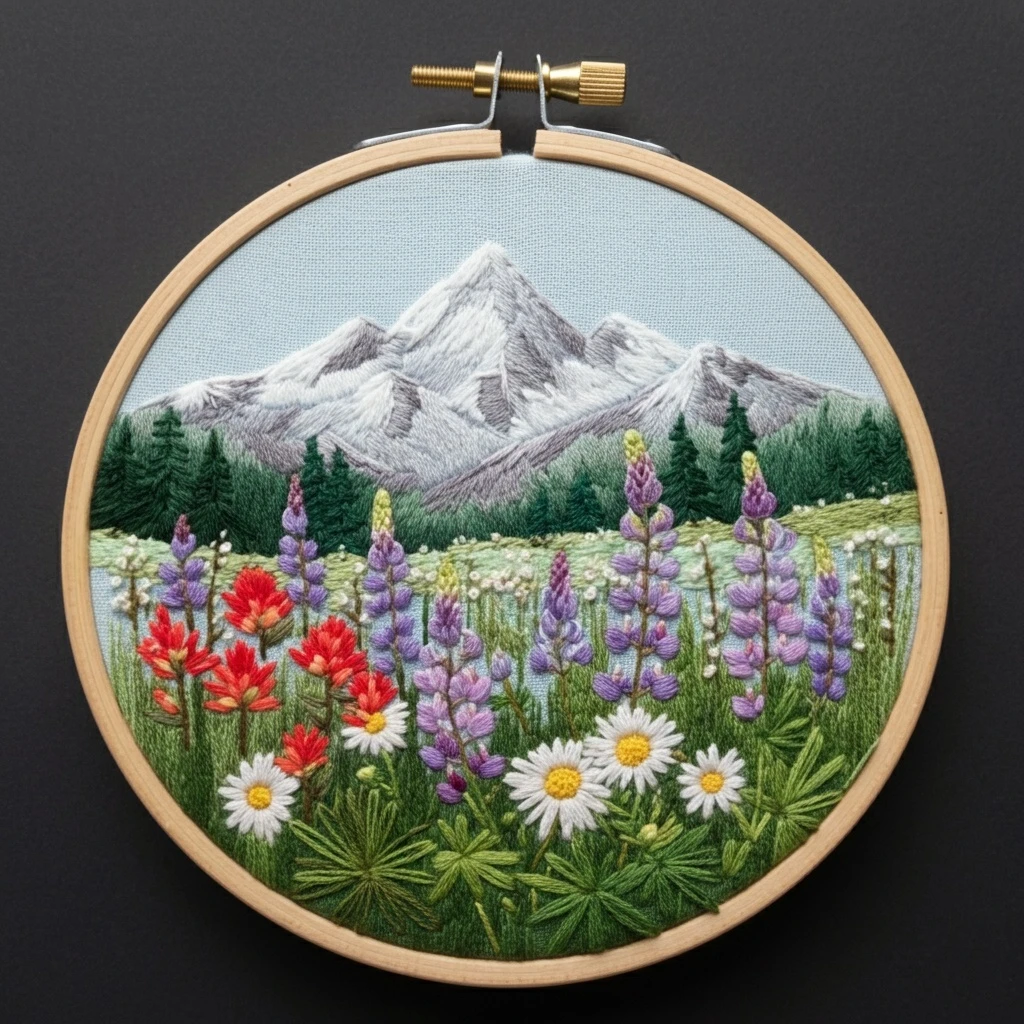
Mountain Landscape with Wildflowers
A soft alpine hoop with snowy grey-white peaks, a pale blue sky, distant evergreens, a misty lake edge, and a foreground meadow filled with purple lupines, white daisies, red wildflowers, yellow centers, and layered green foliage.
Keep the mountains airy and cool, then build the meadow with denser, dimensional stitches for a strong foreground contrast.
Color story from the design
The image reads as a cool mountain scene warmed by meadow flowers. Use muted greys and blue-greens in the distance so the purple lupines, red blossoms, and daisy centers remain the focal points.
Stitch plan by area
| Design element | Suggested stitches | Practical notes |
|---|---|---|
| Sky | long & shortsplit stitch | Use one strand of 747 or leave fabric showing for a light, breathable background. |
| Snowy peaks | long & shortstraight stitch | Follow the mountain slopes. Blend B5200 + 762 for cool snow; add 414 only in crevices. |
| Forest line | fishbonefly stitchstraight stitch | Use 936 behind 3051 trees for depth. Vary tree heights so the horizon feels natural. |
| Lake / reflection | horizontal satinrunning stitch | Keep stitches short and flat. Mix 964 with 747 and a touch of 522 near the banks. |
| Meadow grasses | straight stitchseed stitch | Layer 522, 3051, and 3011 with random stitch lengths; avoid perfectly parallel blades. |
| Lupines | lazy daisydetached chainFrench knots | Stack small detached petals upward, darkest at the base and lighter toward the flower tips. |
| Daisies & red blooms | lazy daisysatin stitchcolonial knot | Use B5200/3865 for petals, 743 knots for centers, and 321 + 721 for warm red blossoms. |
Thread-count guide
Blending & shading
- Mountains: work from pale to dark. Lay B5200 and 3865 first, then add broken 762/414 stitches in the direction of each slope.
- Forest depth: place 936 in the far back, 3051 in front, and a few 522 highlights on tree edges closest to the meadow.
- Wildflowers: blend one strand 553 with one strand 340 for soft purple lupines. Use 321 with 721 for warmer red blossoms.
- Meadow sparkle: add tiny B5200 or 3865 French knots after the greenery is complete so the flowers sit on top.
Outlining details
- Use a fine split stitch in 414 for selected mountain ridges; do not outline every peak or the snow will look heavy.
- Outline the foreground stems with one strand of 839 or 3051 before adding petals.
- Use 936 in short vertical stitches at the base of the meadow to frame the lower edge of the hoop.
- Keep daisy petals loosely outlined by their stitch shape rather than adding a dark border.
Texture suggestions
The scene works best when the background is smooth and the foreground is lively.
- Use directional long-and-short stitching for the mountain faces.
- Add seed stitches in mixed greens for meadow density.
- Build lupine towers with layered detached chains.
- Use French knots for pollen, buds, and small white wildflowers.
Beginner workflow
- Transfer the hoop outline, horizon, peaks, lake, major flower stems, and large blossoms first.
- Stitch back to front: sky, mountains, forest, lake, meadow, then foreground flowers.
- Pause after the greenery and check spacing before adding bright flowers.
- End with knots and highlights so they remain crisp and visible.
Practical tips
- Use a 6-inch hoop or larger so the mountain lines do not become cramped.
- Choose pale blue, cream, or natural linen to reduce sky stitching.
- Keep mountain thread tension relaxed to avoid puckering large filled areas.
- Trim carried threads behind white daisies so dark greens do not show through.
Finishing note
For a polished result, keep the top half calm and cool, then let the bottom third carry the dimension. The contrast between fine grey mountain shading and raised meadow blossoms is what gives this design its handcrafted alpine charm.