
DMC palette & stitching guide
Mountain Landscape
A calm hoop landscape with two icy gray mountain peaks, dark evergreen silhouettes, moss-green midground ridges, a rippled blue-gray lake, warm brown banks, and scattered golden star stitches above the skyline.
Use this companion to keep the mountains crisp, the lake reflective, the pines dimensional, and the starry sky delicate without adding unnecessary bulk.
Design read: what to preserve
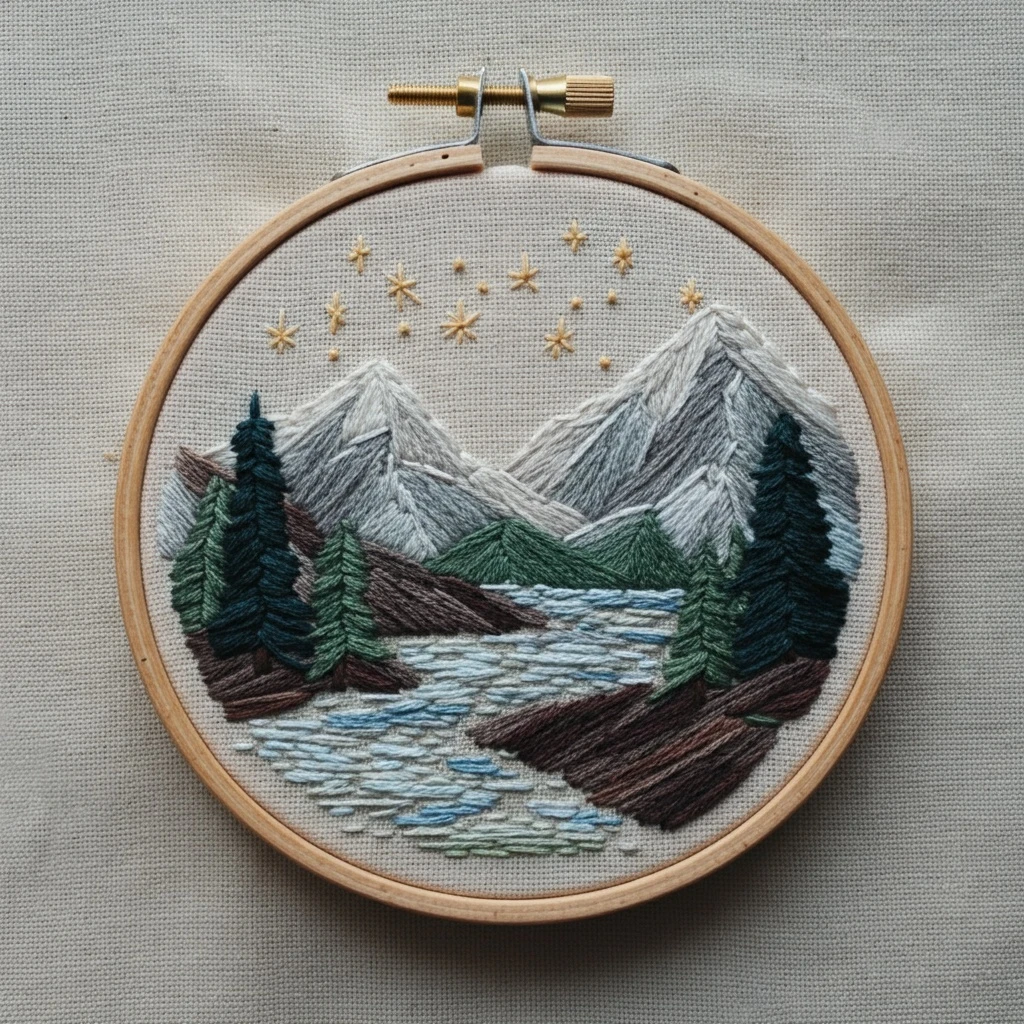
Clear depth layers
The reference relies on stacked layers: pale linen sky, gold stars, snowy peaks, green ridge line, dark pines, lake ripples, and brown foreground banks. Stitch the distant layers flatter and reserve texture for the foreground.
Directional mountain faces
The peaks are built from diagonal gray and white strokes. Let each slope have its own stitch angle so snow, rock, and shadow separate cleanly even when the colors are close.
Quiet moonlit palette
Most colors are muted blue-gray, forest green, and cool neutral. The small golden stars are the only bright warmth, so place them neatly and avoid overusing yellow elsewhere.
Suggested DMC palette
The floss choices below match the visible families in the artwork: frosty mountain whites, layered grays, deep pine greens, slate lake blues, earthy banks, and soft gold star accents.
Sharpest snow caps, tiny lake sparkle, and the brightest mountain ridge stitches.
Soft snow shadows and pale sky-adjacent mountain strokes.
Main rock planes, broken snow transitions, and cool lake reflections.
Mountain mid-shadows and ridge definition inside the peaks.
Deep mountain creases, cool outlines, and shaded shoreline strokes.
Final fine accents in the darkest mountain cracks and pine interiors.
Blue-black pine shadows and the darkest cool notes around the trees.
Dense evergreen silhouettes, tree trunks, and lower branches.
Main pine body color and shadowed midground ridges.
Softer pine tips, distant tree highlights, and muted green ridge planes.
Quiet grassy reflections and pale green transitions at the lake edge.
Background linen-toned sky shading and neutral shoreline blending.
Dry-brush style lake ripples, misty reflection strokes, and stone-like breaks.
Pale blue lake shine and cool reflected snow bands.
Darker water channels and blue-gray shadow under the banks.
Small bright water accents; use as short broken highlights, not solid stripes.
Deepest foreground bank shadows and tree bases.
Warm brown slope stitches and earthy shoreline texture.
Lighter brown bank highlights and transition stitches over dark soil.
Gold stars, tiny sky knots, and warm points of light above the peaks.
Stitch plan by area
Sky and stars
Stitches: open negative space, tiny straight stitches, French knots, and small woven star stitches.
Threads: 1 strand for small dots; 2 strands for the larger starbursts.
Keep the sky mostly unfilled so the linen reads like moonlit air. Use DMC 3820 for stars and add a single 644 shadow stitch only if a star needs soft depth.
Snowy mountains
Stitches: long-and-short, split stitch, and short diagonal straight stitches.
Threads: 1 strand for ridgelines; 2 strands for the broad shaded planes.
Work each slope from peak downward. Blend Blanc + 762 for snow, 318 + 414 for rock, and reserve 413 or 3799 for the deepest cracks.
Midground ridges
Stitches: satin stitch, split stitch, and low couching for clean horizon edges.
Threads: 2 strands for the green ridge shapes; 1 strand for edge corrections.
Use 895 in the lower ridge and 3347/3053 toward the top. Keep these ridges smoother than the foreground pines so they stay farther away.
Evergreen trees
Stitches: stacked fishbone, fly stitch, fern stitch, and short straight branch strokes.
Threads: 2 strands for foreground trees; 1 strand for inner shadows and tips.
Start with the darkest trunk and center line, then layer angled branch stitches outward. Add a few 3347 tips last for dimension.
Lake reflection
Stitches: horizontal straight stitch, split stitch ripples, and a few couched highlight lines.
Threads: 1 strand for mirrored mountain marks; 2 strands for larger blue bands.
All lake stitches should be nearly horizontal. Break lines into irregular lengths so the reflection looks hand-rendered rather than striped.
Brown banks and foreground
Stitches: angled satin stitch, stem stitch, seed stitch, and occasional backstitch.
Threads: 2 strands for slope coverage; 1 strand for fine soil cracks and edge outlines.
Use 3371 nearest tree bases, 839 for the main slopes, and 3860 as scattered highlight strokes following the diagonal bank direction.
Thread-count and blending guidance
| Area | Best strand count | Blend suggestion | Practical note |
|---|---|---|---|
| Open sky | Mostly unstitched; 1 strand details | 3820 for stars, optional 644 for soft neutral specks | Leave plenty of fabric visible. Too much filling will compete with the mountains. |
| Starbursts | 2 strands for large stars, 1 strand for dots | 3820 with a tiny Blanc center on the largest stars | Anchor carefully behind existing stitches so star points stay tidy and radiating. |
| Snow caps | 1 strand over 2-strand base where needed | Blanc + 762, then 318 at the lower edge | Do not outline every white section; let diagonal strokes imply snow texture. |
| Rock shadows | 1 strand detail, 2 strands for filled shadow planes | 318 + 414, with 413 in deepest valleys | Overlap color changes by a few stitches to prevent hard bands. |
| Distant green ridge | 1 to 2 strands | 895 with 3347 and 3053 highlights | Use smoother stitches and fewer outlines than the foreground trees. |
| Foreground pines | 2 strands main body; 1 strand tips | 924/890 base, 895 branches, 3347 highlights | Vary branch lengths so the trees do not look like identical combs. |
| Lake ripples | 1 strand details; 2 strands main blue-gray bands | 3761 + 648 for pale ripples, 3765 + 3843 for blue accents | Keep stitches broken and level. The quiet horizontal rhythm is the key lake effect. |
| Earth banks | 2 strands coverage; 1 strand cracks | 3371 + 839, with 3860 highlights | Angle stitches downward toward the water to guide the viewer into the scene. |
Recommended stitching order
Transfer the big shapes
Mark the two peaks, ridge line, lake edge, main banks, tree silhouettes, and star positions. Avoid drawing every ripple.
Work background first
Place stars lightly, then stitch mountain snow and rock planes from the peaks downward.
Build middle depth
Add green ridges, distant tree hints, and the lake reflection using mostly horizontal stitches.
Finish with texture
Stitch foreground pines, brown banks, final water glints, and the smallest dark outlines last.
Outlining, shading, and texture details
Use colored outlines
For this moonlit design, 3799 and 413 are usually softer than pure black around the mountains. Use 3371 for the brown banks and 924 for tree interiors. Save any black-like line for tiny final accents only.
Split stitch is ideal for mountain ridges because it gives a stitched-pencil edge. Backstitch works better for the shoreline and tree trunks where a firmer border is useful.
Let texture follow form
Mountain stitches should fall diagonally down each slope, pine branches should angle away from the trunk, earth banks should slope toward the water, and lake stitches should stay horizontal.
For extra dimension, let the pines be slightly raised with 2 strands while the lake remains flatter with 1-strand ripple details.
Beginner-friendly practical tips
Limit the first pass
Start each area with one light, one mid, and one dark color. Add extra shades only after the major shapes are readable.
Keep water level
Use two faint guide lines across the lake before stitching. Even small tilts can make the reflection feel unsettled.
Rotate for mountains
Turn the hoop as you work each slope so your hand naturally follows the mountain angle instead of fighting the fabric.
Control dark floss
Dark greens and grays can overwhelm the design. Add them in short strokes, step back, and stop before the trees become solid blocks.
Protect star points
Stitch stars after most mountain work but before bulky trees. That timing keeps the points clean without snagging them during large fills.
Avoid tight pulling
Landscape fills can pucker. Use shorter floss lengths, smooth the fabric often, and keep tension firm but gentle.