
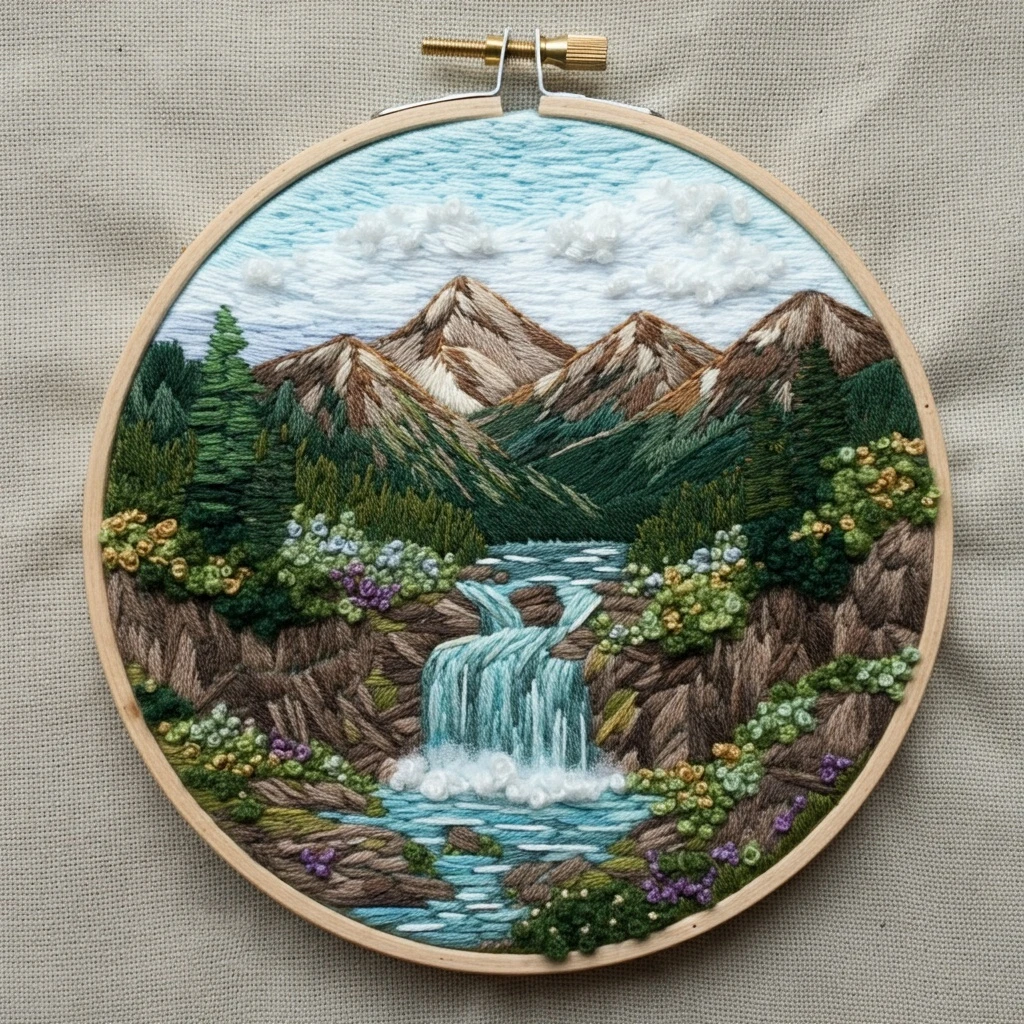
Mountain Waterfall
A layered alpine scene with cool blue sky, distant snow-tipped peaks, deep evergreen slopes, rocky cliffs, a bright turquoise waterfall, foamy spray, and small meadow flowers. The palette should feel crisp, natural, and dimensional rather than overly saturated.
Suggested DMC Color Palette
Use these as practical matches for the visible sky, snow, evergreen forest, warm rock, waterfall, and small botanical accents.
Pale sky, waterfall highlights, and the coolest top edge of mist; blend with white for icy sparkle.
Main waterfall strands and river current; use vertical satin stitches in the falling water.
Deep river channels, shaded falls, and lower pool ripples where the water turns richer.
Snowcaps, foam bubbles, cloud puffs, and final sparkle stitches across the water.
Soft snow shadows, cloud body, and transition stitches so the whites do not look flat.
Deepest pine shadows, valley depth, and the dark base behind the waterfall opening.
Mid-tone conifers and bush masses; excellent for layered fishbone or fly stitches.
Mossy ledges, meadow clumps, and warmer green accents in the foreground shrubs.
Dark rock cracks, mountain ridges, and cliff outlines; keep stitches broken and irregular.
Warm stone planes and mountain faces; blend with gray-browns for natural granite variation.
Sunlit rock tips, tan peak highlights, and tiny warm details in cliff edges.
Cool stone shadows and distant mountain creases; pairs well with 3865 for snowline shading.
Small yellow flower knots and golden shrub tips along the ledges.
Purple wildflower dots and cool contrast accents in the lower foreground.
Stitch Map by Design Area
Work from background to foreground, saving foam, flowers, and crisp outlines for the final pass.
| Area | Recommended stitches | Thread guidance | Practical notes |
|---|---|---|---|
| Sky and cloud layer | Horizontal split stitch, seed stitch, loose whipped backstitch for clouds | 1 strand for sky; 2–3 strands for cloud tufts | Keep sky stitches long and horizontal. Add cloud volume with small padded stitches in B5200 over 3865. |
| Mountain peaks | Long and short stitch, straight stitch ridges, split backstitch edges | 1 strand for far peaks; 2 strands for main mountain planes | Angle every stitch with the slope. Alternate 839, 3862, 422, 645, and 3865 to mimic fractured rock and snow. |
| Evergreen forest | Fishbone stitch, fly stitch, stacked straight stitches, couching for dense rows | 2 strands for trees; 1 strand for distant ridge details | Use 934 at the tree bases, 520 for middle needles, and 3011 only where light catches the foliage. |
| Waterfall | Vertical satin stitch, split stitch, long straight stitch, tiny couching lines | 2 strands for main falls; 1 strand B5200/747 highlights | Let stitches fall straight downward. Blend 3846 with 747 on a few needles, then add white lines over the top. |
| River and pool | Horizontal satin stitch, stem stitch ripples, small detached chain highlights | 1–2 strands; keep highlights single-strand | Use broken horizontal marks so the water shimmers. Place B5200 only on the top of ripples, not everywhere. |
| Rocks and cliffs | Long and short stitch, irregular straight stitch, backstitch cracks | 2 strands for filled rocks; 1 strand for cracks | Vary stitch length deliberately. Dark outlines should be broken so the cliffs stay organic rather than cartoon-like. |
| Flowers and shrubs | French knots, colonial knots, lazy daisy, seed stitch | 2 strands for green leaves; 3 strands for larger flower knots | Cluster yellow and purple knots unevenly. Add a few pale knots near the water to echo mist and meadow blossoms. |
Blending, Shading & Texture Tips
These small choices help the hoop read as a detailed landscape even when stitched at a beginner-friendly scale.
Waterfall glow
- Thread one needle with 3846 + 747 for a soft aqua transition.
- Add single-strand B5200 vertical lines after the base fill is complete.
- Use French knots or loose bullion knots at the base for foamy spray.
Mountain depth
- Keep far mountains cooler and lighter with 645 and 3865.
- Use warmer 3862 and 422 on the forward-facing slopes.
- Outline only selected ridges with 1 strand of 839 to preserve softness.
Forest texture
- Work tree rows from back to front so dark bases tuck under lighter tips.
- Mix 934 and 520 on the needle for natural pine variation.
- Use short, stacked stitches rather than solid satin blocks.
Suggested stitching order
- Stitch sky and distant mountains first with 1 strand so they recede.
- Fill snowcaps and mountain faces, following the diagonal rock directions.
- Add tree masses and valley shadows, then work the cliff and rock shapes.
- Stitch waterfall and river last among large areas so the water stays crisp.
- Finish with foam knots, flower knots, tiny leaves, and selective dark outlines.
Beginner-friendly control
- Use shorter thread lengths, about 14–16 inches, to avoid fuzzing on dense areas.
- For small hoops, reduce nearly all fill stitches to 1–2 strands.
- Do not outline every shape; outline only where contrast needs help.
Finishing note
For the most polished result, lightly steam from the back after stitching, then fluff cloud and foam knots with the needle tip. Keep the waterfall edges clean, but let surrounding rock and shrub stitches remain irregular; that contrast makes the water look bright and moving.