
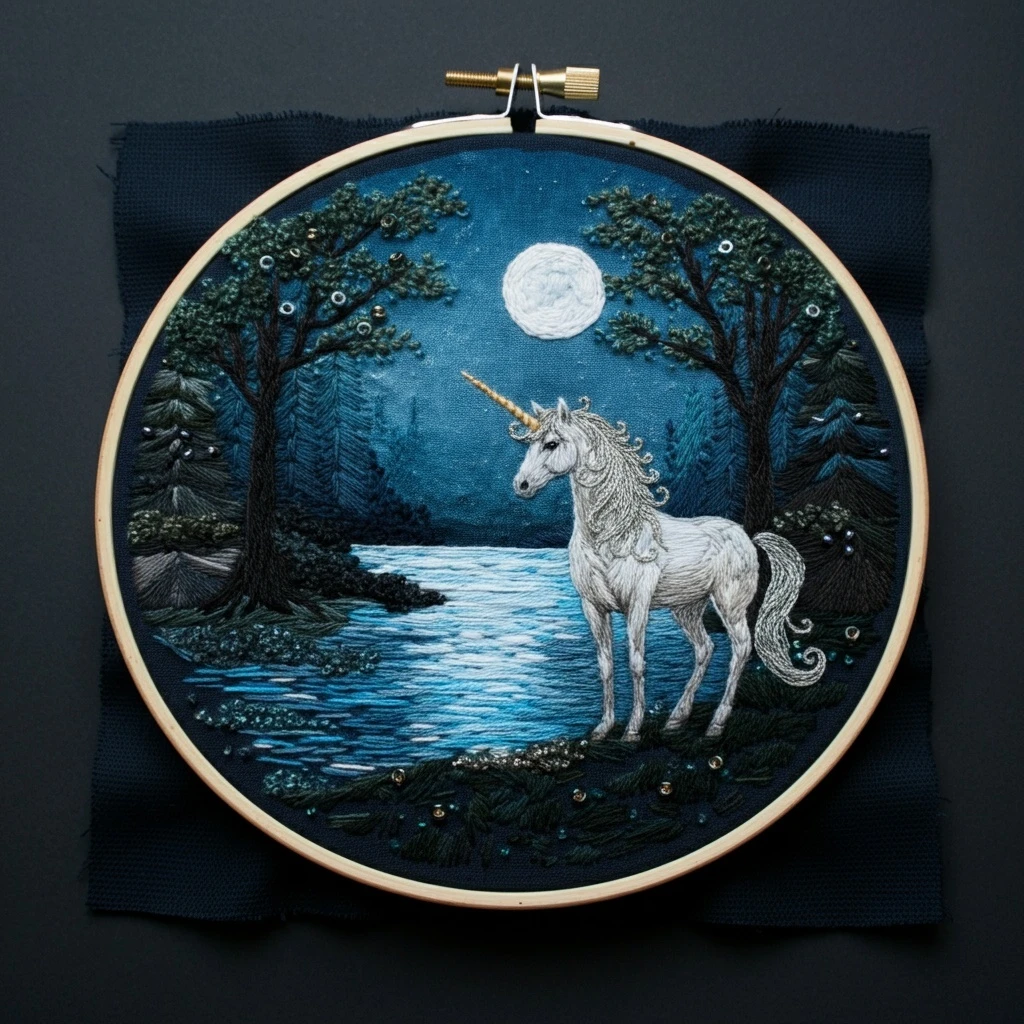
Mythical Unicorn Night Landscape
A moonlit hoop scene with a pale unicorn standing beside a luminous blue river, framed by dark forest silhouettes, textured evergreen branches, scattered stars, reflective water, and a warm golden horn.
Recommended DMC Color Palette
These DMC suggestions reflect the visible design elements: deep navy fabric, blue-green sky, silvery moonlight, cool white unicorn hair, bright cyan water, black-brown trees, muted pine needles, and small metallic-looking gold details.
Stitch Map & Technique Suggestions
For the cleanest finish, stitch the landscape depth first, then the river, then the unicorn. Add branches, stars, knots, and tiny shine marks last so they sit crisply on top.
| Area | Best stitch | Thread count | Practical notes |
|---|---|---|---|
| Night sky | Long & short stitch, soft seed stitch | 1 strand | Use 823 and 3765 in loose directional patches. Keep coverage airy so the dark fabric can act as natural shadow. |
| Full moon | Spiral back stitch, whipped wheel, padded satin | 2 strands | Stitch the moon in rounded bands using Blanc and 762. A spiral direction echoes the textured circular moon in the reference. |
| River reflection | Horizontal satin stitch, running stitch, split stitch | 1–2 strands | Lay broken horizontal strokes of 3846, 3756, and Blanc over darker 3760. Vary line length to suggest rippling water. |
| Unicorn body | Long & short stitch with contour split stitch | 1 strand for shading, 2 for small fills | Follow the body curves instead of stitching straight down. Blend 762 with 318 under the belly, legs, neck, and muzzle. |
| Mane and tail | Stem stitch, split stitch, fine back stitch | 1 strand | Use flowing strands of Blanc, 762, and 318. Let lines overlap slightly to build a wavy, luminous hair texture. |
| Horn | Diagonal satin stitch, couching, back stitch rings | 1–2 strands | Work the horn in slanted bands: 783 for the base, 3821 for highlight, and a tiny 3371 or 414 line at the lower edge. |
| Tree trunks | Split stitch, stem stitch, whipped back stitch | 2 strands for trunks, 1 for branches | Use 3371 with small touches of 939. Stitch trunks after sky but before leaf clusters so foliage can overlap naturally. |
| Evergreen boughs | Fly stitch, straight stitch, detached chain, French knots | 1–2 strands | Layer 500 first, then 501 and 503 at branch tips. Irregular stitches look more organic than symmetrical rows. |
| Stars and tiny glints | French knots, seed stitch, straight star stitches | 1 strand | Use Blanc and 3756 for cool stars. Keep knots tiny and sparse so they do not compete with the moon. |
| Foreground stones/sparkles | Colonial knots, seed stitch, small straight stitches | 1 strand | Combine 503, 762, 783, and 3821 for scattered magical shine along the riverbank and lower hoop edge. |
Blending, Outlining & Shading Guidance
Make the unicorn glow
Use a cool white mix rather than pure white everywhere. Work the body mainly in 762, add 318 where forms tuck under, and reserve Blanc for the top of the neck, face, mane curls, and tail tips.
Keep water lively
Do not fill the river as one block. Stitch short horizontal dashes with spaces between them, placing the brightest 3756 and Blanc lines directly under the moon and around the unicorn legs.
Build forest texture in layers
Start with 939 and 823 silhouettes, then place individual 500, 501, and 503 needles on top. This gives the trees depth without needing dozens of greens.
Use fine outlines sparingly
A single strand of 414 is enough for the eye, nostril, leg separation, hoof edges, and the lower curve of the tail. Heavy outlines can make the unicorn look flat, so keep them broken and delicate.
Beginner-Friendly Order of Work
1. Establish the night
Stitch distant sky patches, dark tree masses, and background silhouettes first. These areas are forgiving and create a base for the bright details.
2. Add the river glow
Work the river in layered horizontal strokes from dark to light. Stop often and view from a distance so the reflection does not become too dense.
3. Finish the unicorn
Stitch the body, mane, tail, horn, and eye after the scenery. This keeps the pale threads clean and lets the figure remain the focal point.
Thread Count, Texture & Practical Tips
- Use one strand for facial details: The unicorn’s eye, nostril, muzzle line, and mane curls will look more graceful with single-strand stitching.
- Use two strands for bold silhouettes: Tree trunks, dark banks, the moon, and the strongest water bands can take two strands for visual weight.
- Blend for moonlit white: Try one strand Blanc plus one strand 762 for the moon edge or unicorn neck highlights when pure white feels too stark.
- Prevent show-through: Avoid carrying dark navy or brown threads behind the unicorn, moon, and bright water. End threads locally and restart as needed.
- Add bead-like sparkle carefully: If substituting metallic thread or beads for some dots, use them only at the end and keep them sparse so the embroidery remains balanced.
- Press from the back: Place the finished piece face down on a fluffy towel and press lightly from the reverse to preserve raised knots, mane texture, and padded moon stitches.