
Night Sky Meteor Shower
A dramatic celestial hoop worked on deep navy fabric, with streaking comets, icy meteor tails, golden shooting stars, and scattered bead-like star points.
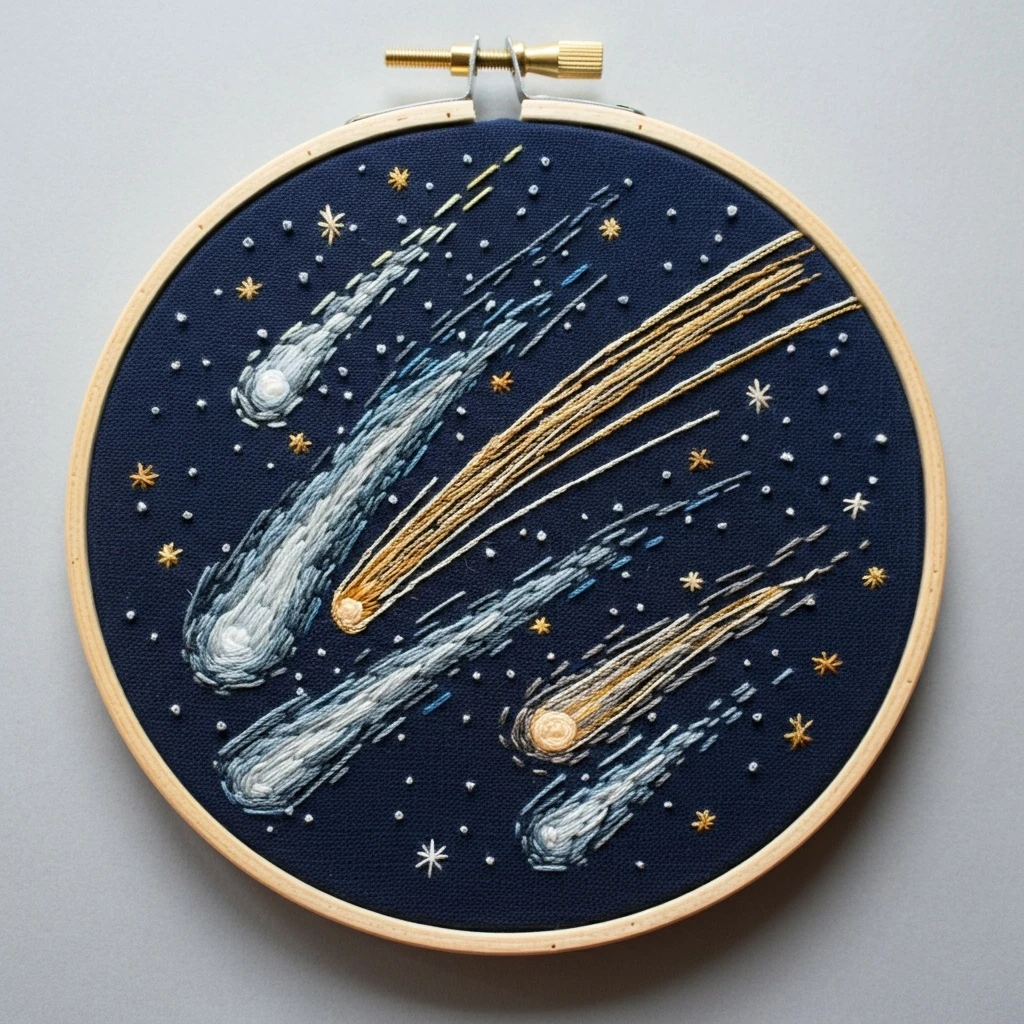
Colors are estimated from the visible embroidery hoop preview and matched to close DMC embroidery floss shades. Use them as a practical stitching palette rather than an exact thread-usage chart.
Likely DMC Color Palette
The design is dominated by the dark blue ground cloth, misty blue-white meteor tails, warm gold comet trails, and tiny crisp white star dots. The palette below keeps the sky luminous while preserving the strong contrast needed on navy fabric.
Design Read
The composition has several diagonally moving meteors, with the strongest golden comet crossing from lower left toward upper right. Cooler blue-white meteors echo that angle and make the whole hoop feel windy, fast, and atmospheric.
The most important contrast is between the dark ground fabric and the pale stitched marks. Keep the tails broken and directional instead of filling them solidly; that broken texture is what makes the meteors look like light and smoke.
Thread Count Guidance
- 1 strand: tiny star dots, distant meteor fragments, fine speed lines, and delicate outlining.
- 2 strands: most meteor tails, starbursts, medium gold streaks, and small filled comet heads.
- 3 strands: brightest comet cores only, especially the golden meteor heads and larger white glowing centers.
- Metallic option: substitute DMC Light Effects E3821 or E5200 sparingly for final sparkle lines; use short lengths to avoid fraying.
Stitching Suggestions
| Element | Stitch Type | Practical Notes |
|---|---|---|
| Large blue-white meteor tails | Long and short stitch, straight stitch | Work in the travel direction using irregular lengths. Blend 930, 932, 3753, 762, and B5200, leaving small gaps so the navy fabric becomes shadow. |
| Round meteor heads | Padded satin stitch or circular long and short | Use 2 strands for the base and add a small B5200 highlight with 1 strand. Keep edges slightly ragged so the head glows rather than looking like a button. |
| Golden shooting-star trails | Stem stitch, split stitch, couching | Lay several parallel golden lines in 727 and 783, then add 977 on the lower edge. Couch very long lines if you want smoother sweeping curves. |
| Warm comet heads | Satin stitch with French-knot center | Fill with 727/783, then add a small 977 shadow and a B5200 or 727 highlight at the leading edge. |
| Tiny star field | French knots, seed stitch | Use mostly 1 strand of B5200 or 762 with one-wrap knots. Vary dot size so the background feels natural, not polka-dotted. |
| Starbursts | Straight stitch, woven star, small fly stitch | Use 727 and B5200 for the largest bursts. Start with a vertical and horizontal cross, then add shorter diagonal rays. |
| Blue sparkle fragments | Tiny straight stitches | Add 3846 only in small amounts along fast-moving tails; it should read as a cold glint, not a new main color. |
| Soft tail halos | Split stitch and sketchy running stitch | Outline only portions of the tails with 3753 or 762. Broken outlines make the glow feel airy and prevent heavy cartoon edges. |
Blending & Shading Plan
For icy meteors, start with scattered dark blue strokes in DMC 930, then layer 932 and 3753 over them. Add 762 near the brightest center and reserve B5200 for the final highlight lines. This keeps the tails smoky instead of flat white.
For the golden streaks, use 783 as the main trail, 727 on the upper/leading edge, and 977 for the warmer lower-shadow edge. A few single-strand B5200 stitches can make the comet heads flash.
Texture Suggestions
- Keep tail stitches uneven in length to imitate motion blur.
- Scatter a few isolated blue stitches outside each tail for sparks breaking away.
- Use French knots only after the long tail stitches are complete so they stay raised and bright.
- Let the dark fabric show between stitch clusters; it is the shadow layer of the design.
Where to Start
Beginner-Friendly Practical Tips
- Use a sharp embroidery needle for the dense dark fabric so tiny stars stay accurate.
- Work with shorter floss lengths on the pale colors; white thread shows fuzz quickly on navy fabric.
- Anchor thread under nearby stitches rather than carrying light colors across the back where they might show through.
- For smooth comet trails, stitch long lines in sections instead of trying to pull one very long stitch across the hoop.
- Do not make every star the same size. Mix knots, straight stitches, and single seed stitches.
- If using metallic thread, add it only as the final surface accent and use a needle with a slightly larger eye.
- Rotate the hoop while stitching diagonal tails so your hand always follows the natural direction of the streak.
- Press finished work from the back on a towel to protect raised French knots and padded comet heads.
Encouraging Finish
This design rewards loose, sketch-like stitching. Let the tails stay broken, let the star dots vary, and save the brightest whites and golds for the final pass. The result will feel like a moving night sky rather than a flat illustration.