
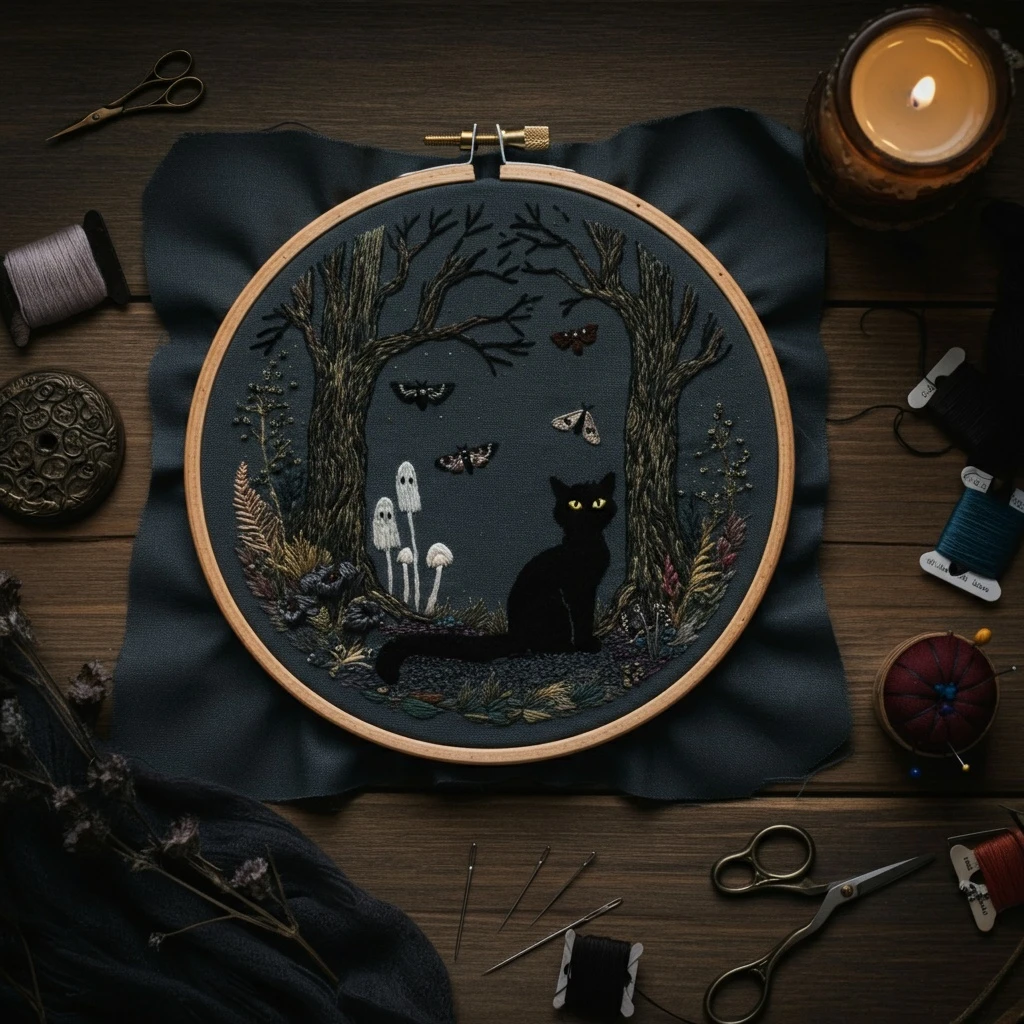
Nocturne Black Cat in a Spooky Forest
A moody hoop design built around a deep blue-green night fabric, a velvet-black cat, gnarled forest trunks, pale ghost mushrooms, moths, dried ferns, muted wildflowers, and tiny candlelit highlights. The palette below keeps the scene mysterious while preserving enough contrast for beginners to stitch each element clearly.
Observed color story
The reference image reads as a nocturne: very dark black and blue-green dominate, with bark in olive-brown streaks, grey-white mushrooms, ochre cat eyes, muted mauve wildflowers, dusty blues in the undergrowth, and warm candle/rust accents around the scene. Keep the fabric visible in the sky area so the embroidery feels atmospheric rather than overfilled.
Stitch plan by design element
Black cat silhouette
Fill the body with 2 strands of DMC 310 using split stitch or short satin stitches following the curve of the back and haunch. Add a few single-strand 3799 strokes along the chest, tail, and shoulder to keep the cat readable without losing the velvet-black look. Work the eyes last in DMC 783 with one strand and a tiny 3865 catchlight.
Spooky trees and branches
Use stem stitch for trunks, then layer irregular long-and-short stitches in 3371, 645, 646, and 926. Keep the strokes uneven, vertical, and slightly twisted. Branches should be 1–2 strands in 310 or 3371 with small fly-stitch twigs at the tips.
Ghost mushrooms
For the tall pale mushrooms, use padded satin stitch in 762 with 3865 on the lit edge. Outline softly with one strand of 647 so the shapes do not look flat against the dark ground. Add tiny black French knots or straight stitches for the ghost faces.
Moths and night creatures
Stitch wings with fishbone stitch or tiny satin stitch in 762, 930, 918, and 310. Use a single black backstitch body and antennae. For the brown moth, blend 918 with 3371 to echo the warm candlelit shadows.
Forest floor and moss
Build the base with seed stitch, detached chain, and short straight stitches in 924, 502, 645, 3013, and 930. Scatter stitches rather than filling completely; the dark fabric should show through and create natural shadow.
Wildflowers and dried ferns
Use lazy daisy leaves in 3013 and 502, long straight stitches for dry fern ribs, and French knots in 3685, 918, and 647. Keep flowers sparse and asymmetric so they frame the cat without competing with it.
Thread-count guidance
| Area | Recommended strands | Why it works |
|---|---|---|
| Cat body and tail | 2 strands for fill, 1 strand for edge details | Creates a dense silhouette while allowing subtle fur direction and clean edges. |
| Tree trunks | 2–3 strands for base, 1 strand for bark lines | Thicker trunk stitches look rugged; single-strand highlights add age and texture. |
| Branches and twigs | 1 strand | Keeps fine silhouettes sharp against the dark sky fabric. |
| Mushrooms and moths | 1–2 strands | Prevents tiny pale shapes from becoming bulky and preserves crisp outlines. |
| Ground cover and wildflowers | 1 strand for detail, 2 strands for foreground leaves | Layered thickness gives depth from distant moss to foreground plants. |
Blending, shading & outlining
Best blends
- 310 + 3799 for visible black fur on dark cloth.
- 3371 + 645 for bark shadows.
- 646 + 3013 for dry fern highlights.
- 924 + 930 for blue-green forest floor depth.
- 762 + 3865 for glowing mushroom caps.
Outlining details
Outline the cat only where needed: ears, back curve, chest, and tail underside. Too much outline can flatten the silhouette. Use one strand of 3799 or 3371 instead of heavy black when outlining against very dark fabric.
Shading direction
Imagine warm light from the upper right and cool moonlit darkness behind the trees. Place 646, 647, and 3013 on the outer trunk edges, keep 3371 in inner grooves, and use tiny 783 dots sparingly for glow.
Beginner-friendly working order
Transfer lightly
Use a pale water-soluble pencil or white transfer paper on dark fabric. Mark only the main outlines, tree trunks, cat silhouette, mushrooms, and flower placement.
Stitch background first
Start with tree trunks and large branches, then add ground cover. This gives the cat and mushrooms a clear place to sit.
Keep the cat crisp
Work the cat after the forest floor. Use a hoop that keeps the fabric taut, and avoid overhandling the black fill so the edge stays smooth.
Add tiny details last
Finish with eyes, moth markings, mushroom faces, seed stitches, and French knots. These final bright points create the nocturne sparkle.
Practical finishing notes
Fabric choice
A dark teal or charcoal cotton-linen blend is ideal. If using black fabric, shift more outlines to 3799, 924, and 645 so the cat and trees do not disappear.
Texture control
Use matte cotton floss for most elements, but consider one strand of metallic gold only for the cat eye glint or candle sparkle if you enjoy specialty thread. Keep metallic accents minimal.
Needle and hoop
Use a size 7 or 8 embroidery needle for 2–3 strands, and a size 9 for one-strand moth and branch details. Tighten the hoop before small satin areas to prevent puckering.
Common fix
If the black cat loses shape, add a few single-strand 3799 fur strokes along the left cheek, chest, and back, then brighten the eyes. The eyes should be the sharpest focal point.