
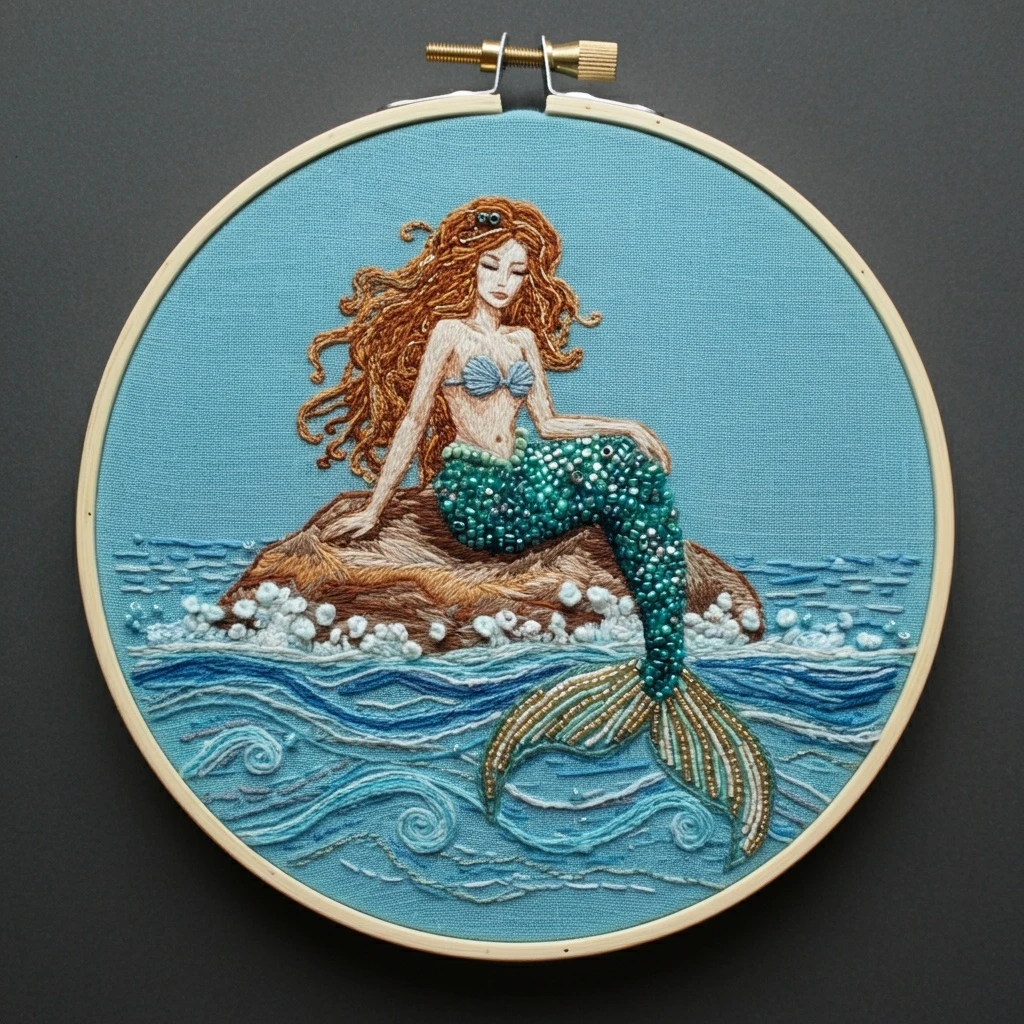
DMC palette & hand embroidery notes
Ocean Siren Mermaid
A sea-washed hoop design with coppery flowing hair, pearled turquoise scales, foamy surf, a warm sunlit rock, shell details, and layered blue waves. The palette below is selected to keep the mermaid luminous while giving the water enough contrast and movement.
Suggested DMC Color Palette
Use the deeper shades sparingly for definition and let the pale sea-glass colors do the glowing work. For the mermaid tail, place the darkest teals in the lower right and underside of the body, then dot the lighter colors on top as reflective scales.
Stitch Map & Order
1. Transfer the largest outlines first
Mark the mermaid silhouette, rock edge, tail curve, major fin ribs, and the three main water bands. Keep small foam dots optional until after the wave stitching is complete.
2. Build the background water
Use stem stitch and loose split stitch in 2 strands for long wave lines. Alternate DMC 3765, 807, 3844, and 747 so the water does not become one flat blue stripe.
3. Shade the rock and body
Work the rock in short-and-long stitch with 433, 434, 898, and a few 945 touches. Stitch the skin with 1 strand where possible; direction matters more than density for a soft illustrated look.
4. Stitch the copper hair in flowing passes
Follow each curl with long-and-short stitch, split stitch, and occasional couching. Let strands overlap the shoulder and background water to create movement.
5. Add the tail texture last
Fill the tail with clustered French knots, colonial knots, or tiny satin dots. Start with 3810 and 500 in shadow areas, then add 3844, 3846, 964, and a few B5200 glints.
Blending & Shading Ideas
Mermaid tail
Blend 3810 + 3844 for the central teal, 500 + 3810 for the underside, and 3846 + 964 for scale glints. Keep the lightest knots irregular so the tail looks wet rather than patterned.
Hair
Use 898 at the deepest curl turns, 433 through the main masses, and 434 on raised strands. A few single-strand 3826 or 3853 stitches may be added for sunlit copper if your fabric is dark enough.
Water
Try one needle loaded with 807 + 747 for pale wave crests and another with 3765 + 3844 for deeper strokes. Switching between the two creates a natural rolling rhythm.
Texture Suggestions
- Foam: Mix French knots, colonial knots, lazy daisy bits, and tiny straight stitches. Use B5200 only on the topmost foam so it stays special.
- Scales: Make knots slightly different sizes by changing wrap tension, not by adding extra strands. This gives a beaded, organic shimmer.
- Fin ribs: Lay long stitches from the tail base outward, then couch with a single strand of 3012 or 832 for controlled lines.
- Rock: Scatter short stitches in several browns, following the rock’s slope. Avoid solid fill; visible stitch direction adds a natural stone texture.
- Ocean swirls: Use stem stitch for tight curls and whipped backstitch for the brighter rolling wave outlines.
Outlining Details
The design relies on fine illustrated edges: the face, arms, shell top, hair tips, fin ribs, and water crests should be outlined with restraint. Use one strand of DMC 898 for the warm dark hair and facial accents, one strand of DMC 3765 for blue water outlines, and one strand of 3012 or 832 for the fin veins. For the skin, avoid black outlines; use 945 or a single strand of 433 only where a shadow truly needs definition.
Needle & Fabric
A size 7 or 8 embroidery needle works for most 2-strand areas. Switch to a sharp size 9 or 10 for one-strand facial details and dense tail knots. A medium blue cotton or linen ground helps the ocean read clearly without filling the whole background.
Hoop Strategy
Keep the fabric drum-tight before stitching knots in the tail and foam. Dense knot clusters can pucker, so rotate around the tail rather than filling one small patch completely at once.
Finishing Tip
After stitching, gently steam from the back into a towel, avoiding pressure on the tail knots. Mount with the foam line level and the fin sweeping down to emphasize the mermaid’s seated pose.