
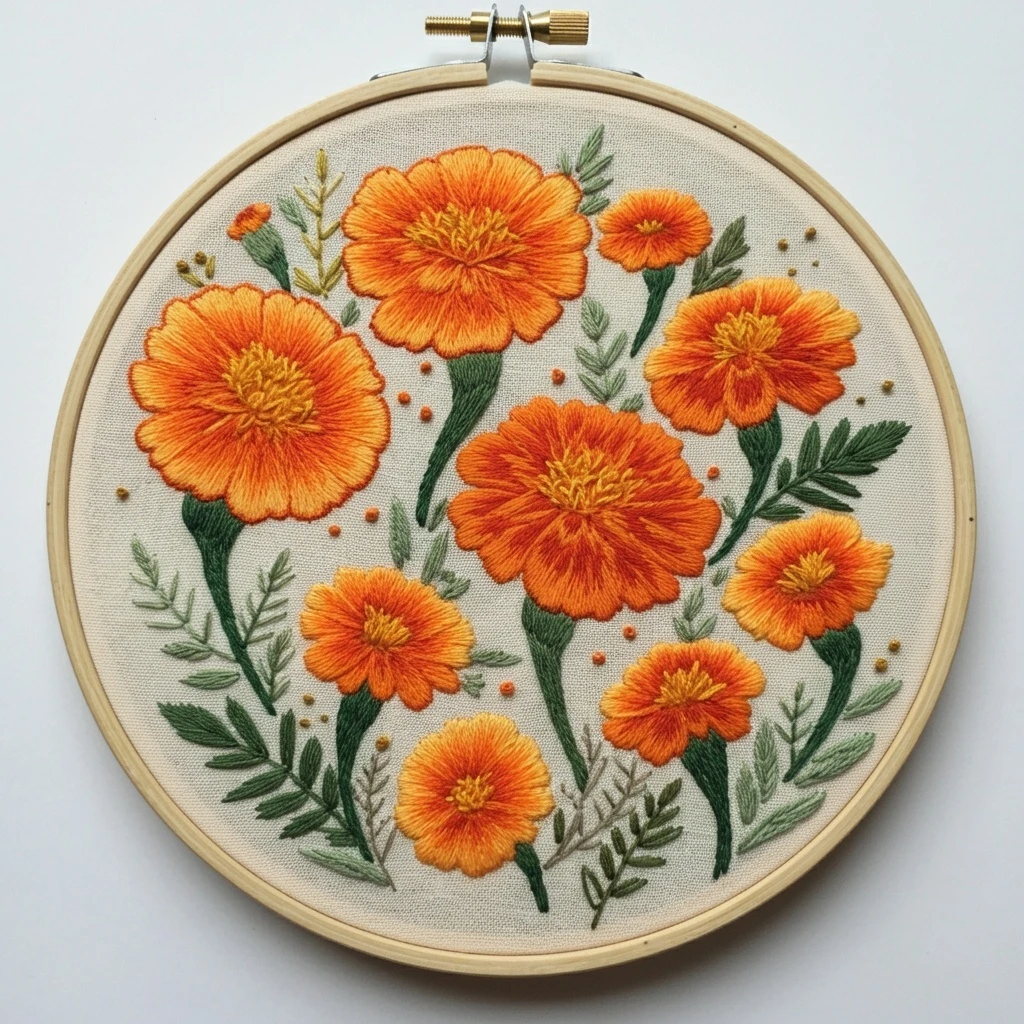
Orange Marigold Floral
A bright marigold hoop design with warm orange blossoms, scalloped petal edges, raised golden centers, deep green stems, and airy sage foliage on natural linen. The mood is sunny and botanical: vivid orange petals should feel dimensional, while the surrounding leaves stay soft and earthy.
Best worked on natural, oatmeal, or warm ivory linen in a 6–8 inch hoopColor story observed from the artwork
The design centers on saturated marigold oranges: glowing yellow-orange on petal tips, pumpkin orange through the petal bodies, and red-orange/copper shadows where petals tuck into the centers. The leaves are muted blue-green, olive, and sage rather than bright lime, giving the florals an earthy hand-stitched look against the neutral fabric.
Stitch map by design element
Open marigold petals
- Use long-and-short stitch, radiating from the flower center toward the scalloped edge.
- Place 919 and 720 near the base, blend into 721, then finish tips with 741 and 742.
- Keep stitch lengths staggered so the petals look softly ruffled rather than striped.
Raised golden centers
- Build centers with French knots, colonial knots, and short seed stitches in 725 and 783.
- Cluster knots tightly in the middle, then space them slightly outward for a natural pollen texture.
- Add two or three 301 or 919 shadow knots at the lower edge to make each center look domed.
Buds and small blossoms
- Use satin stitch for tiny orange bud caps, changing the angle to follow the bud curve.
- Work the green cups with short vertical stitches in 501 and 3011.
- One fine line of 500 on the shaded side keeps the bud forms crisp without heavy outlining.
Leaves and fern sprigs
- Use stem stitch for long stems and straight stitch for thin fern leaflets.
- Use fishbone stitch for larger leaves, with 3011 through the center and 3052 toward the tips.
- Keep the pale sage sprigs in 1 strand so they look airy behind the bold flowers.
Thread-count and blending guidance
Recommended strand counts
- Petal fill: 2 strands for smooth color coverage; switch to 1 strand for final vein strokes.
- Petal edge highlights: 1 strand so the scallops stay delicate and not bulky.
- Flower centers: 2 strands with two wraps for raised knots; 1 strand for tiny seed dots.
- Main stems: 2 strands in stem stitch; 1 strand for the thinnest branching tips.
- Leaves: 2 strands for fishbone stitch, 1 strand for veins and small serrated accents.
Useful blends
- Warm petal body: 1 strand 741 + 1 strand 721 for a lively marigold midtone.
- Inner petal shadow: 1 strand 720 + 1 strand 919 near the center ring.
- Sunlit petal edge: 1 strand 742 + 1 strand 741 along upper scalloped tips.
- Golden center blend: 1 strand 725 + 1 strand 783 for dimensional knot clusters.
- Soft leaf blend: 1 strand 3011 + 1 strand 3052 for gentle background greenery.
Suggested stitching order
Mark the flower circles, petal direction lines, stem paths, and main leaf shapes. Keep transfer marks pale because the natural linen remains visible.
Stitch stems, fern fronds, and leaves before filling the flowers so the orange petals can sit visually on top.
Start with the dark orange base colors, then feather into medium and light oranges as you move to the petal tips.
Keep these slightly simpler than the main flowers; they should support the composition without stealing focus.
Add center knots, tiny decorative dots, and final 1-strand petal veins last so the surface remains crisp.
Outlining, shading, and texture notes
Shading approach
- Place 919 only in the deepest central creases and under overlapped petals.
- Use 720 in short wedge-shaped strokes radiating outward, then blend with 721 and 741.
- Reserve 742 for the uppermost petal tips and the smallest glints of light.
- Shade leaves darker at the stem with 501 and lighter at the tips with 3052.
Texture approach
- Make petal edges slightly uneven with tiny staggered stitches to imitate marigold ruffles.
- Use dense knots in the center of the largest flower and fewer knots in smaller blooms.
- Vary fern leaflet lengths so the greenery looks natural rather than comb-like.
- Add a few loose seed stitches or French knots around the florals for the small pollen-dot details visible in the artwork.
Beginner-friendly practical tips
Hoop and fabric prep
- Choose a firm cotton-linen or linen blend; very loose fabric can pucker under dense petal fills.
- Keep the hoop drum-tight and re-tighten before starting each large blossom.
- Use a size 7 embroidery needle for most 2-strand stitching and a size 5 or 6 needle for dense knots.
Clean finishing
- Do not carry dark green or copper thread behind open pale linen; end and restart instead.
- Stitch one flower at a time so the orange shading stays consistent across each bloom.
- Press from the back on a folded towel to protect raised knots and petal texture.
Palette is a practical DMC approximation based on the visible artwork: fiery oranges, golden raised centers, and muted olive-blue greenery will preserve the warm marigold character of the design.