
DMC color palette & stitching guide
Ornate Floral Vase Arrangement
A richly detailed bouquet with red-and-gold tulips, layered rosette flowers, white daisies, pink buds, textured foliage, and a decorated antique vase. The embroidery benefits from warm contrast, crisp dark outlines, and a mix of smooth satin work with lively woven floral textures.
Core DMC floss palette
These colors are chosen to match the visible red tulips, golden marigold-like blooms, pale roses, crisp daisies, deep leafy greens, and aged metallic-looking vase decoration.
Quick thread plan
| Area | Suggested colors | Use notes |
|---|---|---|
| Tulips | 321 + 744 + 726 | Long-and-short stitch from base to tip; angle strokes to follow the petal curve. |
| Round roses | 815, 321, 352, 818 | Woven wheel or spiral stem stitch; darken the center and lighten outer rings. |
| Daisies | 3865, 842, 726 | Detached chain or satin petals with French-knot centers. |
| Foliage | 890, 469, 3012 | Fishbone leaves for broad leaves; stem stitch with fly-stitch tips for fern sprays. |
| Ornate vase | 420, 3828, 842, 3371, 310 | Use couching and tiny back stitches for scrolls; reserve black for the outer contour. |
Stitch types to emphasize the design
- Long-and-short stitch: best for tulip petals, especially where red edges fade into yellow centers.
- Fishbone stitch: use on the large pointed leaves; split the leaf with a central vein and overlap stitches neatly.
- Woven wheel roses: ideal for the round red, coral, yellow, and blush flowers; vary tension for natural petal depth.
- French knots: cluster in daisy centers and tiny vase blossoms; use two wraps for small dots, three for bold centers.
- Stem stitch and split stitch: for branches, outlines, vase scrolls, and controlled curves around petals.
- Couching: useful for ornate gold vinework on the vase when curves are too tight for satin stitch.
Thread-count guidance
- 1 strand: fine fern tips, tulip vein lines, vase filigree, and delicate outlining inside petals.
- 2 strands: most satin, long-and-short, split stitch, and leaf fill areas; this keeps the bouquet detailed but not bulky.
- 3 strands: woven wheel roses and French-knot centers when you want raised texture.
- 4 strands: only for padded vase base accents or very bold ground shadow strokes.
For a 6-inch hoop, two strands will suit most of the motif. For smaller hoops, reduce the vase ornament and fern sprays to one strand.
Shading and blending ideas
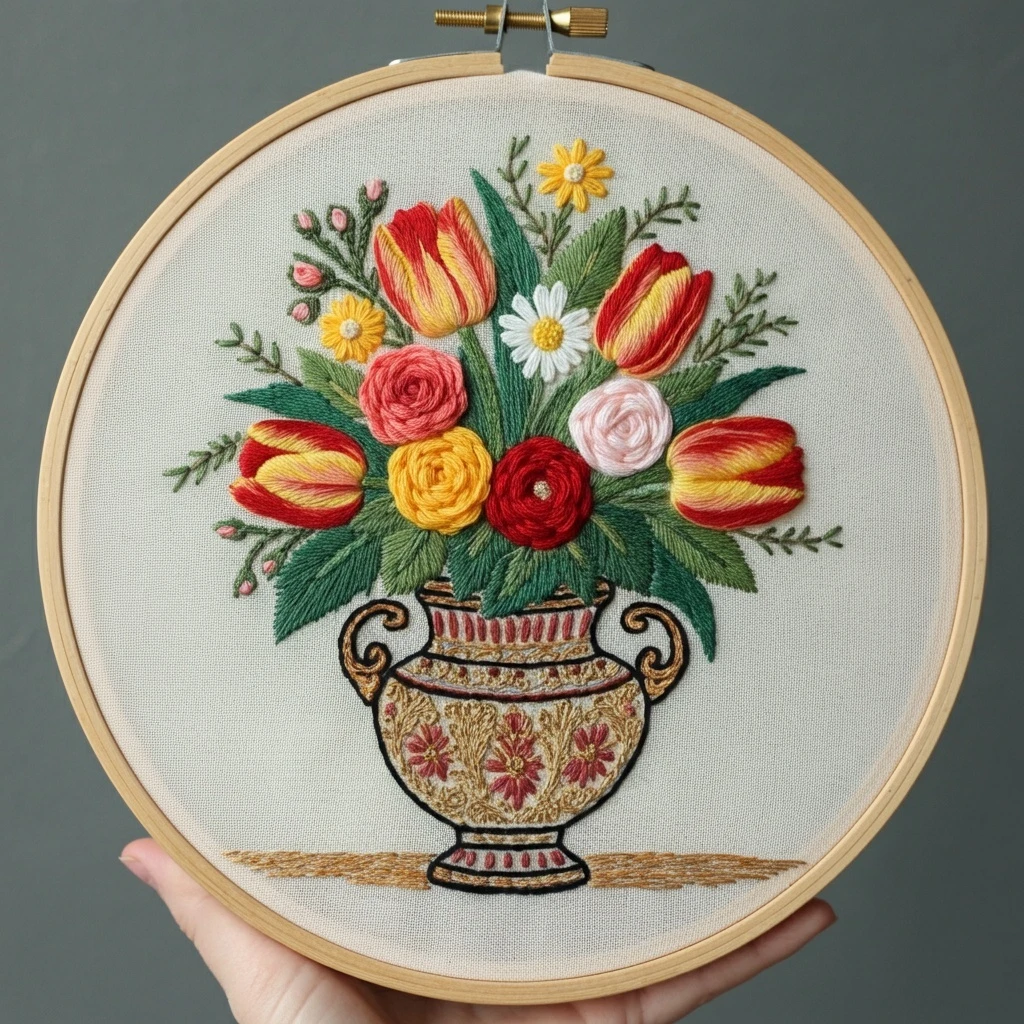
Red-yellow tulips
Start each petal with DMC 815 at the deepest fold, move through 321, then blend 321 with 726 for transition strokes. Finish with short DMC 744 highlights near the petal center.
Layered rosettes
For the coral rose, work a darker 352 spiral at the center and switch to 818 at outer turns. For the red rose, use 815 in the innermost coils and 321 on lifted petal edges.
Antique vase
Fill the vase lightly with 842, then add 420 and 3828 scrolls. A final one-strand 3371 line gives the goldwork an aged, engraved look without making it too harsh.
Outlining details
Outline the vase with DMC 310 or, for a softer antique look, DMC 3371. Keep flower outlines minimal: use one-strand split stitch in the darkest matching color only where petals overlap. For leaves, a dark central vein in 890 plus a few lighter 3012 side strokes will define the shape without flattening it.
Texture suggestions
Give the bouquet three textures: smooth tulips, raised rosette wheels, and airy greenery. The vase should feel decorative rather than solid, so let the fabric show through the gold scrollwork. The tabletop shadow can be loose horizontal straight stitches in 420 and 3828 for a grounded but handmade finish.
Beginner-friendly stitching order
Practical tips before you start
- Use a medium-weight cotton or linen in warm ivory, oatmeal, or natural beige so the pale daisy petals still show.
- Keep fabric drum-tight; woven roses and French knots can pucker loose fabric quickly.
- Shorter floss lengths, about 14–16 inches, prevent fuzzy reds and dark greens.
- When stitching symmetrical vase handles, complete one side, then mirror the stitch direction on the other for a balanced ornamental look.
- For cleaner color changes in tulips, park red threads at the back edge of each petal and avoid carrying them across yellow areas.