
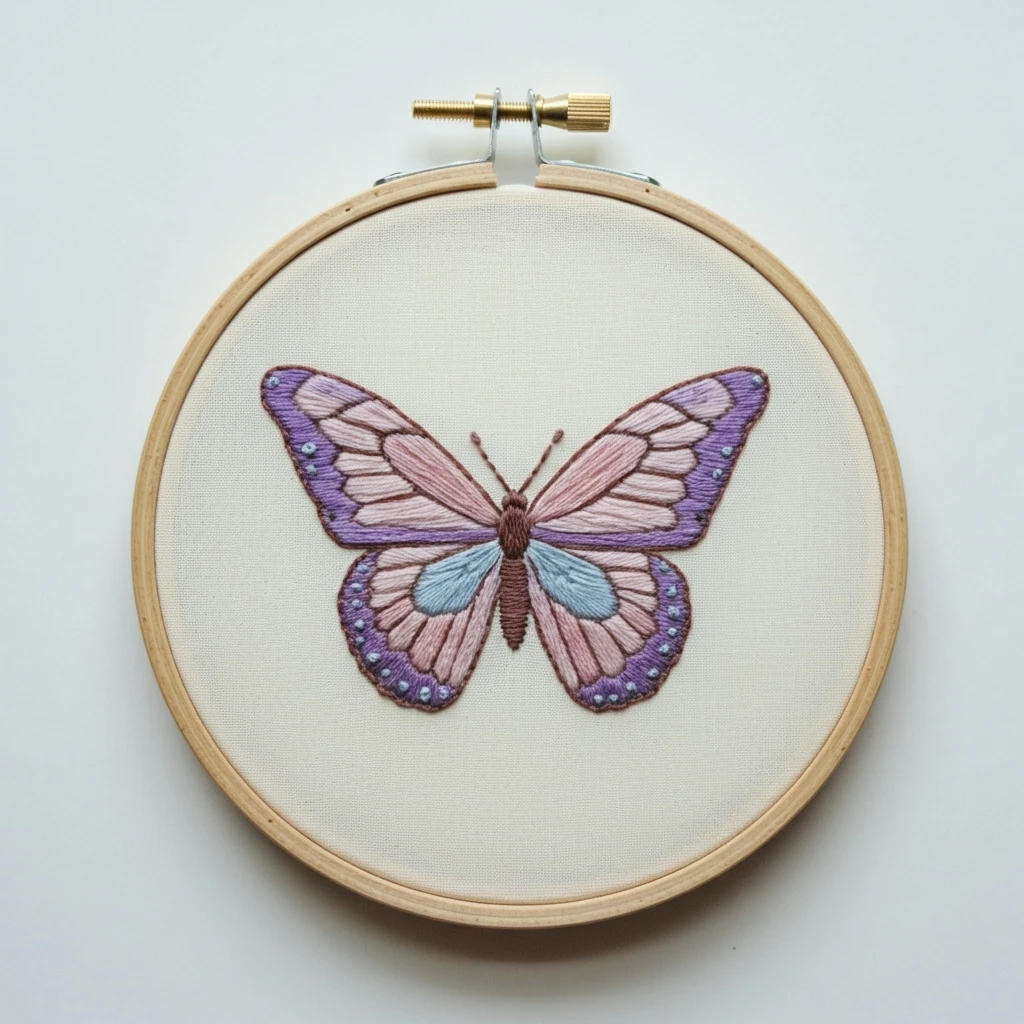
Pastel Butterfly
A graceful stylized butterfly worked in soft lilac, dusty blush pink, pale powder blue, and cocoa-brown outlines. The design feels airy and delicate, with wing panels arranged like stained-glass sections—perfect for smooth satin fills, gentle shading, and crisp line definition.
Especially lovely on ivory linen or pale blush cotton in a 5–7 inch hoopColor story observed from the artwork
The butterfly uses a gentle pastel palette rather than strong contrast. Soft violet frames the outer wing edges, dusty pink fills most wing cells, and pale sky blue accents the lower inner wings. A medium brown body and outlines add just enough definition to keep the design readable without losing the dreamy effect. The tiny dot accents along the outer wings are a cool icy blue, which brightens the overall palette and gives the piece a lightly magical finish.
Stitch map by design element
Outer wing borders
- Use split stitch or neat stem stitch with 1 strand of 839 for the brown outline first.
- Fill the lavender border areas with satin stitch or closely placed long-and-short stitches in 553 and 554.
- Let stitch direction follow the wing edge curve so the border feels smooth and slightly raised.
Pink wing cells
- Satin stitch is ideal for these clean, enclosed shapes; use 2 strands for a smooth glossy finish.
- Blend 223 and 224 so the cells closest to the center look a little lighter and softer.
- For larger sections, use long-and-short stitch instead of full satin if you want easier shading and less snagging.
Blue inner-wing accents
- Work the teardrop-shaped blue panels in satin stitch using 932 shaded up to 775.
- Keep the center line smooth and the stitch direction consistent so both lower-wing accents mirror each other.
- Add one or two tiny highlight stitches of 775 at the top edge for a satiny glow.
Body, antennae, and dots
- Use padded satin stitch or close stem stitch for the thorax and abdomen so the body has gentle dimension.
- Work antennae in 1 strand of 839 using stem stitch or whipped back stitch for a clean line.
- The wing-edge dots can be French knots or tiny straight/seed stitches in 775, with a darker anchoring dot in 932 if needed.
Thread-count and blending guidance
Recommended strand counts
- Wing outlines: 1 strand for crisp detail and delicate separation lines.
- Satin-filled wing cells: 2 strands for most areas; 1 strand for tiny cells or refined highlights.
- Body: 2 strands for padding stitches, then 2 strands for the satin surface.
- Accent dots: 1–2 strands depending on how prominent you want them.
- Fine corrections: keep 1 strand threaded in 839 or 3722 for tidy touch-ups around cell edges.
Useful blends
- Lavender transition: 1 strand 553 + 1 strand 554 for outer wings that need soft depth.
- Pale lilac highlight: 1 strand 554 + 1 strand 211 for very airy upper-wing sections.
- Blush shading: 1 strand 223 + 1 strand 224 for feather-light pink gradients.
- Blue glow: 1 strand 932 + 1 strand 775 for the inner-wing accents.
- Soft outline shadow: 1 strand 839 + 1 strand 3722 when you want lines gentler than solid dark brown.
Order of stitching
Because the design is symmetrical, take time to mark both wings cleanly. A fine water-soluble pen or lightbox transfer helps keep the cell shapes even.
Stitch the body, wing perimeter, and interior dividing lines in 839 before filling. These stitched guides make the satin sections much easier to place neatly.
Work from the center outward and complete mirrored shapes in pairs so both wings stay balanced.
Stitch the pale blue teardrops after the main wing colors so their cool tone stays clean and bright.
Place the small edge dots, extra outline touches, and any one-strand highlight stitches last for a polished finished look.
Outlining, shading, and texture notes
Shading approach
- Keep the deepest violet at outer edges and wing tips, then soften inward with 554 or 211.
- On pink sections, place 223 near the segment edges and 224 toward the center or upper highlight area.
- For the blue panels, use 932 at the base nearest the body and 775 at the rounded outer edge.
- If your fabric is very bright white, a whisper of 822 at the palest cell bases can stop the wings from blending into the ground fabric.
Texture approach
- Use satin stitch for the cleanest modern finish; it mirrors the sleek filled look of the sample.
- If satin stitch feels slippery, substitute controlled long-and-short stitch in larger panels for a softer hand.
- Padded satin on the body creates a pleasing raised center without overpowering the wings.
- Tiny French knots for the dots give just enough sparkle and texture contrast around the border.
Beginner-friendly practical tips
Keeping satin stitches smooth
- Use shorter working lengths—about 14–16 inches—so the floss stays shiny.
- Railroad your stitches if possible, especially in the larger wing cells, to keep the surface flat and even.
- Bring the needle up and down just outside the outline, not in the same hole repeatedly, to avoid gaps.
Making the butterfly symmetrical
- Work one section on the left wing, then its matching section on the right wing before moving on.
- Lay the hoop flat every so often and compare both sides at arm's length.
- If one side becomes denser, compensate with a few extra highlight stitches on the opposite side rather than overworking the first wing.
Fabric and hoop prep
- An ivory or oatmeal cotton-linen blend flatters these pastel shades beautifully.
- Keep the fabric drum-tight; loose fabric makes satin stitch ripple.
- Use a size 7 or 8 embroidery needle for most 2-strand stitching and a crewel needle with a sharp point for precise fills.
Clean finishing
- Avoid carrying dark brown thread behind pale sections—restart instead for a cleaner finish.
- Press the finished piece from the back over a towel to protect the raised body and French knots.
- If framing in the hoop, center the butterfly carefully so the wing tips breathe evenly around the hoop edge.
Palette is a practical DMC approximation based on the visible artwork. Feel free to substitute nearby stash shades, but keep the balance of lilac border, blush-pink wing cells, pale blue accents, and a soft cocoa outline to preserve the design's pastel character.