
Pastel Wildflower Meadow
A soft meadow bouquet with airy green stems, peach and pink daisy-like blossoms, creamy filler flowers, rosy berry clusters, and tiny golden centers. The overall feeling is delicate, dimensional, and beginner-friendly, with most of the charm coming from varied petal stitches and small textured knots.
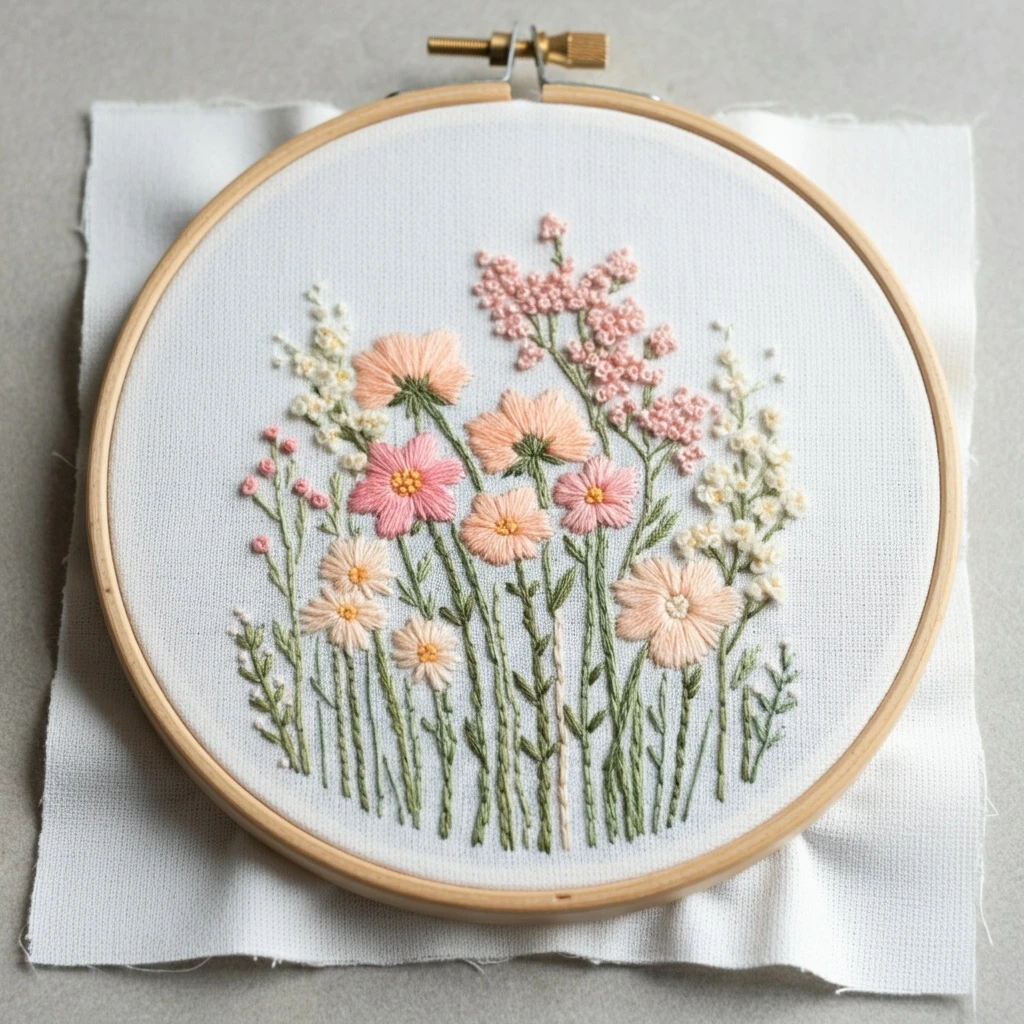
Color story observed from the design
The composition is built around muted wildflower pastels: peach petals, shell-pink daisies, creamy white filler blooms, small dusty rose buds, yellow centers, and a range of olive-green stems. Keep the palette gentle rather than saturated. Use the deeper greens only for stem structure, shadowed leaf veins, and tiny outlines so the meadow stays light and airy.
Suggested DMC floss palette
Thread-count guidance
Stitch suggestions by design area
| Area | Recommended stitches | Practical notes |
|---|---|---|
| Peach daisy petals | Long-and-short stitch, satin stitch, straight stitch | Begin at the outer petal tips with DMC 754, shade toward the center with DMC 758, and vary stitch length so petals look soft rather than striped. |
| Pink daisy petals | Fishbone stitch, satin stitch, split stitch accents | Use DMC 761 as the main petal tone. Add a few DMC 3713 or 335 stitches close to the center for depth. |
| Yellow centers | French knots, colonial knots, seed stitch | Cluster DMC 726 knots first, then place one or two DMC 783 knots off-center for a natural pollen shadow. |
| Pink flower clusters | French knots, pistil stitch, tiny detached chain | Use DMC 3713 and 761 in mixed knots. Keep stems in 1 strand so the raised knots remain the focus. |
| Cream filler flowers | Lazy daisy, French knots, small straight stitches | Use DMC 746 for bright tips and DMC 712 for the lower or tucked petals. Add a tiny DMC 726 center if the blossom is large enough. |
| Leaves and stems | Stem stitch, backstitch, whipped backstitch, fishbone leaf | Work the tallest stems first in DMC 3013, then add foreground lines in DMC 3363 and occasional DMC 3362 shadows. |
| Meadow grasses | Straight stitch, couching, fly stitch | Use uneven lengths and slight angles. A few pale DMC 3053 stitches make the base feel full without overcrowding. |
Blending ideas
For large petals, thread the needle with one strand of DMC 754 and one strand of DMC 758 for a soft peach transition. For pink blossoms, blend DMC 761 + DMC 3713. For stems that need a muted botanical feel, combine DMC 3013 + DMC 3363.
Shading approach
Place darker shades nearest the flower centers and at the underside of overlapping petals. Keep petal tips pale. On the foliage, deepen only the bases of stems and the backs of blossoms with DMC 3362.
Texture notes
The charm of this meadow comes from contrast: smooth petals, wiry stems, and raised knot clusters. Keep French knots irregular in size and spacing so they resemble natural wildflower sprays.
Beginner-friendly stitching order
Practical tips for a polished finish
- Use a tightly hooped linen or cotton ground so long stems stay crisp and straight.
- Rotate the hoop while stitching petals; this helps each stitch radiate naturally from the flower center.
- Keep the back tidy around knot clusters. Too many traveling threads can show through pale fabric.
- For airy meadow spacing, leave small gaps between stems and flowers instead of filling every area.
- Steam-block gently from the back after stitching and avoid pressing directly on French knots.