
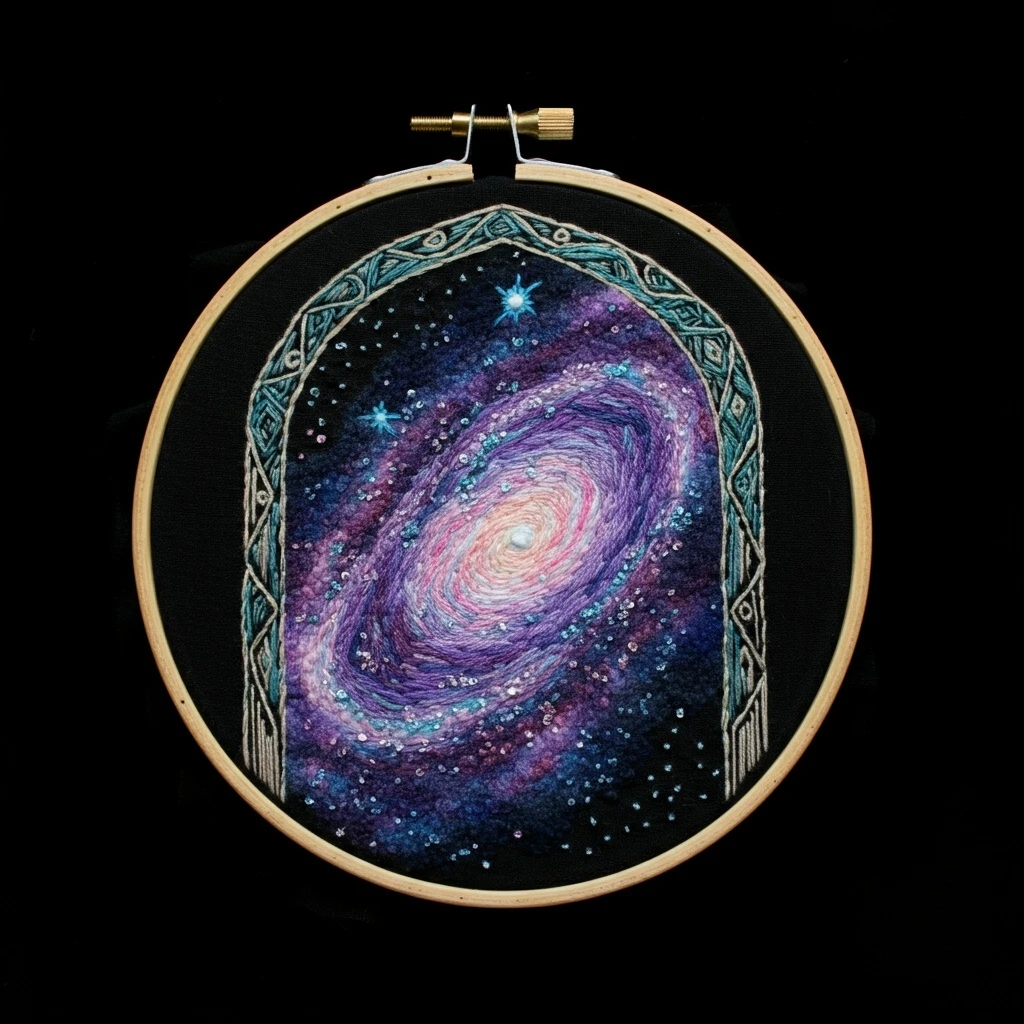
Portal To The Galaxy
A dreamy cosmic embroidery scene built around a glowing circular portal, deep violet space, scattered stars, and luminous blue-pink-gold nebula accents. The best stitched effect comes from smooth circular outlines, soft radial shading, and tiny sparkle details placed with restraint.
Design color read
The design reads as a soft galaxy portal: a dark blue-violet space base, a circular glowing ring, scattered small stars, and misty gradients of lavender, aqua, blush pink, and pale yellow. Keep the darkest shades narrow and controlled so the pastel glow remains the focal point.
Suggested DMC floss palette
This palette keeps the cosmic look rich but still stitchable. Use the darkest colors for contrast and structure, then layer lighter pastel colors outward for the glowing portal effect.
Deepest portal shadows, outer galaxy pockets, and small contrast accents.
Main night-sky violet and curved ring depth around the portal.
Midtone lavender for softened ring transitions and nebula swirls.
Pale glow on the inner ring and misty areas where violet fades outward.
Aqua energy streaks, portal highlights, and cool sparkle accents.
Soft blue glow, tiny star haze, and transition stitches near the portal opening.
Pink nebula clouds and warm halo sections that break up the cooler palette.
Feathery blush highlights and softened edges around mauve galaxy patches.
Warm star points, portal sparks, and tiny glowing dots near the rim.
Small golden emphasis stitches for the brightest star clusters.
Pinpoint stars, central glints, and crisp highlights along the brightest rim.
Optional outline or background depth when stitching on light fabric.
Stitch map by design element
Portal rim
Use split stitch or stem stitch in neat concentric curves. Work from dark violet outward into lavender, aqua, and pale highlight stitches.
Galaxy haze
Use long-and-short stitch with irregular lengths. Feather the edges so pink, lavender, and turquoise look misty rather than striped.
Deep sky areas
Use scattered seed stitch, tiny straight stitches, or lightly spaced satin patches. Leave breathing room so the design does not become too dense.
Stars
Use French knots, colonial knots, or single cross stitches in white and pale yellow. Vary size by switching between one and two wraps.
Energy streaks
Use couching or long straight stitches in turquoise and lavender. Anchor long stitches with a matching thread so they do not snag.
Outer outline
Use one strand of dark navy or grape in backstitch only where definition is needed. Avoid outlining every glow edge.
Thread-count and blending guidance
| Area | Strands | Blending idea | Practical note |
|---|---|---|---|
| Portal ring | 2 strands for visible curved bands; 1 strand for final highlight lines | Progress from 154 to 333, then 340 and 211; add 3811 only on the brightest cool sections. | Mark the circle lightly and rotate the hoop as you stitch to keep the curves smooth. |
| Nebula clouds | 1 strand for soft shading, 2 strands for denser pastel patches | Alternate 3688 and 819 for pink haze, then slip in 211 to bridge into violet. | Use uneven stitch lengths so the color transition looks cloudy, not blocked. |
| Stars and sparks | 1 strand for tiny stars, 2 strands for focal knots | Use 3865 for crisp points, 744 for warm glow, and 3821 for a few stronger gold accents. | Place stars after the main fill so they sit cleanly on top. |
| Dark sky depth | 1 strand for outlines, 2 strands for dark fill accents | Combine 939 with 154 at the deepest corners or along the shadowed side of the ring. | On dark fabric, reduce these shades and use them only for subtle shadow definition. |
Recommended stitching order
- Transfer the main circle, star positions, and major nebula swirls with a fine, removable line.
- Stitch the dark structural rim first so all later glow stitches have a clean edge to follow.
- Add lavender and mauve haze using long-and-short stitch, keeping the edges irregular.
- Layer turquoise highlight strokes and pale lavender bridge stitches around the portal opening.
- Finish with stars, knots, gold sparks, and tiny white glints.
Beginner-friendly tips
- Use shorter stitches on tight circular curves and longer stitches through open cloud areas.
- Do not try to fill the entire sky; negative space makes the stars and portal feel brighter.
- Keep metallic thread optional. If used, add only a few couching stitches after all cotton floss is complete.
- For black or navy fabric, transfer with white chalk or water-soluble stabilizer.
- Test French knots on scrap fabric before adding the final star clusters.
Texture, outlining, and finishing notes
The design should feel luminous rather than heavily filled. Let color families overlap in small, broken strokes and keep the stars crisp on top of the softer galaxy layers.
Soft radial shading
Imagine every stitch moving around or away from the portal center. Use curved stem stitches for the rim, then let long-and-short strokes radiate outward. This directional stitching is what makes the portal feel round and active.
Star texture
Mix French knots, tiny straight stitches, and single cross stitches. Cluster a few stars near the rim, then scatter smaller points outward. Avoid making every star the same size; variation creates depth.