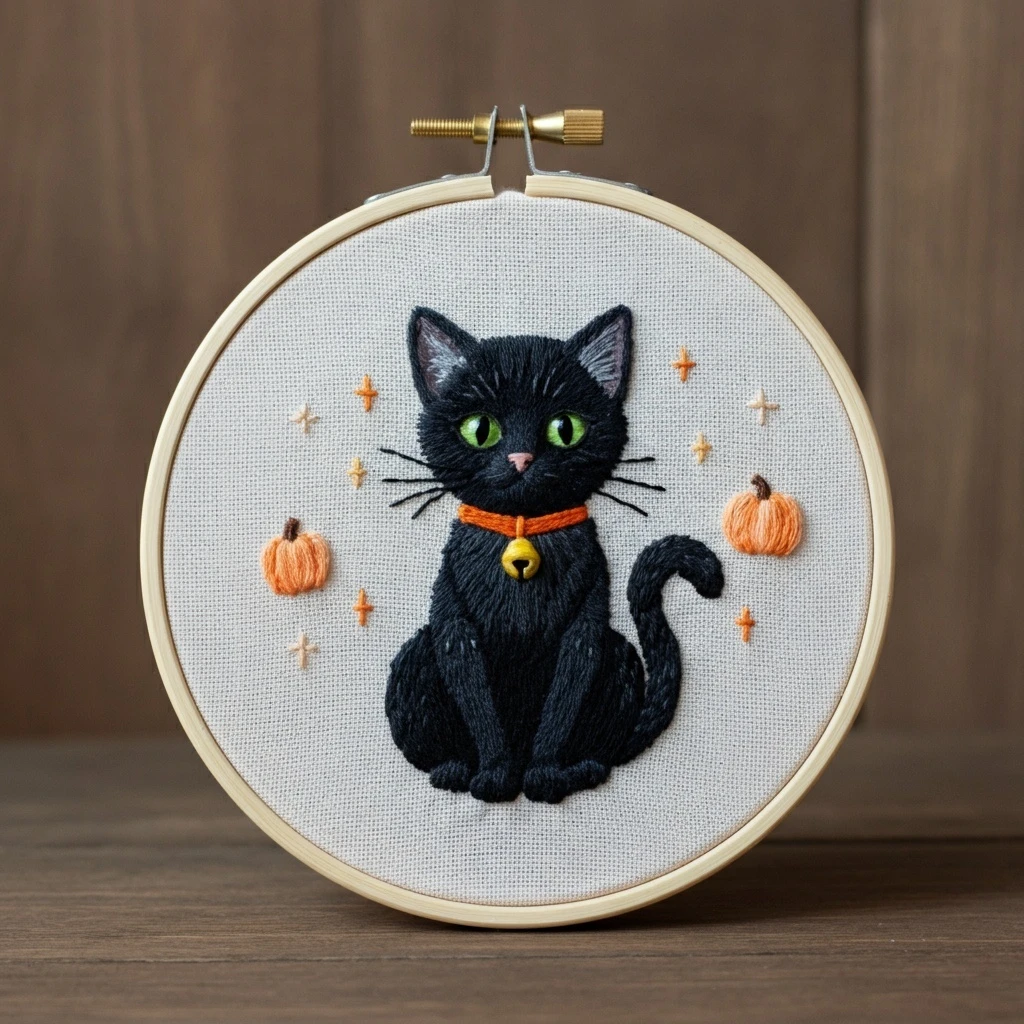

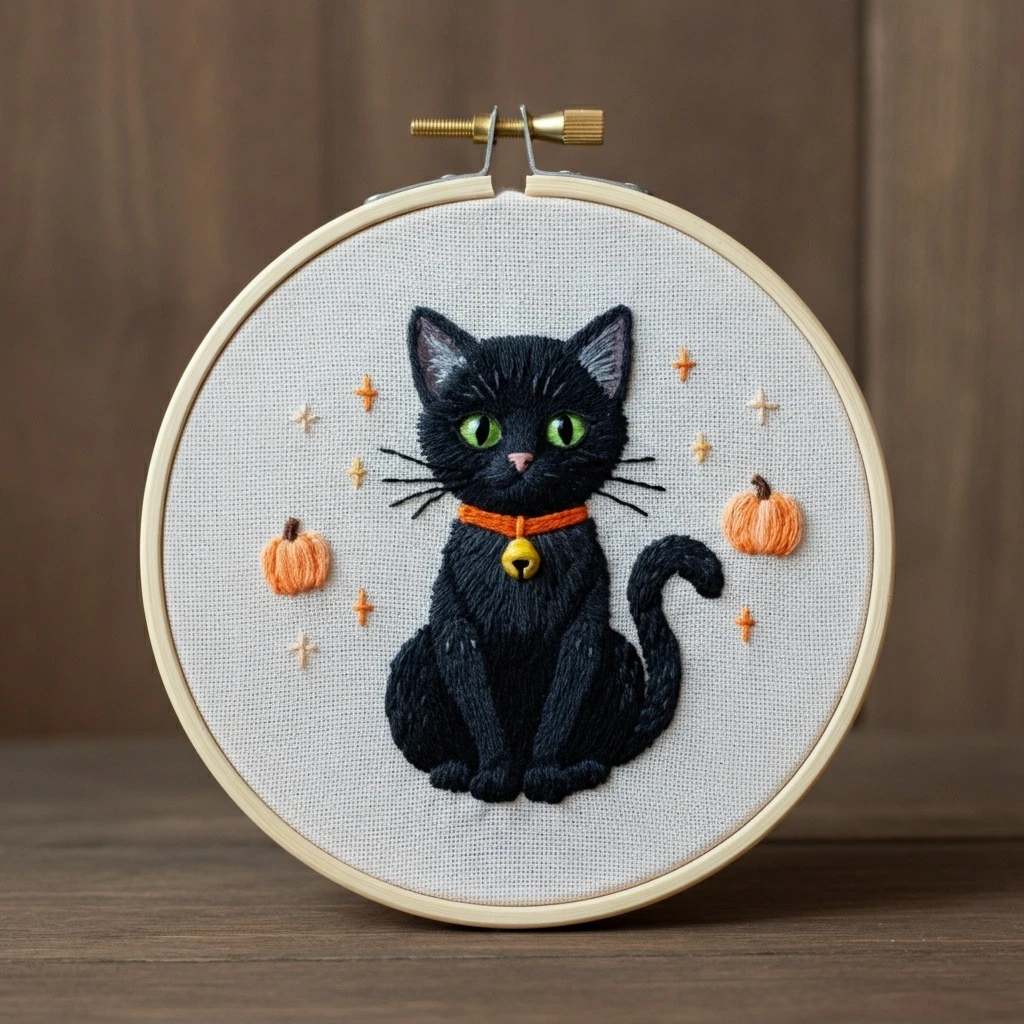
Pumpkin Night Black Cat
A cozy Halloween embroidery scene with a sleek black cat nestled among warm pumpkins beneath a dark autumn night. The design benefits from velvety fur shading, rounded pumpkin ribs, muted vine details, and tiny glowing accents that keep the scene whimsical and polished.
Design color read
The palette centers on strong Halloween contrast: charcoal black fur, blue-violet night shadows, burnt orange pumpkins, golden highlights, brown stems, and muted green vine details. The cat should not be stitched as a flat black silhouette; subtle charcoal, navy, and pewter highlights help reveal the face, ears, chest, and tail curve.
Suggested DMC floss palette
This palette keeps the cat readable, the pumpkins dimensional, and the background decorative. Reserve the darkest colors for the smallest areas so stitch texture stays visible.
Deepest cat details: pupils, nose, paw shadows, and selected silhouette edges.
Main black-cat fill; keeps fur softer and more dimensional than pure black.
Cool night shadows, cat tail depth, and dark background accents.
Small fur highlights along the forehead, chest, ear rims, and tail curve.
Deep pumpkin grooves, lower shadows, and the most saturated autumn-orange areas.
Main pumpkin body color for smooth satin or long-and-short fill.
Raised rib highlights and warm light on the rounded pumpkin tops.
Tiny glow accents, optional star dots, and delicate pumpkin highlight stitches.
Pumpkin stems, warm outlines, branch details, and grounding shadows.
Stem highlights, dry vine texture, and soft autumnal neutral accents.
Muted leaves, pumpkin vines, and small botanical details around the pumpkins.
Halloween night accents, deeper background shadows, and a subtle purple cast.
Stitch map by design element
Black cat fur
Use long-and-short stitch with 1–2 strands, following the direction of the head, chest, back, and tail. Add only a few grey highlight strokes.
Cat face and whiskers
Use one-strand backstitch for eyes, nose, mouth, and whiskers. Keep whiskers fine and slightly curved for a delicate expression.
Pumpkin bodies
Fill each rib separately with satin or long-and-short stitch. Shade from dark orange grooves to lighter tangerine centers.
Stems and vines
Use stem stitch for stems, whipped backstitch for curls, and detached chain stitch for small leaves.
Night details
Use tiny straight stitches, seed stitch, or French knots for stars and specks. Keep them sparse so they do not compete with the cat.
Selective outlines
Use one strand of coffee brown on pumpkin edges and charcoal on cat details. Avoid outlining every fur edge heavily.
Thread-count and blending guidance
| Area | Strands | Blending idea | Practical note |
|---|---|---|---|
| Black cat | 1 strand for fur detail; 2 strands for larger dark fills | Use 3799 as the main fur color, add 823 in cooler shadows, and place tiny 413 strokes on lit edges. | Do not fill the full cat in 310; pure black can hide stitch direction and facial details. |
| Pumpkins | 2 strands for body fill; 1 strand for final rib highlights | Work 720 in grooves, 741 through the center, and 742/744 on the raised rib tops. | Treat each rib like a small curved petal so the pumpkin stays rounded. |
| Stems and vines | 1–2 strands | Use 898 for structure and 3863 on one side for dry woody highlights. | Thin vine lines look cleaner than bulky filled curls. |
| Background accents | 1 strand for small details | Use 550 and 823 for night depth; add a few 744 or 3865 dots for glow. | Place background specks last so spacing can be adjusted after the main design is complete. |
Recommended stitching order
- Transfer the pumpkin ribs, cat silhouette, face, vines, and small background accents with a fine removable line.
- Stitch any background stars or night specks that sit behind the cat.
- Fill pumpkins rib by rib, working darker grooves before lighter raised centers.
- Stitch the cat body with directional long-and-short stitches, then add face and whiskers last.
- Finish with stems, vines, leaves, glow dots, and selective outlining.
Beginner-friendly practical tips
- Use a sharp needle for the dense black-cat area so the fabric holes stay neat.
- Keep pumpkin stitch direction curved; straight vertical lines can make pumpkins look flat.
- Short stitches are best around ears, paws, and the cat face where curves are tight.
- Whiskers should be one strand and stitched after all fur is complete.
- Press the finished piece face-down on a towel to protect raised knots and textured stitches.
Texture, shading, and finishing notes
The polished effect comes from balancing dark, soft fur with plump, glowing pumpkins. Keep the cat details delicate, but allow the pumpkins to show richer orange shading and visible curved stitch direction.
Cat texture
Follow the natural fur flow: outward from the nose, down the chest, around the back, and along the tail. Use broken highlight stitches rather than continuous grey lines so the sheen looks natural.
Pumpkin dimension
Shade each rib from dark groove to light center. A few one-strand golden stitches near the top edge suggest warm light without turning the pumpkin yellow.