
DMC palette & hand embroidery guide
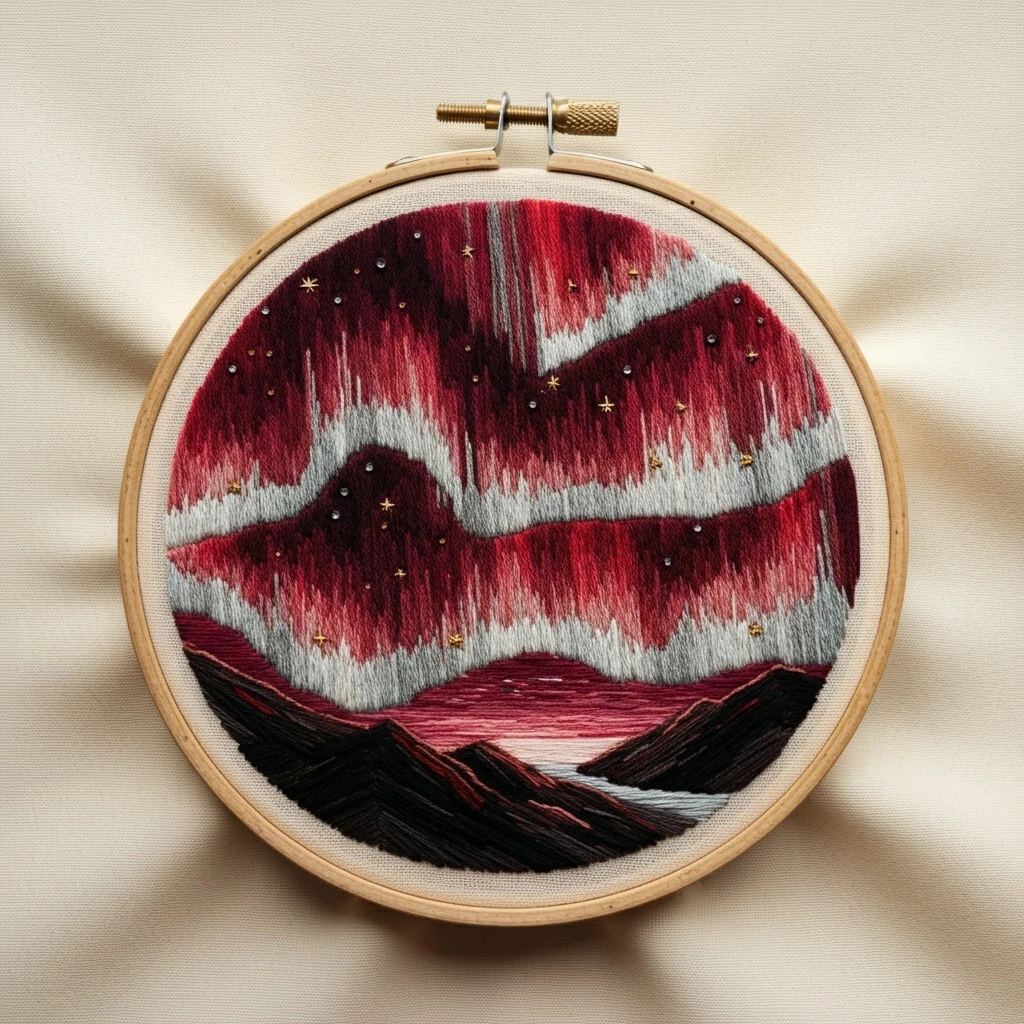
Red Aurora Night Sky
A dramatic round-hoop landscape built from wine-red aurora curtains, cold silver-green light, a rosy horizon, black mountain silhouettes, and tiny metallic-looking stars. The key is long vertical texture in the sky, soft directional shading over the lake, and crisp dark foreground shapes.
Polished DMC Color Palette
The reference image is dominated by garnet, black cherry, smoky silver-gray, dusty rose, charcoal mountain shadows, warm wood/brown accents, and small gold star points. Use the darkest tones sparingly but decisively so the red aurora keeps its glow.
Deepest aurora pockets and shadowed red bands. Place near the top curve and under pale ribbons.
Main wine-red sky mass. Excellent for long-and-short vertical strokes.
Brighter red aurora edges and the center of flowing curtains.
Sparks of warm red where the aurora flares and along lit mountain ridges.
Rosy lake reflections and softened transitions between red and pale gray.
Thin highlights on the horizon, lake glow, and small star glints.
Pale aurora ribbons and icy sky bands. Keep edges feathered, not blocky.
Mid-tone silver-green support for wide pale bands and lake shadows.
Narrow vertical streaks through the aurora and soft mountain/lake cooling.
Mountain detail, softer shadow fill, and smoke-dark sky accents.
Foreground mountain silhouettes and the cleanest outer lower curve.
Small stars and warm flecks. Blend with a single strand of 3821 for brighter points.
Stitch Plan by Design Area
| Area | Recommended stitches | Thread count |
|---|---|---|
| Red aurora curtains | Long-and-short stitch, vertical satin stitch, scattered straight stitches. | 1 strand for painterly blending; 2 strands for bold bands. |
| Pale silver aurora ribbons | Split stitch outline first, then satin/long-and-short fill with feathered edges. | 1 strand at edges, 2 strands in the ribbon center. |
| Lake reflection | Horizontal straight stitch, seed stitch, and short satin strokes following the water line. | 1 strand for fine ripples; 2 strands for the main reflection. |
| Mountains | Long straight stitch, brick stitch, and couching for sharp ridges. | 2 strands for fill; 1 strand for ridge highlights. |
| Stars | Tiny cross stitch, star stitch, French knots, and single seed stitches. | 1 strand; add metallic only if your fabric and needle can handle it. |
Blending & Shading Map
Work from the background forward, then add stars last. The aurora should feel like soft vertical light, while the mountains should stay crisp and heavy.
Aurora blend
- Blend 814 + 815 for the darkest overhead sky.
- Blend 815 + 816 where the red curtain brightens.
- Blend 816 + 304 at the lower red glow and horizon flare.
- Feather 762 into red bands using uneven stitch lengths so the pale ribbons look misty.
Landscape blend
- Use 310 for hard mountain silhouettes, then soften inner planes with 3799.
- Lay 3354 and 3865 horizontally in the lake to suggest reflected light.
- Add a few red ridge stitches in 304 or 816, but keep them thin.
Outlining, Texture & Finishing Details
Outlining details
- Backstitch the round scene edge with 3799 or 310 only after all filling is complete.
- Outline pale aurora bands lightly with split stitch in 415, then cover the line with fill stitches so the boundary stays soft.
- Use 310 for the outer mountain base, but use 3799 along upper ridges to avoid a flat cutout look.
- For tiny star centers, place one French knot in 783, then add two or four single straight stitches for sparkle.
Texture suggestions
- Vary the length of every aurora stitch; perfectly even stitches will make the sky look striped rather than luminous.
- Let some red stitches overlap into the gray ribbons and a few gray stitches drift into the red.
- Use horizontal water stitches that get shorter toward the sides of the hoop.
- For mountains, angle stitches with the slope of each peak so the terrain has direction.
Beginner-Friendly Working Order
- Transfer lightly. Mark the circle, mountain silhouettes, lake edge, and the broad aurora ribbon paths. Avoid drawing every tiny streak.
- Fill the pale ribbons first. Establish 762 and 415 areas so the red can feather into them naturally.
- Add red aurora layers. Work dark to light: 814, 815, 816, then small 304 accents. Keep stitches vertical and uneven.
- Stitch the lake. Use 3354, 3865, 415, and small red touches in horizontal lines. Leave tiny fabric gaps if you want a shimmering effect.
- Build the mountains. Fill the silhouettes with 310 and 3799, then add thin garnet/red highlights on the ridges facing the aurora.
- Finish with stars. Add French knots and star stitches in 783, with a few 3865 pinpoints for cold white sparkle.
Compact Shopping List
Core floss set: DMC 814, 815, 816, 304, 3354, 3865, 762, 415, 414, 3799, 310, and 783. Optional extras: DMC 498, 902, 318, 729, 3821, plus a fine gold metallic thread for confident stitchers.
Needles: embroidery sizes 7–9 for one- and two-strand work; use a slightly larger needle if adding metallic thread. Fabric: natural linen, cotton-linen, or evenweave in cream or warm beige to echo the sample’s hoop-framed look.