
DMC palette & hand embroidery guide
Red Spider Lilies
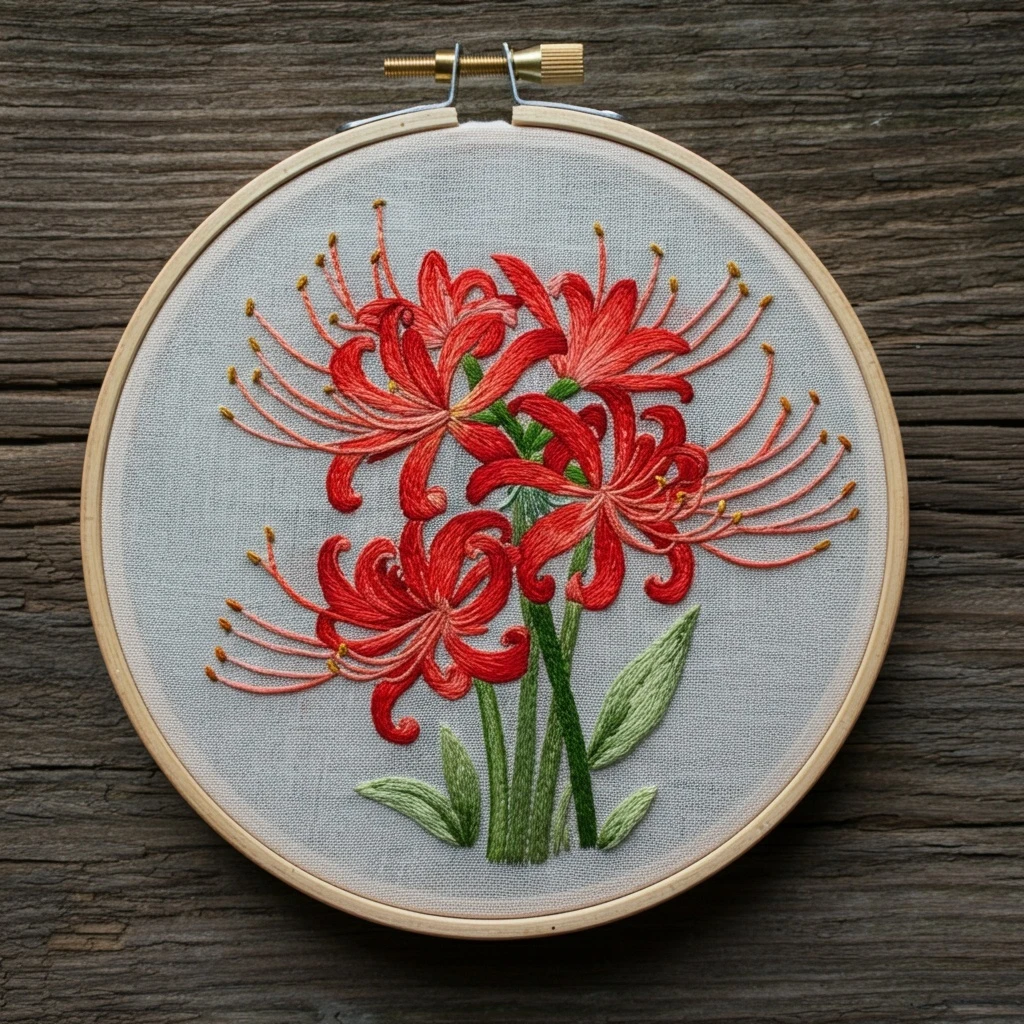
A dramatic cluster of scarlet spider lilies with curling petals, long arcing stamens, golden pollen tips, and fresh green stems on soft neutral linen. The design depends on lively red shading, clean directional stitches, and fine botanical linework.
StyleElegant botanical, bold red florals
FocusCurled petals, swept stamens, layered stems
Best fabricNatural linen or cotton in warm grey, oatmeal, or ivory
Polished DMC Color Palette
Use the strongest reds for the outer petal edges and curled tips, then soften toward the flower centers with coral and peach tones. The greens should stay slightly varied so the stems do not become a flat block.
DMC 666
Bright Red
Main spider lily petal color; ideal for satin stitch fills and high-energy upper ridges.
DMC 321
Red
Core petal body and medium shadows. Blend with 666 for smooth red transitions.
DMC 498
Dark Red
Deep creases, petal undersides, overlaps, and curled inner hooks.
DMC 817
Coral Red
Warm mid-red for petal variety, especially where the reference shifts from crimson to tomato red.
DMC 347
Very Dark Salmon
Stamen curves and soft inner petal veins; keeps thin red lines from looking too heavy.
DMC 352
Light Coral
Petal highlights, center flicks, and blended stitches near flower throats.
DMC 699
Green
Deep stems and hidden leaf bases; useful for shadowed vertical stitch lines.
DMC 702
Kelly Green
Fresh stem highlights and small bright joins behind the blooms.
DMC 469
Avocado Green
Olive shading in the taller leaves and lower stem cluster.
DMC 472
Ultra Light Avocado
Leaf highlights and pale edge strokes on the lower greenery.
DMC 783
Medium Topaz
Golden pollen dots at stamen ends; add last so they sit crisp on top.
DMC 869
Very Dark Hazelnut Brown
Tiny anther shadows and a few dark anchor points at flower centers.
Stitch Map & Practical Use
Spider lilies look best when the stitches follow the motion of the flower: petals curl inward, stamens sweep outward, and the stems rise in clean vertical rhythm.
| Design area | Recommended stitches | Thread count | Helpful notes |
|---|---|---|---|
| Curled red petals | Long and short stitch, satin stitch, split stitch outline | 2 strands for fill, 1 strand for outline veins | Work from the outer curve toward the center. Change direction gradually so each petal keeps its curled ribbon shape. |
| Fine petal veins | Straight stitch, stem stitch, couching for sharp curves | 1 strand | Use 347 or 352 for inner veins; reserve 498 only for the darkest folds. |
| Long arcing stamens | Stem stitch, whipped back stitch, couched straight stitch | 1 strand, or 2 strands for the frontmost curves | Keep tension relaxed so the lines remain graceful and do not pucker the fabric. |
| Golden pollen tips | French knots, colonial knots, tiny satin dots | 2 strands | Stitch these after all red lines are complete. A small brown shadow beside a few knots adds dimension. |
| Stems and leaves | Stem stitch, split stitch, fishbone stitch, long and short stitch | 2 strands for stems, 2-3 strands for leaves | Mix 699, 702, 469, and 472 in alternating rows to avoid flat greenery. |
Blending & Shading Plan
- For bold petals, thread the needle with one strand of DMC 666 and one strand of DMC 321.
- For darker curled tips, blend one strand of 321 with one strand of 498, then finish the edge with a single-strand split stitch.
- For soft inner glow, blend 817 with 352 near the flower centers and along selected petal ridges.
- For the stamens, alternate 347 and 352 rather than using only bright red; this keeps the thin arcs airy.
Outlining Details
- Outline only the outermost petal edges; outlining every line can make the design look crowded.
- Use 1 strand of 498 for shadowed overlaps and 1 strand of 321 for visible petal contours.
- On the longest stamens, couch the curve with tiny holding stitches if your fabric weave makes stem stitch wobble.
- Keep flower centers slightly darker with 498 and a touch of 869 so the petals appear to radiate outward.
Beginner-Friendly Stitching Sequence
Stitch from background structure to small surface details. This keeps the delicate pollen dots and fine stamen lines clean.
Transfer lightlyUse a fine removable pen. Mark the stamen tips and petal centers clearly; they guide the whole flower.
Build greeneryStitch stems first with vertical stem stitch, then leaves with fishbone or long-and-short stitches.
Fill petalsWork one flower at a time. Finish the darker underside before adding bright highlights.
Add fine linesFinish stamens, veins, pollen knots, and final outlines after all main fills are complete.
Hoop tension: drum-tight, not stretched
Needle: size 7-9 embroidery needle
Best thread length: 14-16 inches
Fabric: medium-weight linen/cotton
Texture Suggestions
Petals: Use satin stitch only in narrow curled sections; use long and short stitch for wider petals so the red shades can breathe. Let a few 352 highlight stitches sit on top as final glints.
Stamens: Keep them delicate. One strand of coral-red floss gives the design the open, spidery shape that defines the flower. Add pollen knots with two wraps only, so they stay small and elegant.
Quick Troubleshooting Tips
- If the red area looks too flat, add a few single-strand 498 shadow stitches under curled petal tips and near overlaps.
- If the flowers feel too dark, bring back brightness with 666 on the outer ridges and 352 near the centers.
- If stamen curves pucker, loosen the working thread and use shorter stitches along the curve instead of one long pulled line.
- If leaves disappear behind the flowers, sharpen one edge with 699 and place 472 highlights on the opposite side.