
DMC palette & hand embroidery guide
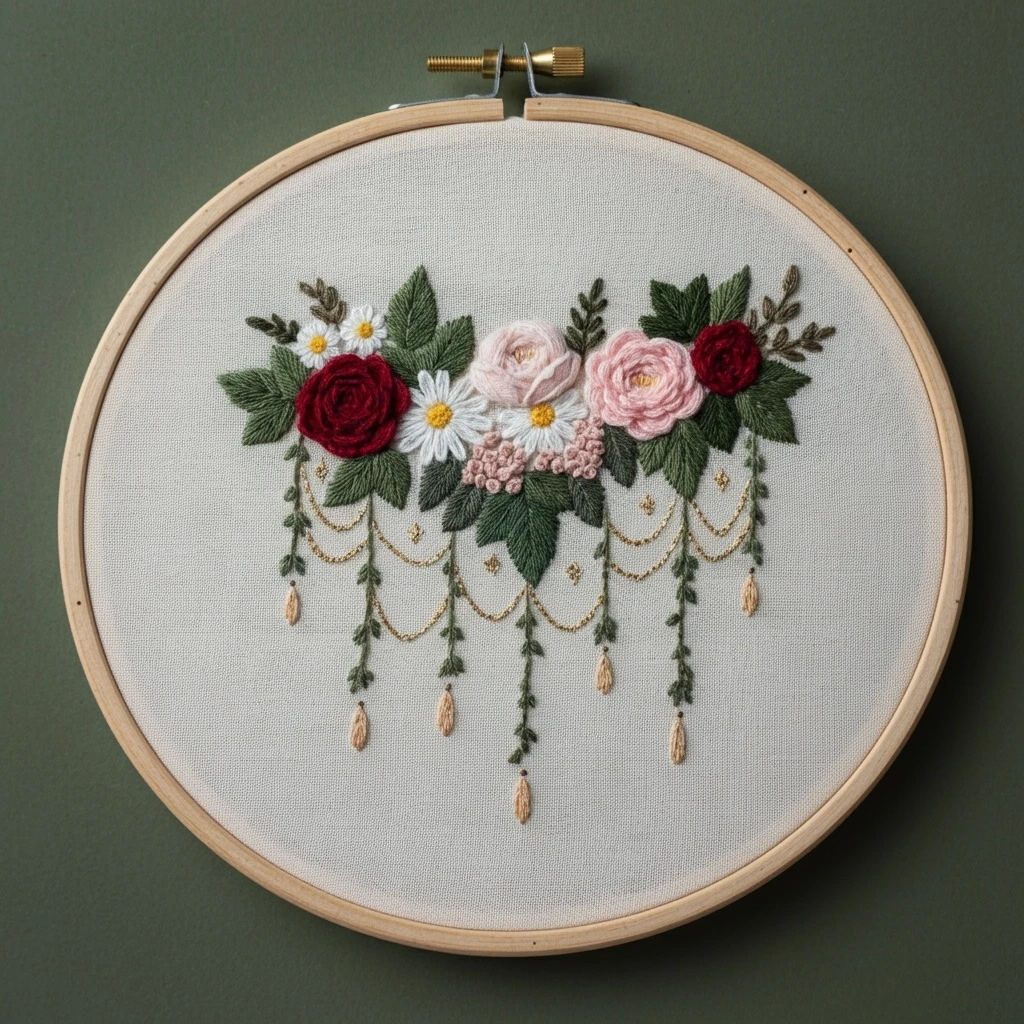
Regal Floral Swag With Draped Chains
A formal floral swag with deep burgundy roses, pale blush blooms, bright daisy faces, layered dark foliage, dangling greenery, and delicate golden chain garlands. The finished embroidery should feel lush at the top and graceful below, with raised flowers, crisp leaves, and fine metallic-looking drapes.
Core DMC Color Palette
This design relies on contrast: rich rose shadows, gentle blush petals, crisp daisy whites, deep green leaves, and elegant gold chains. Use strand changes and small directional stitches to keep the floral crown full without making the hanging details bulky.
DMC 814
Garnet - Dark
Deepest folds in the red roses, inner spirals, and tucked petal shadows.
DMC 815
Garnet - Medium
Main burgundy rose fill; excellent for satin petals and woven rose centers.
DMC 816
Garnet
Brighter red highlights on petal rims and small accent blooms.
DMC 225
Shell Pink - Ultra Very Light
Soft outer petals of the pale roses and blended blush transitions.
DMC 3726
Antique Mauve - Dark
Pink rose shadow lines, petal bases, and definition between curled layers.
DMC 3865
Winter White
Daisy petals, highest shine on pale blooms, and tiny sparkle touches on tassels.
DMC 822
Beige Gray - Light
Subtle daisy-petal shadows and linen-friendly highlights that are softer than pure white.
DMC 742
Tangerine - Light
Daisy centers, pollen knots, and warm golden glints in the floral crown.
DMC 729
Old Gold - Medium
Primary draped chain color; use for couching, back stitch beads, and small star accents.
DMC 677
Old Gold - Very Light
Highlights on chain curves, tassel tips, and the brightest dots near the swags.
DMC 3364
Pine Green
Darkest leaves under the roses and shadowed foliage near the center cluster.
DMC 3051
Green Gray - Dark
Main leaf veins, medium leaf fill, and sturdy vertical hanging stems.
DMC 3052
Green Gray - Medium
Soft olive foliage, fine fernlets, and transition stitches on large leaves.
DMC 522
Fern Green
Leaf-tip highlights and lighter trailing greenery so the drapes stay airy.
DMC 841
Beige Brown - Light
Muted hanging teardrops, tassel shadows, and warm outlines around gold details.
DMC 3371
Black Brown
Tiny deepest accents only: rose creases, leaf overlaps, and chain anchor points.
Stitch Map & Thread Counts
| Design area | Best stitches | Strands | Practical notes |
|---|---|---|---|
| Burgundy roses | Woven wheel, padded satin, long-and-short stitch, split stitch | 2 strands for petals; 3 strands for padded centers | Start with 814 in the inner spiral, fill with 815, then add 816 along upper petal edges. Keep petal stitches curved, not straight across. |
| Pale pink roses | Long-and-short stitch, satin stitch, split-fill, whipped back stitch | 1–2 strands | Use 3726 at petal bases and 225 over the outer turns. A few 3865 strokes on the top rim make the flower look rounded. |
| White daisies | Detached chain, fishbone stitch, satin stitch, French knots | 2 strands for petals; 2–3 strands for centers | Shade the base of each petal with 822, then add 3865 down the center. Work yellow knots after petals so the centers sit raised. |
| Large leaves | Fishbone stitch, long-and-short leaf fill, stem stitch veins | 2 strands for fill; 1 strand for veins | Place 3364 under the flower heads, 3051 through the body of the leaf, and 3052 or 522 at leaf tips. |
| Small sprigs and trailing vines | Stem stitch, fly stitch, straight stitch, lazy daisy | 1 strand for stems; 2 strands for leaves | Keep the vertical greenery lighter than the top swag. Use short leaves spaced irregularly so the strands look botanical and graceful. |
| Draped gold chains | Couching, whipped back stitch, tiny chain stitch, colonial knots | 1 strand for fine chain lines; 2 strands for knots | Draw chain curves carefully before stitching. Use 729 for the full arc and touch 677 on the lower curve where light would catch. |
| Hanging tassels and teardrops | Satin stitch, straight stitch, laid work, back stitch | 2 strands for fill; 1 strand for outline | Fill with 677 or 841, then add one or two 729 center strokes. Do not overfill: the drops should hang lightly below the floral mass. |
Blending & Shading Plan
Use the strongest contrast in the roses and the most delicate thread work in the draped chains.
- Red roses: blend 814 into 815 by overlapping short curved stitches; reserve 816 for just the outer petal lips.
- Pink blooms: place 3726 near the lower petal fold, then feather 225 toward the top edge for a soft watercolor effect.
- White daisies: avoid flat white petals by adding a few 822 stitches at the base and a single 3865 highlight down the center.
- Gold chains: use 729 for structure and add small 677 dots at the lowest points of each swag to imitate glimmer.
Outlining Details
This pattern looks most regal when outlines are controlled and mostly tone-on-tone.
- Outline red roses with one strand of 814 only inside the deepest folds, not around the entire flower.
- Use 3051 or 3364 for leaf edges; avoid black outlines on foliage.
- Anchor chain ends with tiny 3371 or 841 stitches where the drapes disappear under leaves.
- For the pale roses, use 3726 as a stitched shadow line instead of a hard outline.
Suggested Stitching Order
Transfer the layout cleanly. Mark the chain curves, tassel drops, flower centers, and main leaf veins. Symmetry matters most in the hanging swags.
Stitch the foliage foundation. Work dark leaves first behind the flowers, then add medium and light green leaf tips so the bouquet has layered depth.
Build the largest flowers. Complete the red and pink roses before the daisies. Keep rose centers slightly raised and petal edges smooth.
Add daisies and small filler blooms. Stitch white petals next, then French-knot centers and soft pink filler clusters around the middle.
Work the hanging greenery. Use single-strand stems and small fly stitches so the vertical vines stay delicate below the floral crown.
Finish with chains and tassels. Couch or whip the gold chain arcs last to keep them crisp and visible, then add tiny highlight knots at the lowest points.
Beginner tip: if the chain curves feel intimidating, stitch them as a dotted line of tiny back stitches first. Once the spacing looks even, add a second pass of whipped back stitch to create a smoother golden drape.
Texture Suggestions
Raised rose centersUse a small woven wheel or padded satin core so the flowers stand forward from the flatter leaves. Keep outer petals flatter to avoid bulk.
Feathery leavesFishbone stitch gives the larger leaves a natural center vein. For smaller olive sprigs, use fly stitches that alternate left and right.
Jewelry-like chainsCouch a single strand of 729 along each curve, then add tiny 677 stitches as highlights. This keeps the chains neat and decorative.
Fabric & Hoop Notes
- A warm natural linen or cotton-linen blend suits the muted golds and deep roses.
- Use a hoop that keeps the upper swag centered with enough breathing room below the tassels.
- Back the fabric with lightweight stabilizer if using many knots or padded rose centers.
- Press only from the back on a towel after the embroidery is completely dry.
Beginner-Friendly Tips
- Complete one flower type at a time to keep strand choices organized.
- Cut short thread lengths for the gold chains; longer lengths fuzz and lose their smooth shine.
- Use one strand for tiny outlines and details. More strands can blur the dainty jewelry effect.
- Step back often: the top swag should feel rich, while the hanging chains should remain light and airy.