
DMC palette & hand embroidery guide
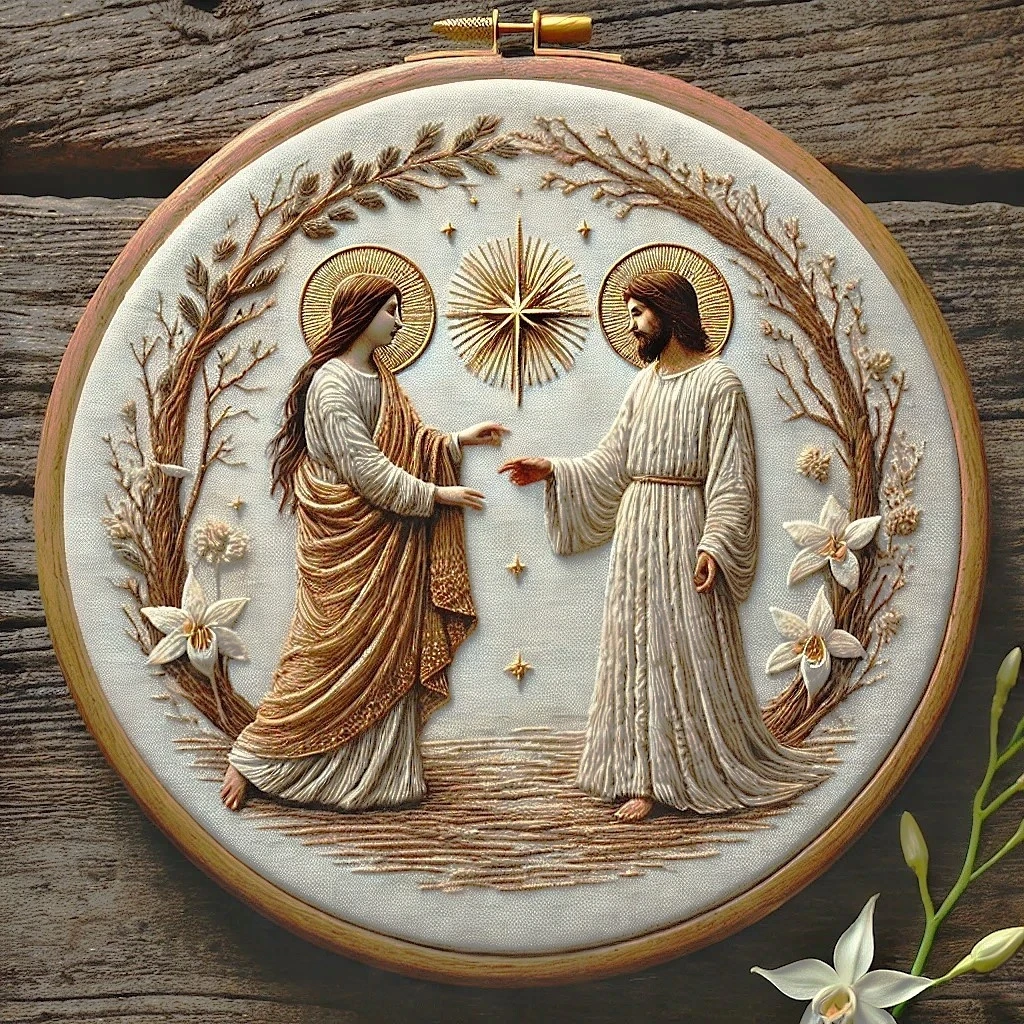
Religious Encounter
A reverent scene with two robed figures facing one another beneath radiant gold halos, a central starburst, arched olive-brown branches, cream lilies, tiny gold stars, and softly stitched ground lines. The embroidery should feel warm, quiet, and luminous, with dimensional robes and delicate sacred light details.
Core DMC Color Palette
This design is built from a restrained devotional palette: linen creams, warm browns, bronze-gold light, and muted natural stems. Keep the figures soft and dimensional, then let the halos, starburst, and tiny stars provide the brightest sparkle.
DMC 3865
Winter White
Brightest robe ridges, lily petal highlights, and small glints on sacred light details.
DMC 822
Beige Gray - Light
Main ivory robe fill, soft background highlights, and gentle transitions on lilies.
DMC 642
Beige Gray - Dark
Robe fold shadows, sleeve undersides, and low-contrast contour lines on cream fabric.
DMC 841
Beige Brown - Light
Warm shading on robe hems, ground strokes, branch highlights, and figure outlines.
DMC 433
Brown - Medium
Primary chestnut drapery, branch arcs, hair midtones, and the textured stitched ground.
DMC 801
Coffee Brown - Dark
Deep hair shadows, garment fold creases, lower branch shadows, and sandal details.
DMC 938
Coffee Brown - Ultra Dark
Tiny darkest accents for eyes, beard depth, sleeve openings, and the deepest hair lines.
DMC 435
Brown - Very Light
Sunlit drapery edges, warm robe folds, branch tips, and bronze transitions around halos.
DMC 729
Old Gold - Medium
Halo rings, main starburst spokes, small stars, and golden ornament details.
DMC 677
Old Gold - Very Light
Bright halo rays, star tips, and highlight stitches where light should appear to shimmer.
DMC 680
Old Gold - Dark
Shadowed side of halos, central vertical ray, and grounding lines beneath gold elements.
DMC 3778
Terra Cotta - Light
Skin tones for faces, hands, and feet; blend sparingly with cream for softness.
DMC 407
Desert Sand - Dark
Nose, hand, and foot shadows, plus warm facial contours and knuckle details.
DMC 3012
Khaki Green - Medium
Muted olive hints in leaves, small wreath sprigs, and subtle botanical shadows.
DMC 3013
Khaki Green - Light
Soft leaf highlights and pale twig tips without making the wreath too green.
DMC 3823
Yellow - Ultra Pale
Lily throats, tiny candle-like accents, and soft glow stitches near the central star.
Stitch Map & Thread Counts
| Design area | Best stitches | Strands | Practical notes |
|---|---|---|---|
| Ivory robes | Long-and-short stitch, split stitch, stem stitch, laid filling | 1–2 strands for folds; 3 strands only for padded ridges | Use 822 as the main tone, 642 in folds, and 3865 on raised ridges. Follow the fall of the fabric vertically so the robes appear heavy and graceful. |
| Brown mantle and drapery | Long-and-short stitch, satin stitch, couching, split-fill | 2 strands for fill; 1 strand for fold lines | Blend 433 and 435 across highlighted folds, then add 801 only inside the deepest pleats. Curved rows make the fabric look wrapped around the body. |
| Faces, hands, and feet | Tiny satin stitch, split stitch, short straight stitch | 1 strand | Keep facial work minimal. Use 3778 for the base, 407 for warm shadows, and 938 only for the smallest eye, beard, and hair accents. |
| Hair and beard | Stem stitch, split stitch, long straight stitch, couching | 1 strand for strands; 2 strands for dense masses | Layer 433 and 801 in the direction of the hair, then add a few 938 strokes at the crown, beard base, and under the veil. |
| Halos and central starburst | Radiating straight stitch, couching, whipped back stitch, tiny French knots | 1 strand for rays; 2 strands for ring outlines | Stitch the circle first with 729, then place 677 rays evenly around it. Use 680 for the inner ring or vertical central ray to add depth. |
| Branch wreath | Stem stitch, whipped stem stitch, fly stitch, detached chain, seed stitch | 2 strands for main branches; 1 strand for twigs | Use 433 for the branch base, 841 for highlights, and 3012/3013 on select leaves. Keep twig ends irregular for a natural wreath silhouette. |
| Lilies and small flowers | Satin stitch, fishbone stitch, detached chain, French knots | 2 strands for petals; 2–3 strands for centers | Shade petal bases with 822 or 642, highlight with 3865, then add 3823 and 729 knots in the throat. |
| Ground texture | Running stitch, seed stitch, couching, irregular straight stitch | 1–2 strands | Layer 841, 433, and 642 in broken horizontal lines. Leave gaps so the ground feels light and does not compete with the figures. |
Blending & Shading Plan
The most convincing effect comes from quiet shading rather than strong outlines.
- Robes: blend 822 into 642 with staggered vertical stitches, then add 3865 only on the highest folds.
- Brown drapery: place 801 in the fold valleys, fill with 433, and skim 435 along the upper fold edges.
- Halos: alternate 729 and 677 rays for a hand-gilded effect; add 680 on one side of the circle for a subtle shadow.
- Skin: keep faces and hands softer than the robes by using one strand and very short stitches.
Outlining Details
Fine outlines help separate the figures without making the scene cartoonish.
- Use one strand of 841 or 642 along robe edges; reserve 801 for deep sleeve openings and mantle shadows.
- Outline halos with whipped back stitch in 729 for a smooth circular rim.
- Use 433 for branch outlines and 3012 only as small botanical accents, not a full green border.
- For facial features, use single-strand 938 only where necessary; tiny marks look more refined than heavy outlines.
Suggested Stitching Order
Transfer the main geometry first. Mark the halo circles, central starburst, faces, hands, robe folds, and wreath arc. Accuracy in the halos makes the whole piece feel balanced.
Work background branches and ground. Stitch the wreath and ground texture before the figures so later robe edges can sit cleanly on top.
Complete the ivory robes. Fill large robe areas with long-and-short stitches, following the vertical folds and leaving space for brighter ridge highlights.
Add mantle, hair, and skin. Build warm brown drapery, then stitch hair and the small facial and hand details with one strand.
Stitch lilies and small blossoms. Add floral accents around the wreath after the main branches are finished so petals stay crisp and raised.
Finish with halos, stars, and rays. Work all gold elements last to keep them bright, clean, and free of lint from the darker threads.
Beginner tip: for neat halos, lightly draw the circle and stitch the outline before adding rays. Turn the hoop often so every ray points outward from the same center instead of leaning to one side.
Texture Suggestions
Dimensional robe foldsUse laid stitches or padded split stitch under the brightest robe ridges, then cover with 3865. This gives the garments a sculpted, icon-like depth.
Glowing sacred lightKeep halo rays single-strand and evenly spaced. A few tiny 677 knots near the starburst add sparkle without needing metallic thread.
Natural branch wreathVary twig length and stitch direction. Use fly stitches and detached chains sparingly so the wreath frames the figures rather than overpowering them.
Fabric & Hoop Notes
- A warm ivory linen or cotton-linen fabric supports the antique gold and sepia palette beautifully.
- Use a firm hoop and keep tension even, especially when stitching long robe folds and straight halo rays.
- Back the fabric with lightweight stabilizer if you plan to add padded robe ridges or dense French knots.
- Press from the back on a thick towel so raised rays, flowers, and robe folds are not flattened.
Beginner-Friendly Tips
- Separate the project into zones: wreath, ground, robes, figures, flowers, then gold details.
- Use shorter thread lengths for 3865 and 677; pale threads show fuzz more quickly than dark browns.
- For robe shading, stitch a few sample folds on scrap fabric before working the figures.
- Step back frequently: the scene should read as calm and luminous, not overly outlined or high contrast.