
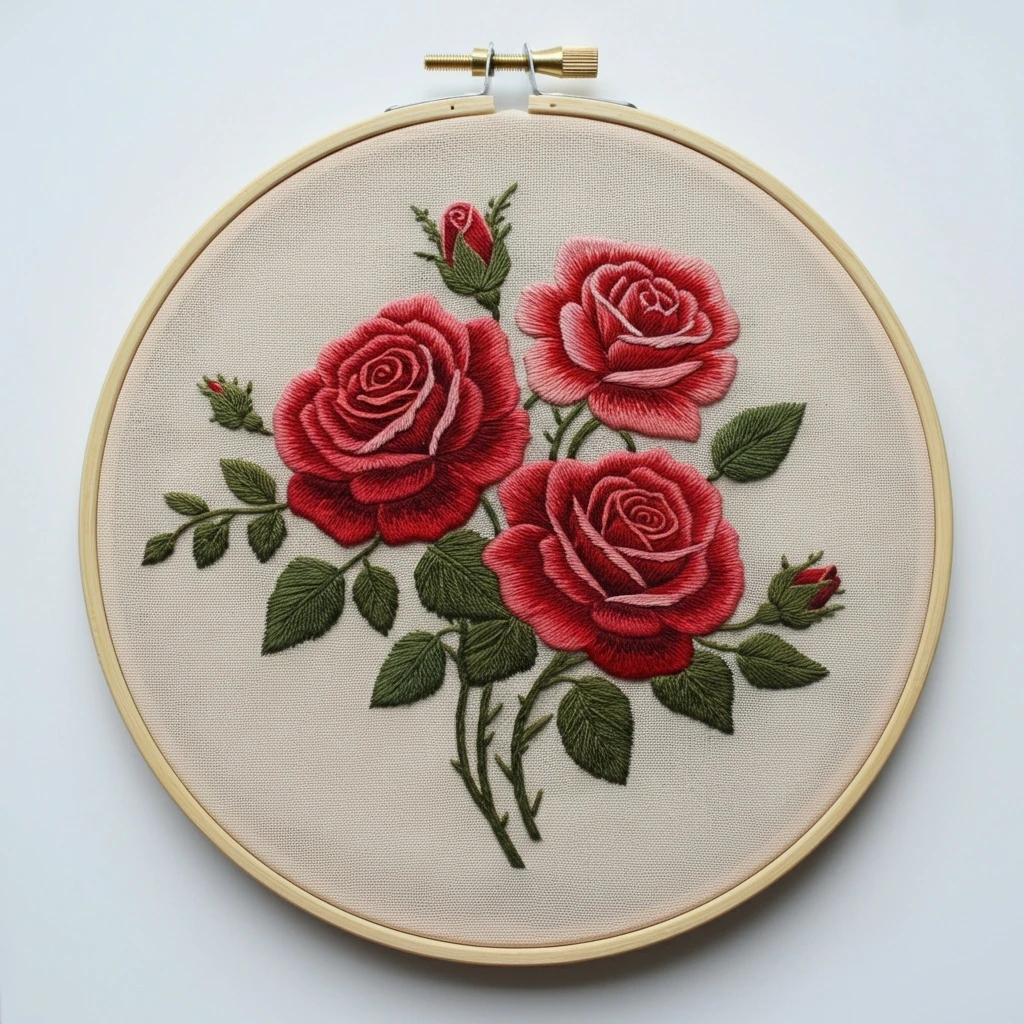
Romantic Rose Garden
A rich garden-style rose composition with three open red blooms, small buds, deep green foliage, and soft blush petal highlights on warm natural fabric. The design works best with layered satin, long-and-short shading, and crisp stem details that keep the bouquet elegant rather than heavy.
Color Story From the Reference
The image is built around velvet red roses with burgundy petal shadows, coral-red midtones, pale pink turned edges, olive stems, and textured forest-green leaves. Use the darkest reds sparingly in petal folds and the light pinks only on edges, ridges, and curled petals so the roses keep their dimensional shape.
Deepest rose creases, inner spirals, lower petals, and shadow under overlapping blooms.
Main dark red structure for shaded petal bases and dramatic outer folds.
Primary rose red for most satin-filled petals and bud bodies.
Bright red transitions on petal centers; blends beautifully with 816.
Warm blush highlights on petal rims and front-facing curled edges.
Tiny highlight strokes; keep very narrow so roses do not turn pastel.
Leaf undersides, stem shadows, and dark central veins.
Main foliage color for shaded leaf fill and sturdy rose stems.
Mid-leaf highlights and lighter stem sides; blend with 935 for texture.
Optional hoop-toned accent for warm outlines, label motifs, or aged botanical warmth.
Recommended Stitches by Area
| Design Area | Best Stitches | Thread Guidance | Practical Notes |
|---|---|---|---|
| Large rose petals | Long-and-short stitch, padded satin stitch, split stitch outline | 2 strands for fill; 1 strand for fine edge lines | Work from the petal base outward, changing from 814/815 into 816/321. Follow each petal curve so the stitches radiate like natural veins. |
| Inner rose spirals | Stem stitch, split back stitch, tiny satin strokes | 1 strand for spiral lines; 2 strands for small fills | Use 814 inside the tight curls, then add a single 3712 or 761 ridge on the side catching light. |
| Rose buds | Fishbone stitch, satin stitch, whipped back stitch | 2 strands red; 1 strand for outline | Keep buds compact with dark red at the base and a blush highlight along one folded lip. |
| Leaves | Fishbone stitch, closed fly stitch, straight stitch veins | 2 strands for leaf fill; 1 strand for veins | Alternate 935 and 936 on either side of the center vein. Add 934 along the underside for depth. |
| Stems and thorny sprigs | Stem stitch, whipped stem stitch, couching | 2 strands for main stems; 1 strand for small offshoots | Use 934 on the shadow side and 936 as a slim highlight on the lit side of curved stems. |
| Fine outlines | Split stitch, back stitch, couching | 1 strand only | Outline selectively. Too much dark line can flatten the flowers; reserve it for petal overlaps and leaf edges. |
Blending & Shading Plan
Rose depth blend
814 + 815815 + 816816 + 321
For a soft painterly result, combine one strand of each neighboring red in the needle. Begin with the darkest blend in folds, then switch to brighter blends across the petal face.
Petal edge highlights
3712761
Use single-strand highlight stitches along only the curled edges and a few inner spiral lines. Short, broken marks look more natural than continuous pink outlines.
Leaf texture
934935936
Stitch leaves with a central vein first, then angle fishbone stitches toward it. Mixing 935 and 936 gives the serrated leaves the ribbed texture visible in the sample.
Natural fabric balance
Because the background is warm beige, avoid pure white highlights. Salmon-pink and warm red sit more harmoniously against linen or cotton-linen blends.
Stitching Order
Use a fine washable pen or light pencil. Keep rose petal lines precise, but do not overdraw every internal shade line.
Stitch the main stems in 935 with a shadow pass of 934. This anchors the bouquet and lets flowers sit cleanly on top.
Complete background leaves before rose petals. Use 2-strand fishbone and add 1-strand veins last.
Start with the darkest recessed petals, then work outward and upward. Use long-and-short rows to feather reds together instead of making hard stripes.
After the red fill is complete, place slim 3712/761 highlights and a few 814 crease lines to sharpen the curled petals.
Beginner-Friendly Practical Tips
Thread count
- Use 2 strands for most petals and leaves.
- Use 1 strand for spiral centers, veins, petal rims, and small buds.
- Use 3 strands only if the pattern is enlarged or you want a plush dimensional rose.
Needle and fabric
A size 7 or 8 embroidery needle works well on linen, cotton-linen, or tightly woven cotton. Keep the fabric drum-tight so long satin stitches do not sag.
Avoid bulky knots
Start with a waste knot or tiny anchoring stitches under an area that will be covered. Roses have dense fills, so buried tails are easy to hide.
Control petal shine
Lay stitches parallel within each petal section and use a laying tool or needle tip to smooth strands. Untwisted strands make the red roses look more velvety.
Finishing suggestion
Mount this design in a pale wood hoop or a simple oval frame. The warm hoop tone echoes the beige fabric and lets the deep red roses remain the focal point. Steam lightly from the back only, then lace or glue the fabric neatly behind the hoop.