
Rowantree With Orange Berries
A warm woodland botanical guide for stitching a rowan branch or small tree with glowing orange berry clusters, textured bark, layered green leaves, and soft natural shading.
Design read
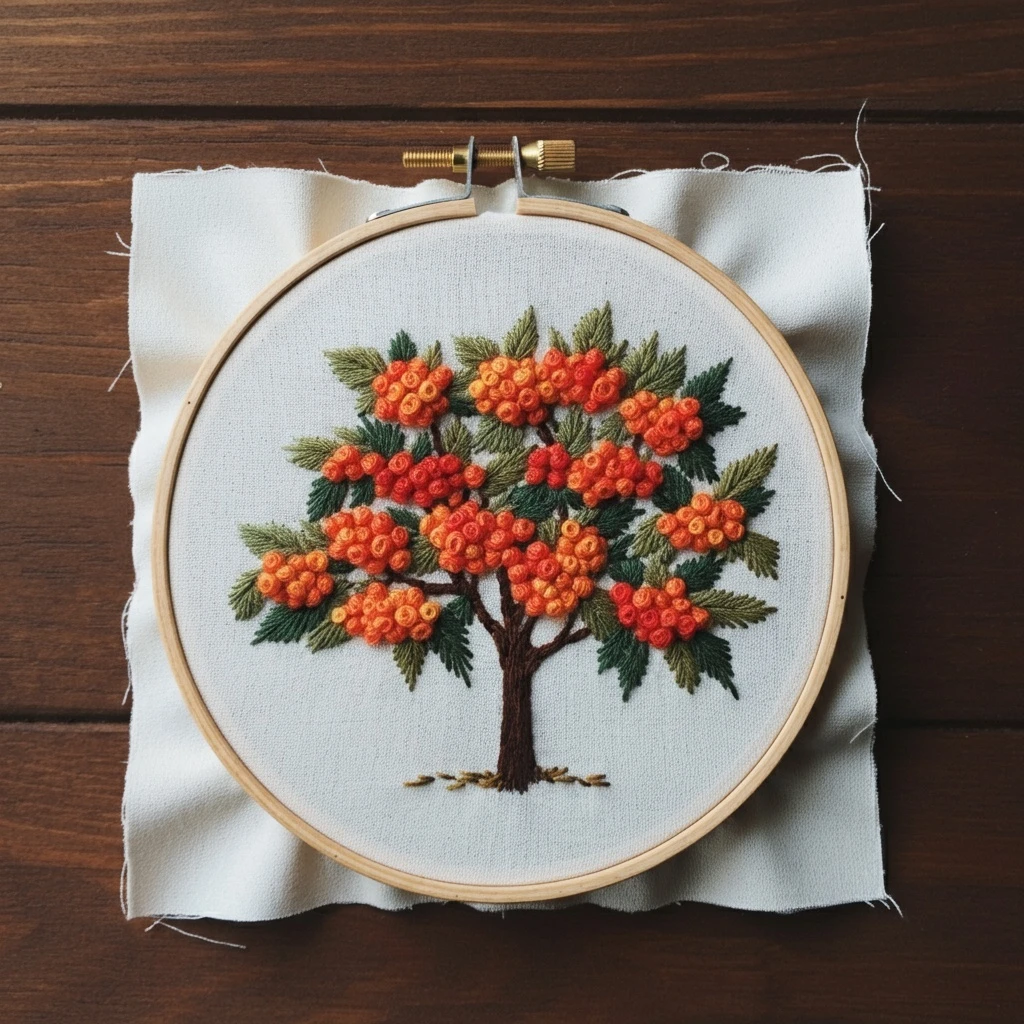
This design is best treated as a delicate botanical composition: slender brown stems, airy compound leaves, and small clusters of bright orange rowan berries. The contrast should come from warm berries against quiet olive greens, with the branch kept fine and graceful rather than heavy.
Keep the embroidery light. Use dense stitching only in the berry clusters, then let the leaves and twigs breathe so the finished hoop feels natural and elegant.
Thread-count overview
Berries: 2–3 strands Leaves: 1–2 strands Stems: 1–2 strands Outlines: 1 strandFor a polished hand-embroidered look, vary strand count rather than changing stitch size everywhere. Use plumper threads for berries, finer threads for leaf veins, and a single strand for twig tips and final definition.
Suggested DMC color palette
Stitch plan by element
| Area | Recommended stitches | Practical notes |
|---|---|---|
| Orange berries | French knots, colonial knots, padded satin stitch | Use 2 strands for small berries and 3 strands for the front cluster. Mix DMC 740 and 742 on top-facing berries, then tuck DMC 900 into the shaded lower edge. |
| Leaflets | Fishbone stitch, straight stitch, lazy daisy | Stitch each leaflet from base to tip. Alternate DMC 469 and 3011, adding DMC 3012 to the outermost leaflets for light. |
| Branches | Stem stitch, split stitch, couching | Use 2 strands of DMC 433 for main stems. Add a single-strand DMC 938 line on the underside of thicker branches. |
| Fine twigs | Back stitch, whipped back stitch | Keep twig tips fine with one strand. Whip a few branch lines with DMC 921 for warmth near berry clusters. |
| Leaf veins | Straight stitch, tiny back stitch | Use one strand of DMC 3011 or 938 only where needed. Too many veins can make the design look busy. |
Blending & shading ideas
Berries
For rounded berries, stitch the lower third in DMC 900 or 921, the middle in DMC 740, and a tiny top highlight in DMC 742. If using French knots, place the darker knots toward the back of the cluster.
Leaves
Blend one strand DMC 469 with one strand DMC 3011 for realistic olive leaves. For fresher tips, blend DMC 469 with DMC 3012. Keep the lightest leaf color away from the berry centers so the eye stays on the fruit.
Bark
Use DMC 433 as the base branch line, then add broken one-strand marks in DMC 938. Short uneven bark marks look more natural than perfectly continuous outlines.
Outlining details
- Outline berry clusters selectively, not every berry. Use tiny DMC 900 or 938 stitches only where berries overlap.
- Keep leaf outlines very light. A single central vein is often enough for small rowan leaflets.
- Use a slightly darker line under the main branch to create lift and direction.
Texture suggestions
- Combine French knots with a few padded satin berries so the cluster has natural variation.
- Use split stitch for twig curves; it creates a smooth, woody line without bulk.
- Add occasional detached chain stitches for leaves that face outward from the branch.
Beginner-friendly tips
- Stitch stems first, then leaves, then berries last so the orange knots stay clean and raised.
- Mark berry centers lightly with a removable pen before stitching clusters.
- Do not pull knots too tight; rowan berries should sit slightly proud of the fabric.
Suggested working order
- Transfer the branch lines and main berry cluster shapes with a fine, removable marking tool.
- Stitch the main branch in 2 strands of DMC 433 using stem stitch, then add dark bark accents with 1 strand of DMC 938.
- Work the leaves from back to front using 1–2 strands, alternating muted and brighter greens.
- Add berries last with DMC 740 as the main tone, DMC 900 for shadow, and DMC 742 for tiny highlights.
- Finish with tiny berry dimples, leaf veins, and any final warm copper touches in DMC 921.
Hoop finish: press from the back on a towel, avoid crushing the French knots, and trim jump threads behind berry clusters so no shadows show through pale fabric.