
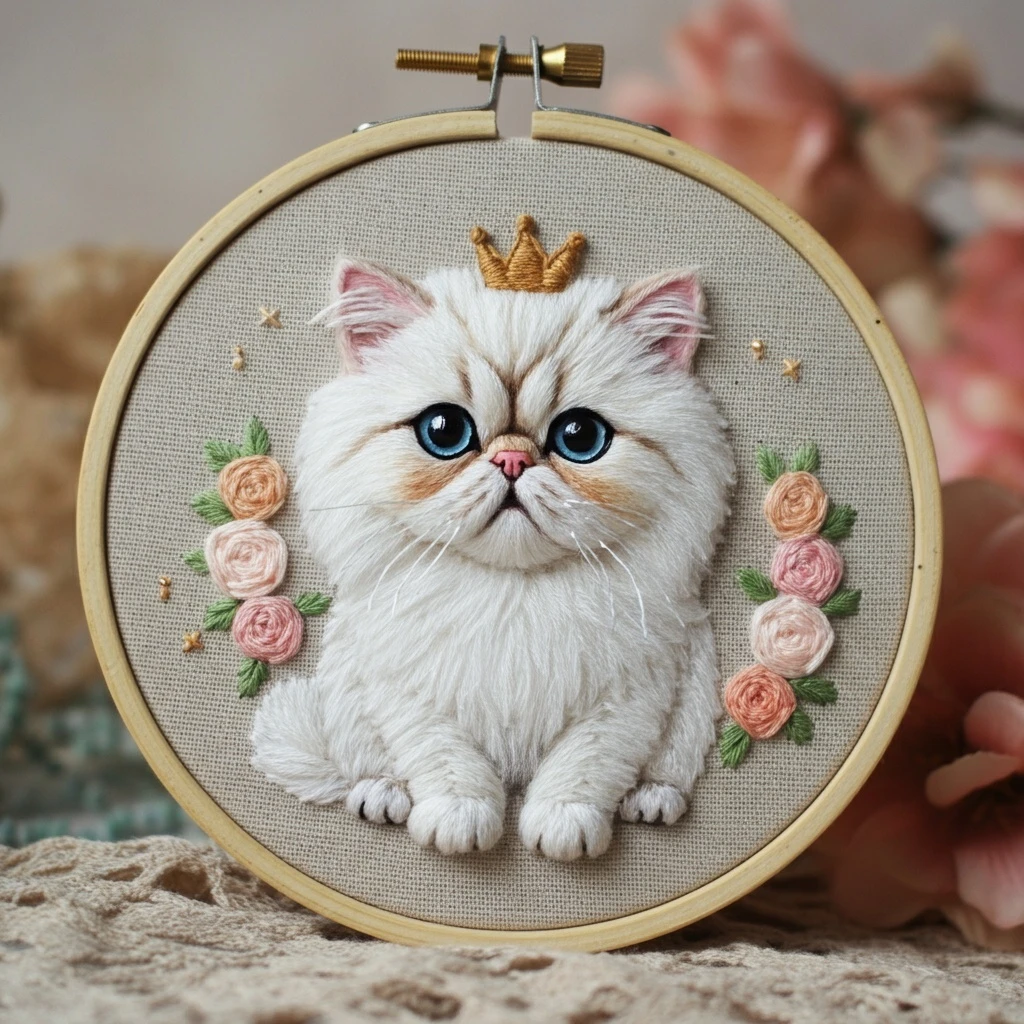
Royal White Kitten Variant
A soft, elegant palette for a white kitten portrait with regal decorative details: creamy fur, pale grey shadows, warm blush, jewel-like accents, and fine whisker linework. The goal is plush texture without making the white areas look flat.
Polished DMC Palette
Choose creamy whites and pale greys for the kitten, then add warm gold, soft rose, and a small amount of dark contrast for the royal features. The palette below is arranged by practical use rather than by hue.
Stitch Map & Thread Counts
| Area | Best stitches | Thread count | Practical note |
|---|---|---|---|
| White fur and chest fluff | Long-and-short stitch, split stitch, tiny straight stitches | 1 strand for texture; 2 strands for larger filled sections | Follow the direction of the fur: outward from the nose, downward on the chest, and curved around cheeks. |
| Muzzle, cheeks, and brow | Short split stitch, seed stitch, feather-soft straight stitches | 1 strand | Alternate Blanc, 746, and 762 so the face has shape without obvious stripes. |
| Inner ears and nose | Satin stitch, padded satin, small straight stitches | 1-2 strands | Use 152 lightly; add one tiny darker stitch with 221 only at the deepest fold or nose base. |
| Eyes and jewels | Satin stitch, tiny couching, French knots | 1 strand details, 2 strands for filled iris | Keep eye outlines crisp with 844; place one pale highlight stitch last for a glossy expression. |
| Crown, chain, bell, regal trim | Satin stitch, back stitch, couching, colonial knots | 2 strands for gold; 1 strand for edges | Use 728 on top-facing planes and 783 on lower edges to imitate metal shine. |
| Whiskers and facial outline | Whipped back stitch, single long straight stitches | 1 strand only | Use Blanc or 762 on colored fabric, 844 only for the root points. Do not pull whiskers too tight. |
Blending ideas
- Soft white fur: stitch one strand Blanc beside one strand 746, not twisted together, for a natural broken highlight.
- Cool shadows: blend 746 + 762 for under the chin; add single 415 strokes only in the deepest separations.
- Antique gold: work 783 first as the base, then lay shorter 728 strokes over the crown ridges.
- Rose accents: mix 152 + 221 in tiny flower petals or bows so the red-pink detail does not overpower the kitten.
Outlining details
- Use split stitch instead of thick back stitch around the kitten silhouette for a softer fur edge.
- Reserve dark brown for features, not the full outline; a white kitten looks more realistic with broken pale contours.
- For crown points and jewelry, outline with 783, then add small 728 highlight dashes along the upper-left edges.
- Whiskers look best as single confident stitches. Mark them lightly first and stitch from face outward.
Shading & Texture Strategy
Start by placing the face landmarks: eyes, nose, mouth, and crown center. Then stitch the fur from the inside outward so later stitches can overlap naturally. For a royal white kitten, the most important shading is not dark color; it is the careful placement of warm off-white, pearl grey, and clean white highlights.
Beginner-Friendly Working Order
- Transfer only the main contours, facial features, crown edges, and major fur direction lines. Too many guide lines can muddy white floss.
- Stitch the eyes first with 3768, 927, 844, and a final Blanc highlight so the character is established early.
- Work the pink nose and ears next, keeping the stitches smooth and small.
- Fill the white fur in layers: 746 base, 762 shadows, Blanc highlights, and a few 415 separation strokes.
- Add crown or chain details after the fur so metallic-looking stitches sit neatly on top.
- Finish with whiskers, tiny dark accents, and any loose seed stitches for fluff around the cheeks and chest.