
DMC palette & hand embroidery notes
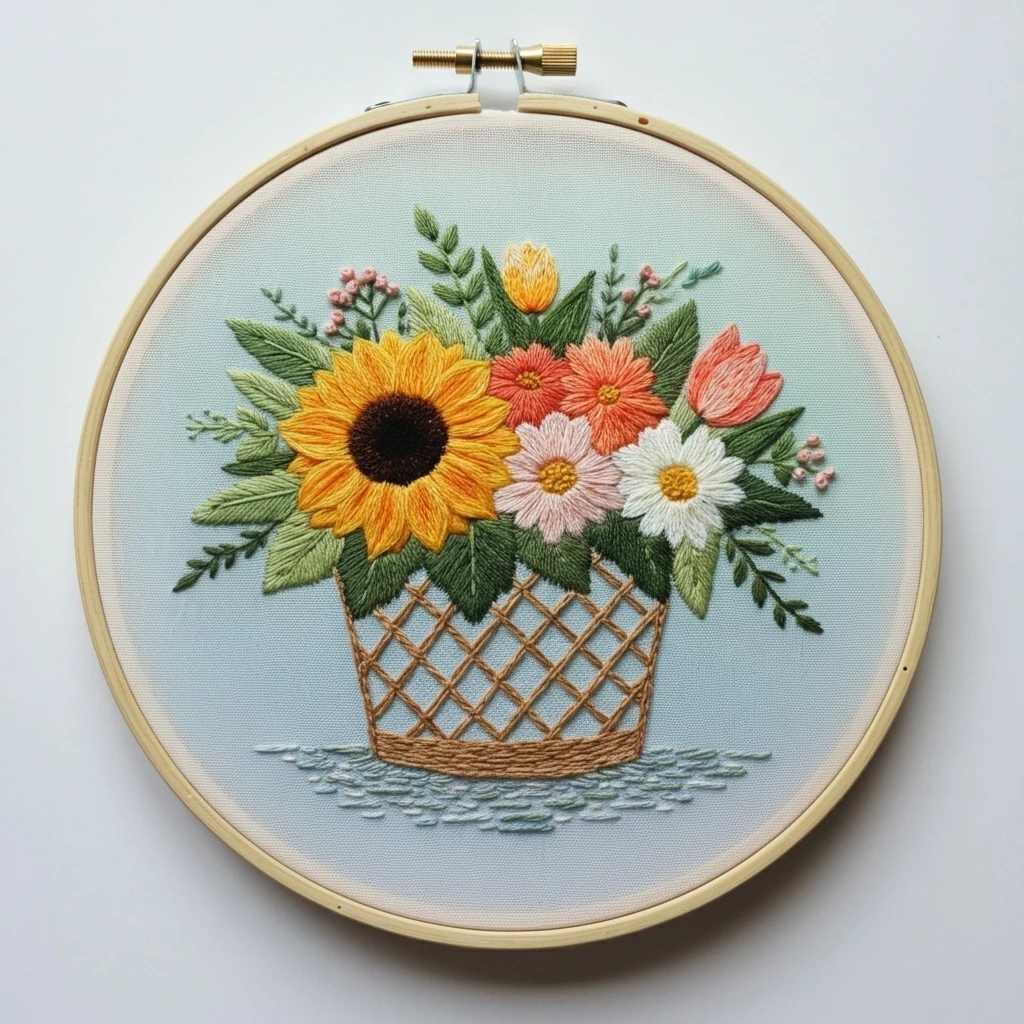
Rustic Summer Bouquet in a Woven Basket
A warm, cottage-garden hoop built around a sunflower focal point, coral and blush daisies, a rose-pink tulip, layered sage leaves, tiny berry sprigs, and a cross-laced basket. This guide translates the visible colors and textures into practical DMC choices and beginner-friendly stitch planning.
Color Story from the Reference
The design reads as a sunny summer arrangement: strong golden petals and a dark seed center anchor the left side, while coral-orange blossoms and pale blush/white daisies soften the middle. The tulip at right adds salmon pink, the foliage ranges from dusty sage to pine green, and the basket brings warm straw, tan, and caramel browns. Use the light blue fabric as a quiet background and keep the basket slightly textured so it supports the flowers without overpowering them.
Main sunflower and yellow tulip highlights; use 2 strands for bright petal centers.
Warm shaded yellow petals, especially near the sunflower center and folded tulip tips.
Deep sunflower shadow strokes and warm transitions into orange petals.
Sunflower seed center, tiny dark accents, and the deepest basket/leaf creases.
Coral daisy petals and the warm side of the tulip; blend with 352 for soft depth.
Petal highlights on orange-coral flowers, especially outer tips catching light.
Blush daisy petals, pink berry caps, and the pale side of the rose tulip.
Pale petal highlights and softening stitches over blush flowers.
White daisy petals; add sparse 762 or 819 for shadows rather than flat white fill.
Daisy centers, sunflower seed rim, and the warmest dotted flower centers.
Dusty sage leaves and light filler fronds; ideal for the rustic muted foliage.
Mid-tone leaf veins, shaded leaf bases, and stems behind the flowers.
Deep large leaves under the bouquet and shadow foliage around the basket lip.
Fine dark outlines, leaf undersides, and depth between crowded stems.
Basket diagonals and rim lines; use firm, even tension for the woven lattice.
Basket highlights, lifted strands, and warm tan texture on the lower band.
Stitch Map by Design Element
| Area | Recommended Stitches | Practical Notes |
|---|---|---|
| Sunflower petals | Long and short stitch, satin stitch tips, split stitch outline | Work from the outer tip toward the dark center. Alternate DMC 972, 742, and 977 in narrow wedges so the petals look lively rather than striped. |
| Sunflower center | French knots, seed stitch, tiny straight stitches | Use 3371 as the core, then scatter 783 and 420 around the edge. Pack knots closer in the middle and loosen them at the rim. |
| Coral and blush daisies | Lazy daisy, fishbone, satin stitch, back stitch | Keep petal stitches radiating cleanly from the center. For bigger petals, split each petal into two or three long-and-short passes. |
| Pink tulip | Padded satin stitch, split stitch, long and short stitch | Outline first with split stitch, add 761/352 highlights on the petal edges, and deepen folds with 351. |
| Leaves and stems | Fishbone stitch, stem stitch, fly stitch, straight stitch | Use 3052 for light leaves, 3051 for veins, and 3345/895 for shadow leaves tucked beneath the bouquet. |
| Berry sprigs | French knots, colonial knots, stem stitch | Use 761 with a tiny 819 highlight knot. Stitch sprigs with 1 strand so they stay delicate. |
| Woven basket | Couching, back stitch, stem stitch, whipped back stitch | Lay the diagonal lattice first in 420, then cross the opposite direction. Add 422 on top-facing strands to create the woven-over effect. |
| Ground shadow | Seed stitch, running stitch, detached straight stitches | Use muted blue-gray, sage, or pale green scraps sparingly. Keep it airy so the basket remains the focal base. |
Thread Count & Blending Guidance
Suggested Strand Counts
- 2 strands: most flower petals, medium leaves, and basket diagonals.
- 1 strand: fine stems, leaf veins, berry sprigs, petal crease lines, and final outlines.
- 3 strands: basket rim/base, sunflower seed knots, and any areas that need raised rustic texture.
- 6 strands only for accents: optional large French knots or heavily textured basket couching.
Useful Blends
- Sunflower glow: 1 strand 972 + 1 strand 742 for natural golden mid-tones.
- Deep yellow shadow: 1 strand 742 + 1 strand 977 near the seed center.
- Coral petal shift: 1 strand 351 + 1 strand 352 for petals between orange and salmon.
- Rustic leaf blend: 1 strand 3052 + 1 strand 3051 for soft sage-green leaves.
- Basket variation: 1 strand 420 + 1 strand 422 for natural wicker color movement.
Shading, Outlining & Texture Tips
Petal Shading
Begin with the lightest petal color at the outer edge, then tuck darker stitches closer to the flower center or under overlapping petals. Vary stitch length so transitions look painterly instead of banded.
Clean Outlines
Use one strand of 895 for the darkest leaf separations and one strand of 3371 only where the design needs true depth. For softer outlines, use the same color family one shade darker than the fill.
Basket Texture
Stitch the basket lattice with consistent diagonals. To show one strand crossing over another, add a short highlight stitch in 422 at the overlap and a tiny 3371 shadow under it.
Keeping the Bouquet Balanced
Stitch the large sunflower first, then the basket, then the major daisies and tulip. Add leaves last so they can fill gaps naturally. This order prevents the background foliage from crowding the flower shapes and lets you adjust the density of greenery as the bouquet develops.
Beginner-Friendly Workflow
- Transfer lightly: keep flower outlines visible but not heavy; the pale blue fabric makes dark transfer marks harder to hide.
- Secure fabric firmly: the woven basket needs even tension, so tighten the hoop before starting the lattice.
- Work from back to front: stitch tucked leaves and stems first, then large flowers, then knots and surface details.
- Use shorter threads: 14–18 inches reduces fuzzing, especially with golden yellows and basket browns.
- Test knots on scrap: French knots for the sunflower center and berries look best when consistent in size.
- Step back often: the bouquet is detailed; viewing it from arm’s length helps you judge whether more shading or fewer accents are needed.
For a rustic finish, allow small color variations and slightly irregular foliage. The charm of this design comes from the contrast between structured basket weaving and loose, garden-style flowers.