
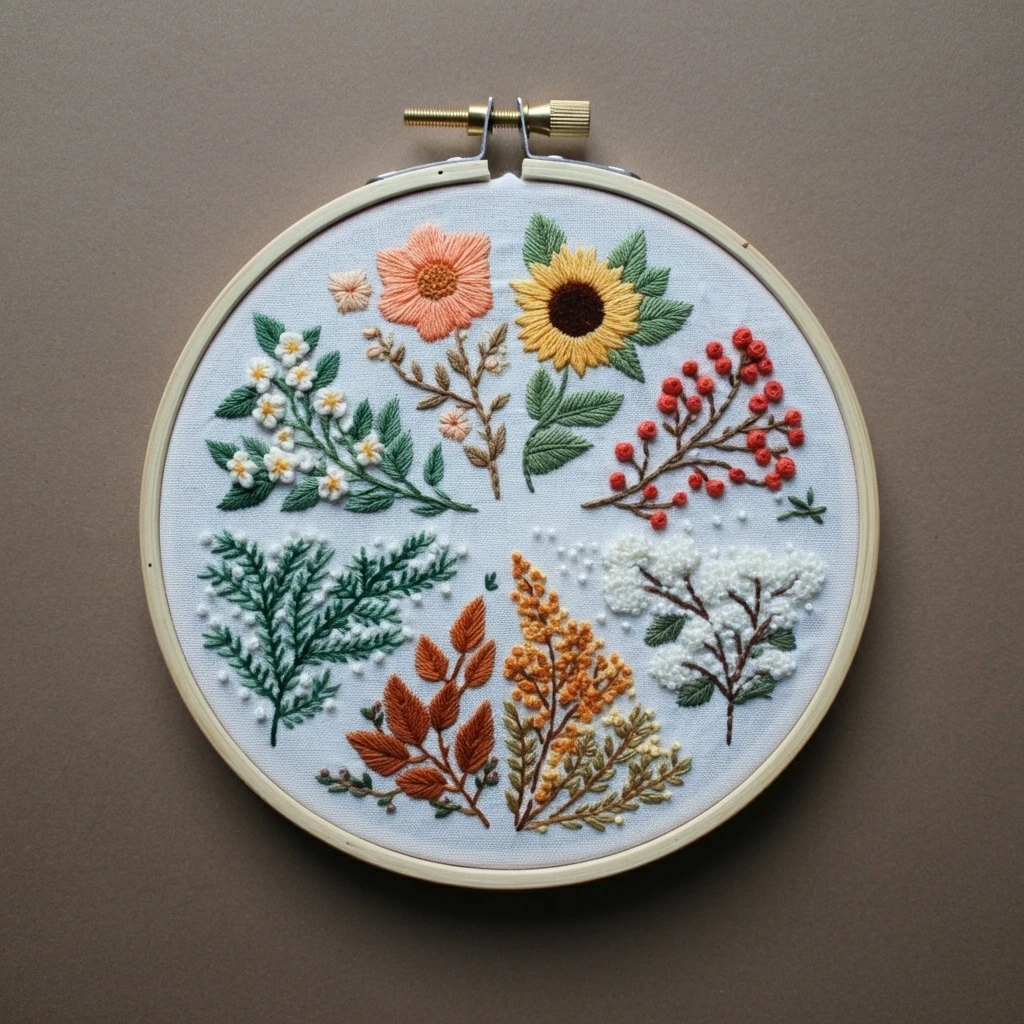
Seasonal Botanical Sampler
A balanced hoop of small botanical studies: spring blossoms, a coral daisy, sunflower, red berry branch, evergreen sprigs, rust leaves, golden seed plumes, and soft winter cotton-like clusters. The stitched look benefits from distinct seasonal color families, fine stem outlines, raised knot details, and varied leaf textures so each miniature plant reads clearly while the full hoop remains harmonious.
Image color read
The reference design sits on pale cool fabric inside a light wooden hoop. The strongest notes are deep evergreen foliage, sunflower yellow, coral-pink petals, bright red berries, warm rust autumn leaves, straw-gold seed heads, brown branching stems, and creamy white blossoms. Keep the palette slightly muted rather than neon; the design should feel like a naturalist sampler with cozy handmade texture.
Suggested DMC floss palette
Stitch suggestions by motif
| Design area | Best stitches | Practical notes |
|---|---|---|
| Fine stems and branching twigs | Stem stitch, split stitch, back stitch | Use 1 strand and taper branch ends by shortening stitches. Brown stems look more natural when alternated with a few tan stitches. |
| Green leaves and ferny sprigs | Fishbone stitch, lazy daisy, straight stitch | Start with the center vein, then angle each side stitch toward it. Mix dark and mid greens rather than filling each leaf in one flat color. |
| Sunflower and coral daisy | Long-and-short stitch, satin stitch, French knots | Work petals from outer edge toward the center. Use darker shades at petal bases and knots for textured centers. |
| Red berries and gold seed heads | French knots, colonial knots, tiny satin dots | Place knots after stems are finished so berries sit raised on top. Vary knot size for a more organic cluster. |
| White blossoms and winter cotton | Detached chain, satin stitch, clustered French knots | Add a gray or cream under-stitch to keep white petals visible on pale fabric. |
Blending, shading & outlining
Soft botanical shading
For flowers, blend one strand of the main color with one strand of the darker shade for the first row near the center, then switch to the main shade, and finish petal tips with the lightest thread. This creates a gentle painterly fade without complicated color changes.
Leaf depth
Use DMC 890 or 986 along one side of darker leaves, then DMC 469 through the middle and DMC 3013 sparingly near the tips. A single 1-strand back-stitched vein in deep green sharpens the shape.
Outlining strategy
Outline only the areas that need clarity: twig structures, petal overlaps, and leaf center veins. Avoid outlining every white blossom edge in dark thread; use pearl gray or a single soft green anchoring stitch instead.
Texture plan for a lively sampler
Beginner-friendly working order
- Transfer lightly: use a fine water-soluble pen and mark only the main stems, flower centers, and leaf direction lines. Too many detail marks can trap you into stiff stitching.
- Stitch stems first: complete brown and green stem lines before adding leaves or knots. This keeps the structure clean and prevents berries from snagging.
- Add leaves second: work from darker greens to lighter greens, placing center veins last if needed.
- Fill flowers and leaves: use satin or long-and-short stitch with 2 strands, keeping stitches aligned with the petal or leaf growth direction.
- Finish with knots: berries, seed heads, flower centers, snow dots, and cotton clusters should be last so they remain dimensional.
- Press carefully: press face down on a fluffy towel from the back only. Do not flatten raised knots with direct heat.