
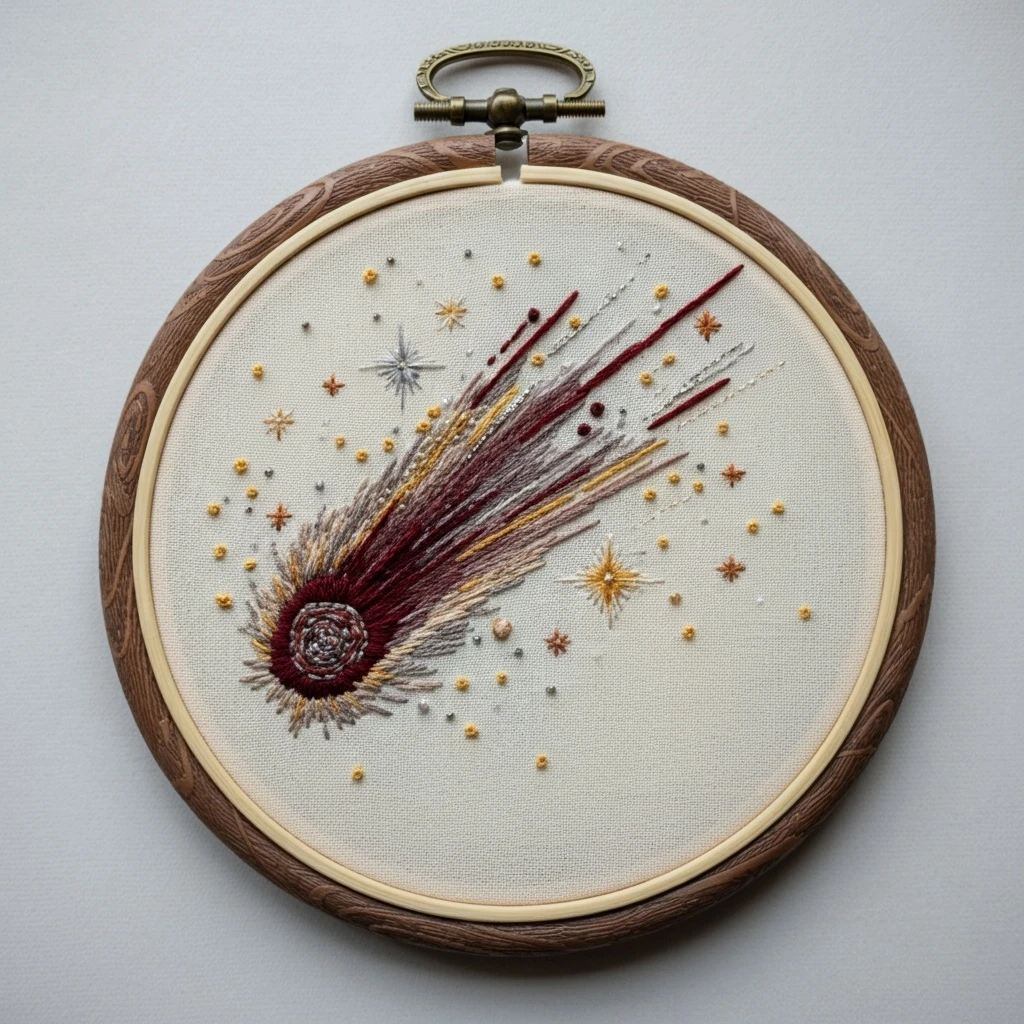
DMC palette & hand embroidery notes
Shooting Star Celestial
A polished stitching plan for a magical night-sky hoop: deep celestial blues, violet shadows, warm golden starlight, soft moonlit whites, and delicate sparkle details for a graceful shooting-star design.
Design read & color mood
Reference image used for design analysis: shooting star, celestial motifs, night-sky contrast, glowing trail, and fine decorative star details.
This pattern works best when the brightest stitches are saved for the very end. Build the sky and decorative curves first, then add gold star centers, white tips, and tiny knots so the piece feels luminous rather than flat.
Best overall approach
Keep the background airy: do not fill every inch. Let the fabric act as breathing space between the shooting star, constellation dots, and curved sky elements. Use darker blues to frame the composition and gold-white highlights to pull the eye along the star trail.
Quick stitch map
Thread-count guidance
- Use 1 strand for constellation lines, tiny star outlines, and the faintest sky details.
- Use 2 strands for most outlines, small satin areas, moon shapes, and smooth sky curves.
- Use 3 strands only for bold star centers or thicker decorative trail accents; too many strands can make small celestial motifs bulky.
- For blending, thread the needle with one strand each of two neighboring colors, such as 726 + 725, 312 + 158, or 746 + 762.
- On darker fabric, test 746 and 3865 first: 746 reads brighter and cleaner, while 3865 gives a softer moonlit effect.
Suggested DMC floss palette
Use this palette as a practical match for the celestial design. The goal is a deep night base, a violet-blue transition, and bright but controlled star highlights.
Deepest outer sky, tiny shadow gaps around stars, and grounding contrast for the shooting-star trail.
Use sparingly for the darkest night-sky outlines or the farthest edge of the hoop composition.
Main stitched sky areas, larger celestial curves, and background arcs where you want a rich blue without going black.
Midnight-to-twilight transitions, shaded portions of comet tails, and cool outlines around moon or cloud shapes.
Soft blue shadow for layered sky bands, small star halos, and waterlike shimmer if the design includes flowing celestial ribbons.
Muted violet-blue for transition strokes between navy and purple; excellent blended with 312 for smoky depth.
Mystic purple accents, lower-sky shadows, constellation details, and dramatic contrast behind bright gold stars.
Secondary purple glow, inner sky swirls, and small decorative curls near the shooting star.
Pale lavender highlight for misty glow, soft star haze, and the faint edge of the comet trail.
Brightest golden star points, sparkles, and the luminous center of the shooting star.
Warm gold body of the star, medium trail strokes, and bold decorative dots.
Deeper golden shadow at the base of stars and the lower side of the comet trail.
Muted antique gold for rustic celestial accents, small moons, or warm shadows that should not look too orange.
Moonlit highlights, crisp star tips, and final catchlights that make the design sparkle.
Soft silver edge highlights on moons, cloud wisps, and pale star halos.
Cool gray shadow for moon craters, metallic-looking star outlines, and subtle depth in white areas.
Tiny blush-warm accents in the star trail when you want a sunset-kissed celestial glow.
Alternative to 746 for softer highlights on natural fabric; good for glow that should look gentle, not stark.
Blending, shading & outlining
Shooting-star glow
Blend from DMC 746 or 726 at the brightest point into 725, then 783 or 3852 along the underside of the trail. Use staggered long-and-short stitches rather than straight bands so the glow looks soft.
Night-sky depth
For curved celestial bands, alternate 336, 312, and 158. Keep the darkest 823/939 mostly at outer edges, between motifs, or underneath bright gold details for contrast.
Clean outlines
Use a single strand of 823 or 312 for tiny outlines. For decorative arcs, work split stitch first; if a smoother raised line is desired, whip it with a lighter blue or lavender.
Texture suggestions
Optional sparkle
A single strand of metallic gold or silver can replace a few stitches in the star trail, but use it sparingly. Metallic thread is most effective when it appears as a highlight, not a full replacement for cotton floss.
Beginner-friendly practical tips
- Start with the largest arcs and trail lines. They establish the movement of the design and make small stars easier to place evenly.
- Work dark to light in the sky, then light to bright in the star. This prevents pale threads from picking up dark lint and keeps the final highlights crisp.
- Use short stitch lengths on curves. Smaller backstitches turn corners more smoothly and look more polished on celestial swirls.
- Mark star centers lightly. A tiny dot helps keep straight stitches even, especially on five-point sparkle shapes.
- Do not over-pack French knots. Leave space between knots so each star reads clearly against the fabric.
- Press from the back when finished. Place the embroidery face-down on a towel so raised knots and satin stitches keep their dimension.