
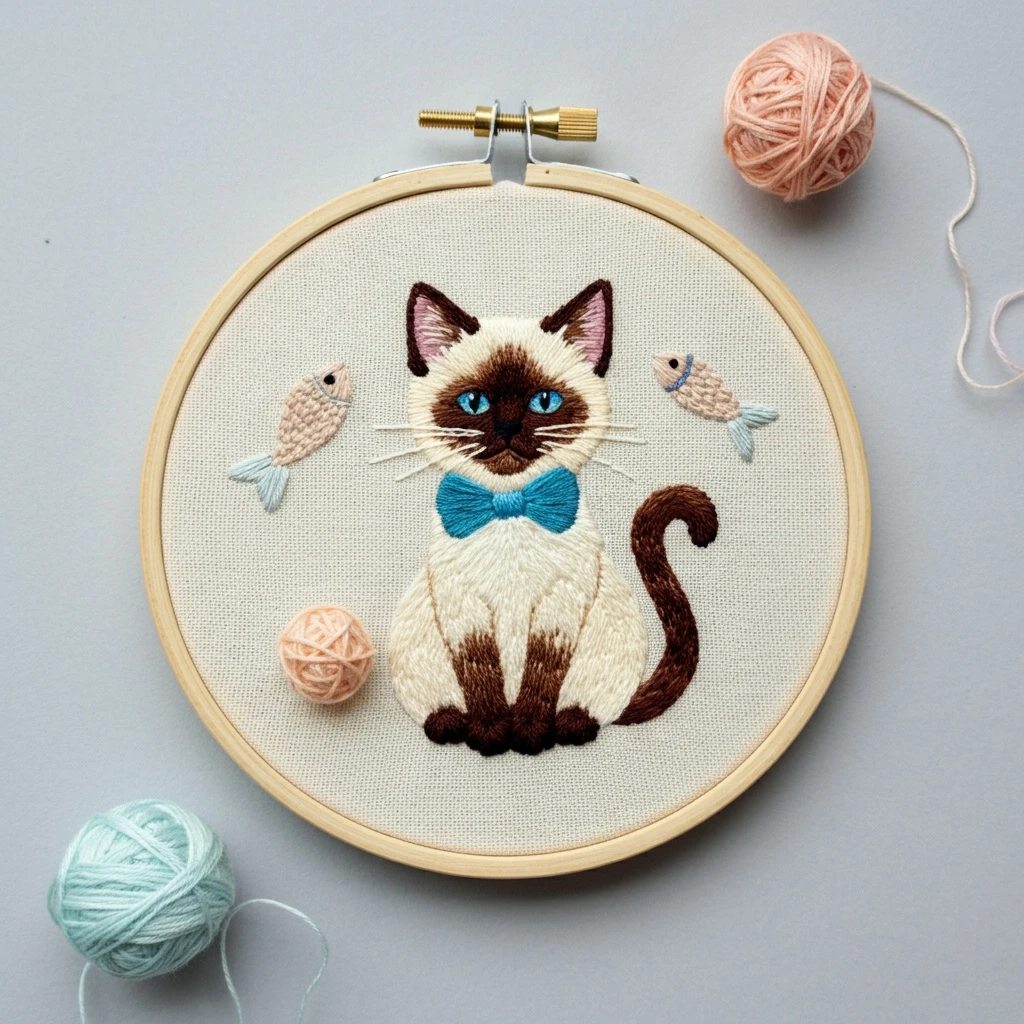
Siamese Cat
A polished stitch-planning guide for a Siamese cat embroidery design: creamy body fur, seal-brown points, bright blue eyes, soft facial modeling, delicate whiskers, and tidy contour work for a calm portrait finish.
Design color read
This Siamese cat motif calls for a controlled neutral palette rather than many loud colors. The strongest contrast belongs on the ears, muzzle mask, paws, and tail, while the chest and body should stay soft ivory, biscuit, and pale taupe. A clear blue eye accent keeps the portrait lively; fine dark outlining defines the nose, eyelids, paws, and whisker roots without making the cat look heavy.
Suggested stitching order
- Work light body areas first so darker point colors do not transfer onto pale stitches.
- Add seal-brown ears, muzzle, paws, and tail using directional stitches that follow fur growth.
- Finish with eyes, nose, whiskers, and the crispest outline details last.
Core DMC palette
Stitch map and practical use notes
| Area | Best stitches | Thread count | How to use the colors |
|---|---|---|---|
| Body fur | Long and short stitch, split stitch rows, light satin for small patches | 1 strand for fur shading; 2 strands for larger filled body zones | Begin with DMC 712, feather in 739 and 3864 following the curve of the chest and cheeks. Keep stitches irregular in length so the coat looks soft, not striped. |
| Face mask and ears | Long and short stitch, fishbone-style directional fills, split-stitch edge | 1 strand for gradients; 2 strands for dense ear tips | Blend 3863 into 898, then reserve 3371 for the deepest corners. Keep the center of the muzzle slightly lighter so the expression stays gentle. |
| Blue eyes | Satin stitch, tiny split-stitch outline, French knot or straight stitch highlight | 1 strand only for control | Use 3841 toward the inner glow and 3843 at the rim. Add a pinprick of B5200 last for a wet, glassy highlight. |
| Nose and mouth | Tiny satin stitch, backstitch, seed stitch | 1 strand | Use 758 for a soft nose base, touch 3371 along the nostril and center line. Avoid thick black lines; miniature details look more natural. |
| Whiskers | Single long straight stitches, couching if needed | 1 strand, or one separated filament for very fine work | Use B5200 on darker areas and 3864/712 on pale areas. Pull each whisker in one confident stroke and do not over-tighten the fabric. |
| Contour outline | Backstitch, stem stitch, split backstitch | 1 strand for face; 2 strands only on outer silhouette | Use 898 for soft outlines and 3371 only where the pattern needs deep definition, such as pupils, paw separations, and ear tips. |
Blending recipes
Cream body transition
Seal point depth
Eye sparkle
Texture and shading guidance
For a realistic Siamese coat, stitch direction matters more than heavy coverage. On the forehead, angle stitches outward from the center. On cheeks, curve stitches down and away from the eyes. On the body, follow the long sweep from shoulder to chest.
When shading the face mask, do not create a hard circle around the muzzle. Instead, let 3863 and 898 overlap with staggered long-and-short stitches. This gives the seal points the soft smoky edge that Siamese cats are known for.
Beginner-friendly embroidery tips
Complete cream and tan areas before using 898 or 3371. Dark fibers can cling to light sections if handled too early.
The expression depends on tiny details. Switch to 1 strand and make small, controlled stitches around eyelids, pupils, and nose.
Add whiskers after all filling and outlining is complete. Use a sharp needle and one smooth pull for each line.
Thread blending works best when your stitches follow the cat’s fur growth. Random directions can make the coat look patchy.
Use coffee brown instead of black for most contour lines. Save black-brown for the smallest, deepest accents.
After stitching, place the embroidery face-down on a towel and press gently from the wrong side to preserve fur texture.
Optional finishing touches
Add a few single-strand seed stitches in 739 and 3864 across the body for subtle coat variation. If the pattern includes a decorative frame or background sprigs, keep them muted so the cat remains the focal point. A very light wash of cream and tan thread around the silhouette can help the portrait feel warm without distracting from the blue eyes.