
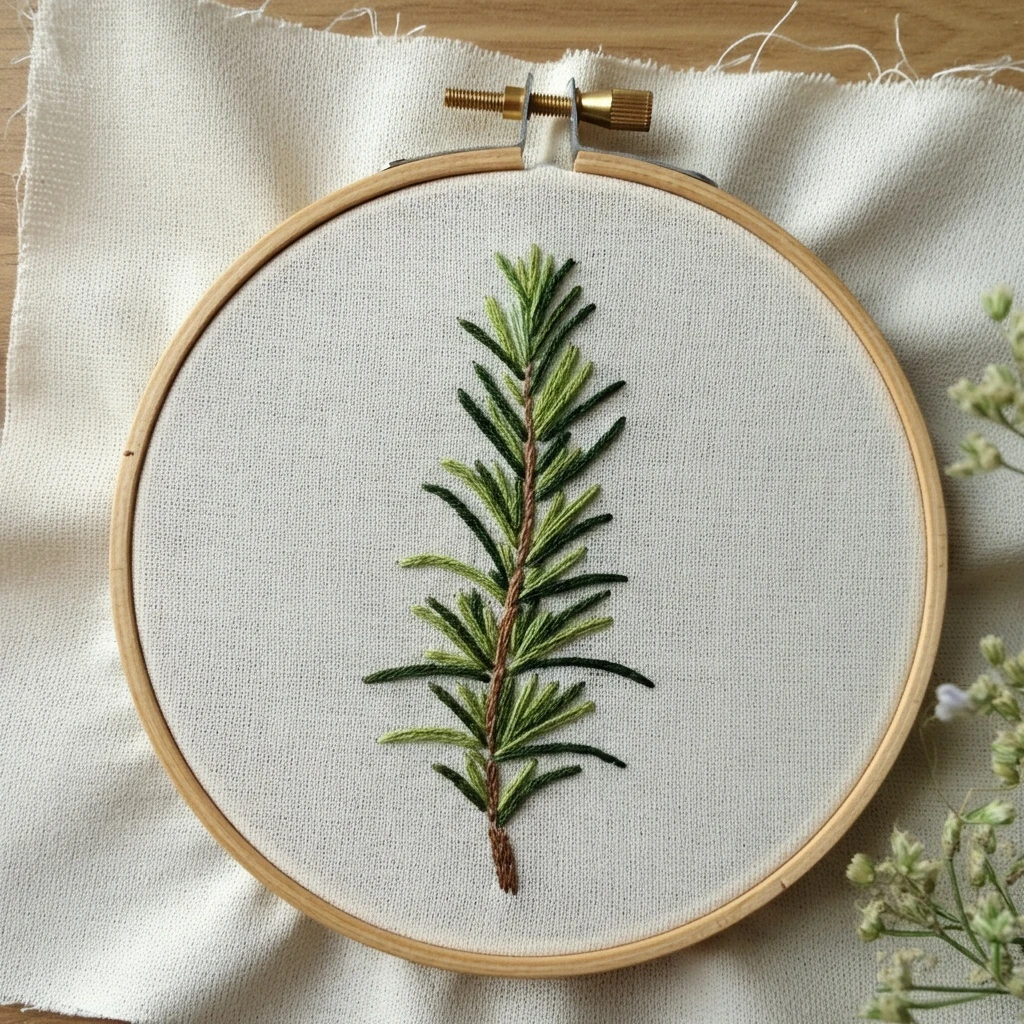
Simple Rosemary Sprig
A clean herb-study embroidery with one upright woody stem and angled rosemary needles in layered greens. The design is minimal, botanical, and very beginner friendly: the beauty comes from controlled line direction, subtle green variation, and a slightly raised bark-like center stem.
Color read & DMC floss palette
The reference is built from a narrow, natural palette. Keep the fabric quiet and let the rosemary needles vary from dark outer strokes to lighter inner highlights. Use browns only for the central woody stem so the sprig remains fresh rather than heavy.
Stitch placement map
| Area | Recommended stitches | Thread count |
|---|---|---|
| Central woody stem | Stem stitch for a twisted herbal stem; split stitch if you want a flatter line. Add one or two short dark brown stitches at the lower base. | 2 strands for the main stem; 1 strand dark brown for fine bark shadows. |
| Long rosemary needles | Straight stitch worked from stem outward. Let some stitches overlap the stem slightly so the leaves feel attached. | 2 strands for most needles; 3 strands only on the darkest lower needles if you want more weight. |
| Fine upper growth | Short straight stitches with 1 strand, alternating DMC 3347, 3012, and 3013. | 1 strand for delicate new growth and tapered tips. |
| Needle shadows | Single dark stitches beneath or beside mid-green stitches; avoid outlining every leaf. | 1–2 strands depending on desired contrast. |
Shading & blending plan
Rosemary reads best when the dark values anchor the silhouette and the light values sit as occasional glints. Do not blend every needle; instead, make each leaf a single confident stroke and let the color changes create dimension.
- Dark foundation: place DMC 934 and 895 first on the outermost lower leaves and tucked shadow areas.
- Main body: fill the majority of needles with DMC 3345, varying the angle slightly as you move upward.
- Olive lift: add DMC 3347 and 3012 along the left-facing and central needles to brighten the sprig.
- Highlight restraint: reserve DMC 3013 for the newest tips and a few short strokes near the top.
- Stem blend: alternate DMC 898 and 434 in the stem stitch path; keep the dark brown mostly on one side for a rounded effect.
Beginner-friendly working order
Outlining details
This design should not have a heavy cartoon outline. Use outline-like stitches only where they naturally belong: the brown stem, a few deep green outer needles, and the darker underside of the lower sprig. For crispness, place dark stitches just beside mid-green stitches rather than directly on top of them.
For a softer modern look, skip backstitch outlines entirely and rely on directional straight stitches. For a slightly bolder pattern sample look, add a single 1-strand dark green stitch to the longest leaf tips.
Practical tips for a polished finish
- Use shorter strands of floss, about 14–16 inches, to keep greens smooth and prevent fuzzing.
- Separate all strands first, then recombine them before stitching for cleaner, flatter lines.
- Stagger the leaf lengths: rosemary needles should look irregular but balanced.
- Leave small gaps of linen between some leaves so the sprig stays airy.
- Press from the back on a towel after stitching to protect raised stem texture.