
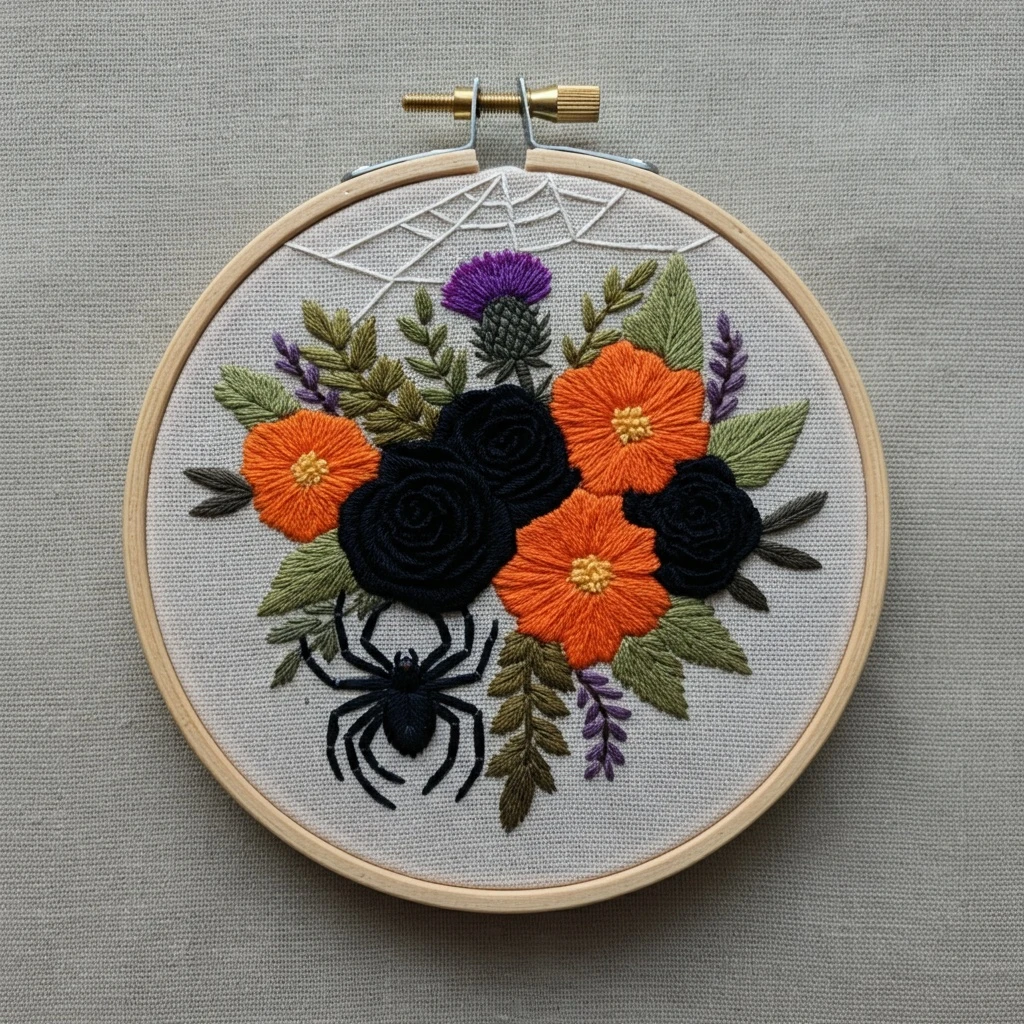
Spooky Blooms Halloween Spider Black Rose Bouquet
A polished embroidery color and stitching guide for a Halloween bouquet built from velvety black roses, warm orange blooms, olive-sage leaves, violet accents, a delicate white web, and a bold black spider.
Color story observed from the design
This hoop has a strong Halloween contrast: the composition alternates bright burnt-orange blossoms with almost-black roses, then softens the drama using dusty sage leaves and muted olive sprigs. Purple appears in two places: a vivid thistle-like bloom at the top and slim lavender sprigs tucked between leaves. A fine white spider web creates negative space near the top, while the large spider below gives the bouquet its unmistakably spooky finish.
The design works best when the darkest values are reserved for the rose centers, spider body, and a few leaf shadows. The orange flowers should remain the brightest focal point, while the greens stay natural and slightly grayed so they do not compete. The web should look airy and light, not heavy.
Recommended supplies
- 6-inch or 7-inch hoop to leave breathing room around the bouquet.
- Medium-weight linen or cotton-linen in oatmeal, flax, or mist gray.
- No. 7 embroidery needle for 2–3 strands and No. 9 for 1-strand detail.
- Water-soluble pen for the web lines and spider legs.
- Optional laying tool for smoother satin stitches on rose petals and orange flowers.
Polished DMC floss palette
These shades are selected to match the visible colors and value shifts in the sample. You can swap nearby DMC numbers if needed, but preserve the overall relationship: soft linen background, deep black focal flowers, warm orange petals, muted olive foliage, violet accents, and crisp pale web highlights.
Stitch plan by design area
| Area | Best stitches | Thread count |
|---|---|---|
| Black roses | Split stitch or short satin stitch in curved sections; add a few stem-stitch lines in charcoal for petal spirals. | 2 strands, 1 strand for inner detail |
| Orange flowers | Long-and-short stitch or radial satin stitch worked from flower center outward. | 2 strands |
| Flower centers | French knots, colonial knots, or tiny seed stitches for texture. | 2–3 strands |
| Sage and olive leaves | Fishbone stitch or satin stitch for broad leaves; stem stitch and detached chain for narrow sprigs. | 2 strands |
| Purple accents | Straight stitch clusters, detached chain, and short satin stitch for the thistle head. | 1–2 strands |
| Spider web | Fine back stitch or split stitch with very even tension. | 1 strand |
| Spider | Satin stitch for body, back stitch for legs, and a few overlapping stitches to thicken joints. | 2 strands; 1 strand for leg tips |
Thread-count guidance
- 1 strand: web lines, rose spiral accents, edge highlights on petals, tiny leaf veins, and final crisp details.
- 2 strands: most of the bouquet fills, including petals, leaves, spider body, and lavender accents.
- 3 strands: flower centers or a slightly chunkier spider body if the pattern is enlarged.
- 6 strands: generally avoid for this design, since the bouquet relies on neat layering and narrow shapes.
Blending & shading ideas
Black roses
Blend DMC 310 with 3799 so the petal turns remain visible. Use 310 only in the deepest spiral centers and lower tucked petals, then soften outward with 3799. For a warmer shadow, introduce a little 3371 beneath overlapping petals.
Orange blooms
Use DMC 920 as the main petal color, add 921 toward the outer edges or upper petals, and drop a few 922 stitches at the brightest tips if you want a smoother tonal lift. Keep the base near the center slightly darker so the flowers read as rounded.
Leaves & greenery
Start broad sage leaves in 3052, shade one side with 935, and finish the brightest ridge with a few 3053 stitches. Use 934 only in the smaller, darker sprigs or where the bouquet layers overlap.
Outlining details
- Outline the spider in DMC 310 with neat back stitch after the body is filled. This keeps the legs clean and graphic.
- For the black roses, avoid a full heavy outline everywhere. Instead, use selective inner lines in 3799 to separate petals.
- The orange flowers usually need little outlining; define them with stitch direction and a slightly darker base instead of thick borders.
- Keep the web delicate. One-strand back stitch or split stitch is enough; any thicker and it will overpower the bouquet.
- If your fabric is very warm-toned, use B5200 for the main web and Blanc only for final touch-up highlights.
Shading guidance
- Darkest accents: rose centers, spider body, and a few underside leaves.
- Brightest focal points: orange flower petals and pale web lines.
- Midtone bridge: use sage greens and medium violets to connect bright and dark motifs.
- Negative space: leave fabric showing between web strands and around bouquet edges for clarity.
Texture suggestions
- Black roses: compact curved stitches for a plush, velvet look.
- Orange petals: radiating stitches from center outward to suggest open blooms.
- Sage leaves: fishbone stitch for a natural center vein.
- Lavender sprigs: detached chain or straight stitch buds.
- Spider: satin body with narrow, slightly tapered legs.
Order of stitching
Beginner-friendly practical embroidery tips
- Work from back to front: stitch the farthest leaves and small accents first, then add the flowers, and finish with the web and spider on top.
- Use short stitch lengths on curves: this is especially important for rose spirals and spider legs, which look cleaner when the stitches are smaller.
- Do not over-outline black petals: stitch direction and subtle gray highlights do more for shape than a thick border.
- Keep the web taut but not tight: if you pull too firmly, the linen can pucker and distort the geometric lines.
- Anchor dark thread carefully: avoid carrying black floss behind the pale web area. Start and stop nearby instead.
- Build color gradually: if you are unsure about blending, begin with just two shades per motif. You can always add highlight stitches later.
Finishing notes
- Press from the back over a thick towel to protect raised flower centers and satin areas.
- Trim loose dark thread tails carefully so they do not show through the light fabric.
- Block the finished piece gently if the web caused any distortion.
- For display, a natural wood hoop suits the rustic Halloween bouquet nicely.
Quick visual summary
This design succeeds because it balances drama and softness. The black roses and spider deliver the spooky focal point, the orange flowers bring warmth and visibility, the sage and olive foliage soften the composition, and the white web adds delicate contrast. Keep the darkest darks concentrated, let the orange blooms glow, and preserve a light hand in the web for the most polished finish.