
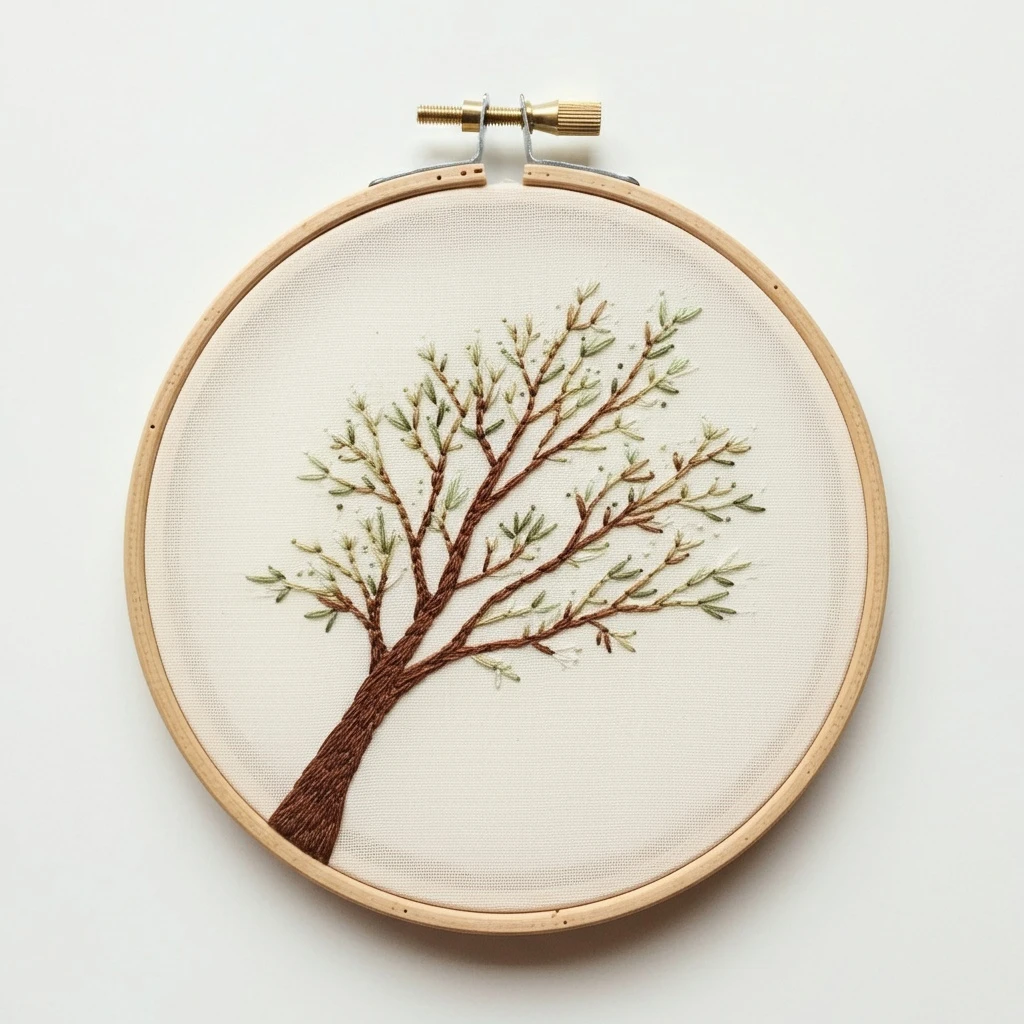
Spring Branch Tree
A quiet, airy spring tree worked in warm bark browns, olive-sage new growth, and soft linen neutrals. The design relies on graceful branch direction, slim leaf strokes, and subtle value shifts rather than heavy color contrast.
Likely DMC Color Palette
Colors are estimated from the visible hoop preview and matched to practical DMC cotton floss shades. Use these as close embroidery equivalents for the slanted brown trunk, twiggy branch network, fresh sage leaves, tiny buds, linen ground, and pale hoop tones.
Stitching Suggestions
The sample reads best when the trunk has layered bark texture and the outer branches stay light, open, and directional. Avoid overfilling the foliage; the breathing room around the leaves is part of the spring feeling.
| Design Element | Recommended Stitch | Practical Notes |
|---|---|---|
| Slanted trunk | Long and short stitch, split stitch | Work upward in vertical-to-diagonal strokes following the tree lean. Mix 801 and 938 for depth; add 975 sparingly along the lighter side. |
| Main branches | Stem stitch or split stitch | Use two strands near the trunk, then taper to one strand as branches fork. Keep stitch direction flowing outward. |
| Fine twigs | Backstitch, straight stitch | Use one strand of 434 or 975 for the thinnest twig tips. Vary stitch length to avoid a rigid, mechanical look. |
| Spring leaves | Straight stitch, detached chain, tiny fishbone | Place leaves in pairs or small sprays angled away from the branch. Use 3052 as the main color and 3053 at the tips. |
| Tiny buds and seed dots | French knots or colonial knots | Use one wrap for small dots. Mix 3051 with 613 so the buds look natural rather than polka-dotted. |
| Bark ridges | Single-strand couching or irregular backstitch | After the trunk fill is complete, add darker narrow lines over the top to suggest ridges and shadowed bark grooves. |
| Soft airy gaps | Negative space | Leave open fabric between leaves and twigs. This is especially important in the upper crown where the design should feel breezy. |
Thread Count, Blending & Shading
Thread-count guidance
- Trunk fill: 2–3 strands, depending on hoop size. Use 3 strands only if the pattern is enlarged.
- Main branches: 2 strands near the trunk, tapering to 1 strand on the outer forks.
- Leaves and tiny twigs: 1 strand keeps the crown delicate and prevents bulky foliage.
- French knots: 1 strand with one wrap for tiny buds; 2 strands with one wrap for slightly larger olive dots.
Blending ideas
- Blend one strand 801 with one strand 938 for rich trunk shadows without turning black.
- Blend one strand 801 with one strand 975 on the sunlit middle limbs for a warm bark transition.
- Blend one strand 3052 with one strand 3053 for fresh spring leaf clusters that are soft rather than neon.
- Use 613 only as a restrained accent; too much pale beige can make the foliage look dusty.
Texture & Outlining Details
Bark texture
Use uneven long-and-short stitches rather than perfectly parallel satin. The trunk in the preview has a hand-drawn, fibrous quality, so small overlaps and slight changes in brown are welcome.
Branch taper
Every branch should become slimmer as it moves away from the trunk. When a limb forks, reduce to one strand before the fork so the division looks natural.
Leaf rhythm
Stitch leaves as short, quick marks rather than solid filled shapes. Alternate 3052 and 3053 to create a varied, feathery canopy.
Outlining
Outline only where needed: the trunk base, a few main limbs, and select shadow lines. Heavy outlining around every twig will flatten the tree.
Suggested Stitching Order
Beginner-Friendly Practical Tips
- Keep the fabric drum-tight in the hoop so long trunk stitches do not pucker.
- Use shorter stitches where the trunk curves; long stitches across curves can look flat.
- Thread only 14–18 inches of floss at a time to reduce fuzzing in the darker browns.
- Do not pull French knots too tightly; tiny raised buds make the tree feel lively.
- Rotate the hoop while stitching branches so your needle follows the natural direction of growth.
- Before adding more leaves, hold the hoop at arm’s length. The design should remain sparse, graceful, and spring-like.