
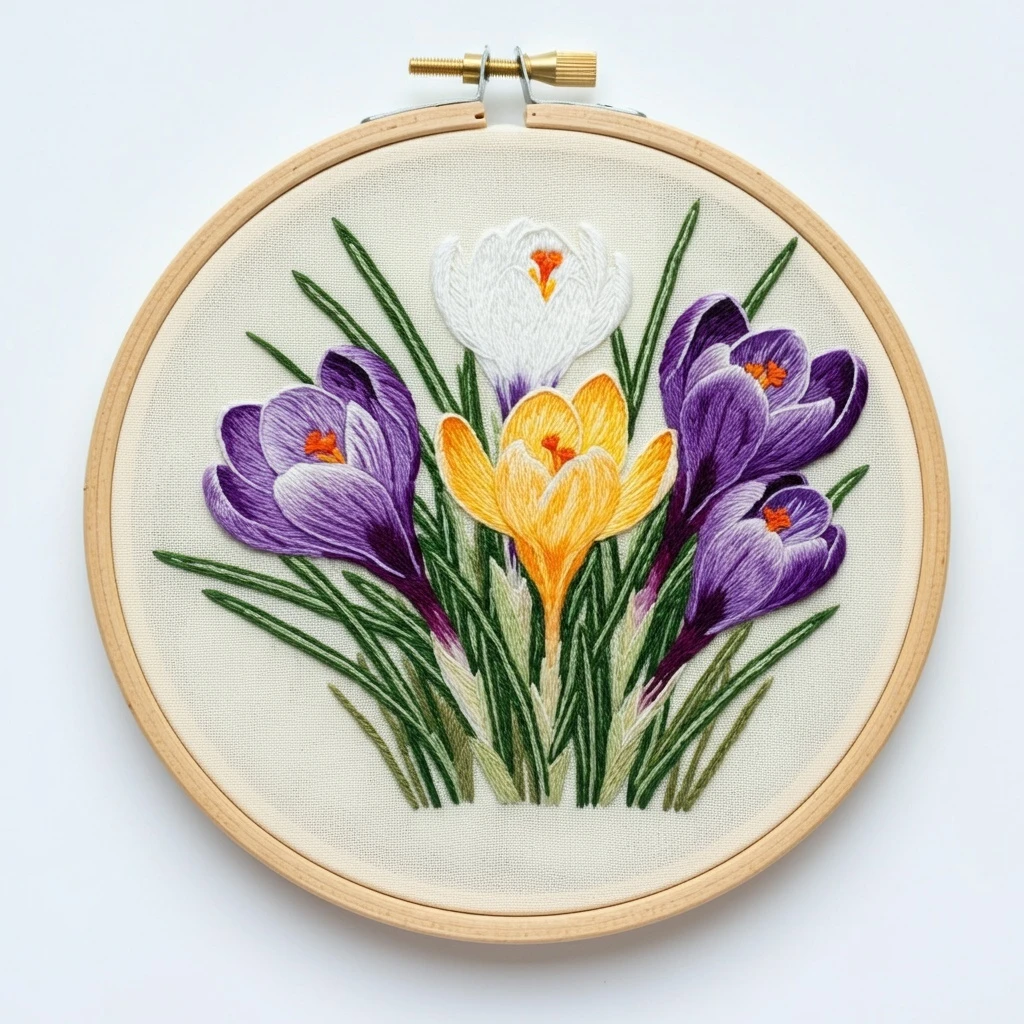
Spring Crocus Flower
A polished DMC color palette and stitching plan for a fresh crocus hoop with purple, white, and golden blossoms rising through narrow spring leaves. Colors are estimated from the visible embroidery preview and matched to practical close DMC embroidery floss shades.
Likely DMC Color Palette
Palette based on the visible hoop: deep violet crocuses, lavender highlights, a white top bloom, one golden yellow crocus, orange stamens, and layered spring grass.
Coverage percentages are visual estimates from the preview, not exact thread usage. Keep extra white, violet, and green on hand because those areas carry most of the design.
Stitching Suggestions
| Element | Stitch Type | Practical Notes |
|---|---|---|
| Purple crocus petals | Long and short stitch | Begin with DMC 550 at the base, feather into 552, then add 554 and 211 on raised ridges. Follow the natural curve of each petal rather than stitching straight up. |
| White top crocus | Long and short stitch with split-stitch edge | Use 3865 for the main petal fill and 822 for light gray-beige shadow lines. A one-strand split outline keeps white edges visible against the linen. |
| Yellow crocus | Satin stitch or long and short stitch | Work from petal base to tip with DMC 742 at the throat and 725 toward the outer petal. Use slightly curved stitches for a cupped shape. |
| Flower throats and stamens | Tiny satin stitches, straight stitches, or French knots | Use DMC 741 as a bright accent. Two or three short stitches are enough; oversized knots can overwhelm the flower center. |
| Long grass leaves | Stem stitch, straight stitch, and couching | Use 895 for dark central blades, 699 for most leaves, and 732 for muted lower blades. Vary length and angle so the grass feels lively. |
| Unopened buds | Fishbone stitch and straight stitch | Blend pale 822 or 3865 with muted green 732 along the sides. Add a fine purple line near the base where buds meet the darker stems. |
| Petal veins | One-strand straight stitch | Add veins after the fills are complete. Use lighter violet on dark petals and 822 on white petals; keep them sparse and directional. |
| Final outlines | Split stitch or backstitch | Outline only the necessary petal overlaps and key leaf edges. Too much outlining will flatten the soft spring feel. |
Blending, Shading & Texture
Petal dimension
Use directional long-and-short stitch to make each crocus cup feel folded. Place the darkest purples at the petal bases, under overlaps, and along the outer side petals. Let lighter lavender sit on the central ridges and upper curves.
Yellow glow
For the central yellow flower, blend DMC 742 into 725 with short staggered stitches. Add a few almost-white highlight strokes only near the petal tips if you want a brighter spring look.
Grass movement
Keep the leaves thin and varied. Mix straight stitches with stem stitch, and allow some blades to pass behind flowers while others overlap the bottom petals. This creates depth without needing heavy fill.
Optional blended needles
Try one strand DMC 552 plus one strand DMC 554 for mid-purple transitions, or one strand DMC 699 plus one strand DMC 732 for softer leaf blades. Blended needles are especially useful where the reference shows streaky natural shading.
Where to Start
Helpful Beginner Notes
- Use shorter stitches on small petals; long stitches can snag and make the crocus cups look bulky.
- Turn the hoop as you stitch so each petal’s stitches follow the petal curve naturally.
- Do not overfill the narrow leaves. A single confident line often looks cleaner than several crowded stitches.
- Keep orange centers small and bright; they are accents, not large filled areas.
- If your purple petals feel too dark, add a few one-strand DMC 554 highlight lines rather than removing stitches.
- Save outlining for the very end so you can decide which overlaps truly need definition.