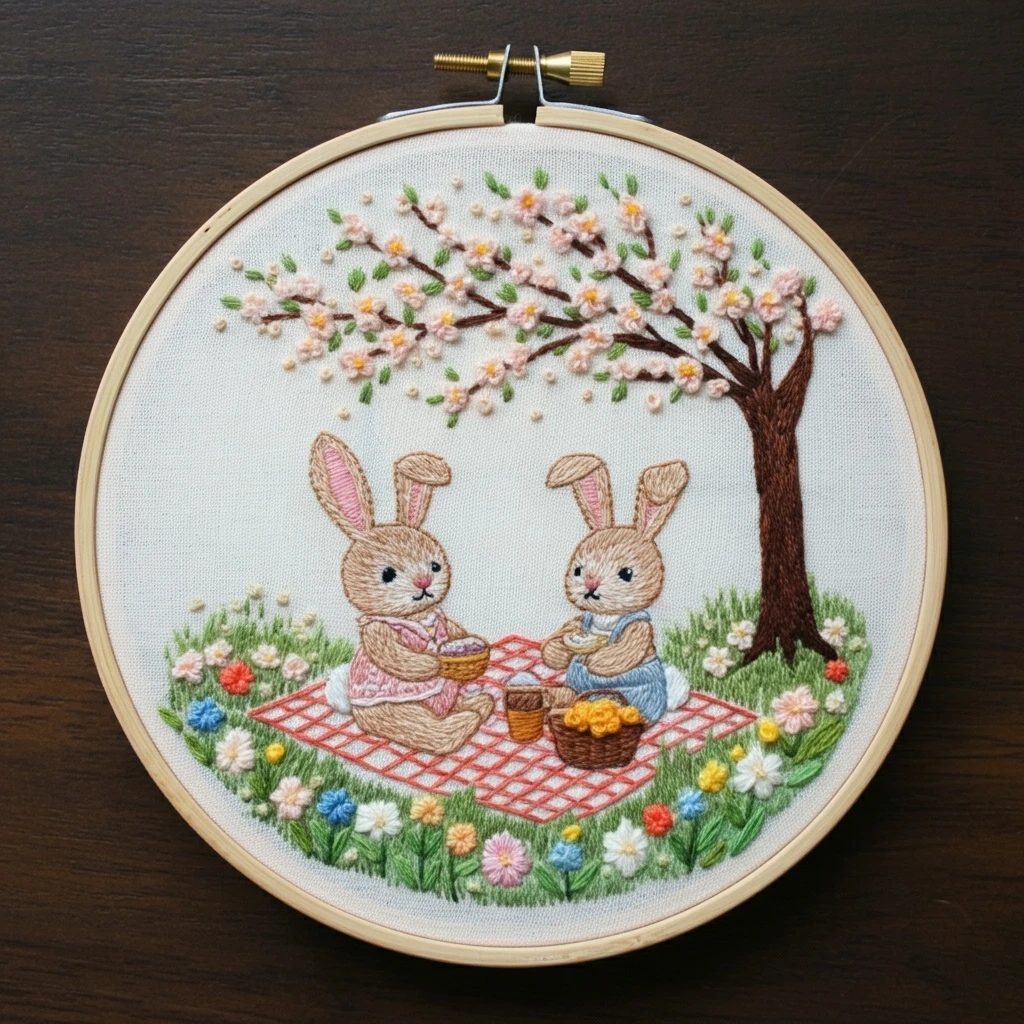


Spring Picnic Under the Cherry Tree
A cheerful storybook palette inspired by two picnic bunnies beneath a dark cherry tree, soft blush blossoms, bright meadow grasses, scattered daisies, a red gingham blanket, blue overalls, a pink dress, and golden picnic treats. These suggestions translate the scene into practical DMC floss choices, strand counts, stitch direction, blending ideas, and finishing details.
Color Story From the Reference
The design is lively but gentle: a warm beige linen ground holds soft tan bunnies, a rich chocolate-brown cherry trunk and branches, blush-pink blossom clusters, spring greens, pops of red and blue in the blanket and flowers, and small golden picnic accents. Keep the contrast highest in the tree and blanket grid; keep the bunnies, petals, and grass softer so the scene feels hand-stitched and nostalgic.
Suggested DMC Floss Palette
| Design area | DMC colors | Use & notes |
|---|---|---|
| Cherry trunk & deep branches | 3371 Black Brown 938 Ultra Dark Coffee Brown 898 Very Dark Coffee Brown 801 Dark Coffee Brown | Use these as the structural darks for the trunk, branch forks, and underside of large limbs. Keep the darkest color inside creases and at the right side of the trunk for dimension. |
| Bark highlights & branch texture | 975 Dark Golden Brown 400 Dark Mahogany 433 Medium Brown 435 Very Light Brown | Layer narrow stem and split stitches over the dark trunk. These warm browns create bark ridges without making the tree look flat. |
| Cherry blossoms | 963 Ultra Very Light Dusty Rose 818 Baby Pink 3716 Very Light Dusty Rose 761 Light Salmon 353 Peach | Use the palest pinks for most petals, then touch the lower petal folds with 761 or 353. Vary each flower slightly so the canopy looks organic. |
| Blossom centers & picnic treats | 742 Light Tangerine 743 Medium Yellow 726 Light Topaz 3821 Straw | French knots make bright blossom centers. Use the stronger yellows on pastries or fruit in the picnic basket and softer 3821 for small highlights. |
| Grass base & meadow | 3011 Dark Khaki Green 3012 Medium Khaki Green 3013 Light Khaki Green 3347 Medium Yellow Green 3348 Light Yellow Green | Build the ground with many short straight stitches. Use darker greens under the blanket and tree, lighter greens at the front edge and around flowers. |
| Leaves & spring shoots | 470 Light Avocado Green 471 Very Light Avocado Green 472 Ultra Light Avocado Green 905 Dark Parrot Green | Use small detached chain, fly stitch, or leaf stitch on the branches. Mix avocado greens with the khaki grass colors so the leaves stay fresh but not neon. |
| Bunny fur | 839 Dark Beige Brown 840 Medium Beige Brown 841 Light Beige Brown 842 Very Light Beige Brown 3864 Light Mocha Beige | Use long-and-short stitch following the curves of heads, ears, arms, and feet. Keep faces lighter and place darker browns along ear rims, lower paws, and body shadows. |
| Inner ears, cheeks & pink dress | 151 Very Light Dusty Rose 818 Baby Pink 605 Very Light Cranberry 3733 Dusty Rose | Use one strand for cheeks and ear shading; use two strands for the dress. Add small darker stitches at dress folds and bunny ear bases. |
| Blue overalls & blue flowers | 3755 Baby Blue 932 Light Antique Blue 931 Medium Antique Blue 3761 Light Sky Blue | Work clothing with smooth satin or split stitch, then add 1-strand darker seams. For blue flowers, use lazy daisy petals with a yellow knot center. |
| Red gingham blanket & red flowers | 351 Coral 350 Medium Coral 347 Very Dark Salmon 321 Red | Use coral-red for the blanket grid and flower pops. Keep the blanket lines slim so the lattice remains crisp and does not overpower the bunnies. |
| Daisies, tails & soft highlights | B5200 Snow White 3865 Winter White Ecru 822 Light Beige Gray | Use creamy whites for petals, bunny tails, and tiny fabric highlights. Reserve B5200 for daisy tips or eye catchlights only. |
| Basket, cup & picnic shadows | 433 Medium Brown 434 Light Brown 436 Tan 938 Ultra Dark Coffee Brown | Use woven straight stitches or couching for basket texture. Add dark brown under the basket rim and cup base to anchor the picnic objects. |
Stitch Types by Design Element
Cherry Tree & Branches
- Stem stitch: excellent for curved branches and the main branch lines reaching across the hoop.
- Split stitch: use for trunk outline and bark ridges, especially where the trunk flares at the base.
- Long-and-short stitch: fill the trunk vertically, changing direction around branch forks.
- Couching: optional for the thickest limbs; couch a dark strand with warm brown tack stitches for raised bark.
Cherry Blossoms & Leaves
- Detached chain: quick rounded petals for the blossom clusters.
- Satin stitch: use on larger foreground flowers so they look plush and dimensional.
- French knots: yellow centers and tiny floating buds between branches.
- Fly stitch or lazy daisy: small green leaves, angled outward from the branches.
Bunnies & Clothing
- Long-and-short stitch: main fur fill, following each curve of the head, body, arms, and feet.
- Split stitch: neat outlines around ears, paws, overalls, and dress edges.
- Satin stitch: inner ears, clothing panels, basket handles, and compact picnic items.
- Seed stitch: light fur flecks on cheeks and paws for a soft, fluffy finish.
Picnic Blanket, Grass & Flowers
- Backstitch: red gingham grid lines; stitch the diagonals after the main grass is complete.
- Straight stitch: individual grass blades, varied in length and angle.
- Woven straight stitches: basket side and picnic cup texture.
- Lazy daisy: meadow petals in white, blue, coral, pink, and yellow.
Thread Counts & Blending Ideas
1 strand Fine detail
Use for bunny eyes, mouths, whisker marks, clothing seams, small blanket intersections, flower stems, tiny branch tips, and single bark lines.
2 strands Main stitching
Use for most fur, leaves, flowers, clothing panels, basket texture, grass strokes, and blanket lines. Two strands give readable coverage without flattening the illustration.
3 strands Raised accents
Use selectively for blossom clusters, bunny tails, the basket rim, or front meadow flowers. Avoid using three strands on facial details or the blanket grid.
| Blend | Where to use it | Effect |
|---|---|---|
| 1 strand 938 + 1 strand 801 | Deep trunk grooves and branch forks | Rich bark depth without relying on flat black. |
| 1 strand 975 + 1 strand 433 | Bark highlights and outer limbs | Warm reddish-brown texture that catches the light. |
| 1 strand 963 + 1 strand 818 | Soft blossom petals | Very pale, romantic pink that suits the airy canopy. |
| 1 strand 3716 + 1 strand 761 | Lower petal shadows and fuller blossoms | Subtle peach-pink depth for clustered flowers. |
| 1 strand 840 + 1 strand 841 | Main bunny fur | Natural tan fur with gentle tonal variation. |
| 1 strand 841 + 1 strand 842 | Faces, paws, and ear highlights | Soft lightening around the expression and small limbs. |
| 1 strand 3011 + 1 strand 3347 | Mid-ground grass | Balanced meadow green with depth and freshness. |
| 1 strand 351 + 1 strand 350 | Picnic blanket red grid | Clear coral-red check lines with a stitched, not printed, look. |
Outlining, Shading & Direction
Outlining Details
- Outline the bunnies in 1 strand of 839 or 840, then add only the eyes and tiny mouths in 3371 or 310.
- Use 1-strand 938 or 3371 to define the darkest branch forks, but switch to 898 or 801 on outer branch edges.
- For the blanket, stitch the coral grid as clean backstitch lines over the pale blanket base; do not fill the entire blanket red.
- Outline clothing with a darker related shade: 931 for blue overalls and 3733 or 605 for the pink dress.
- Use broken, short outlines on flowers and grass rather than continuous heavy lines, keeping the garden edge soft.
Shading Guidance
- Shade the tree from dark interior grooves to warmer brown outer bark. Vertical stitches on the trunk and diagonal stitches on branches will make the tree feel naturally grown.
- Keep blossoms pale at the top of the canopy, then add slightly deeper pinks near branch contact points and flower centers.
- Lighten bunny faces and bellies with 841, 842, and 3864. Use darker browns under arms, feet, and ears so the bodies remain rounded.
- Place darker grass behind the blanket and tree base, then layer lighter green tips in front to frame the picnic scene.
- Use small white and yellow flowers at the foreground edge to balance the darker tree mass on the right.
Practical Embroidery Tips
Recommended Work Order
- Transfer the tree, bunnies, blanket grid, basket, and main flower placement with fine washable pen or a pale transfer pencil.
- Stitch the trunk and main branches first, since they establish the canopy structure and strong dark values.
- Add blossoms and leaves over branch tips, allowing a few petals to overlap the brown lines for a natural spring-tree look.
- Work the grass base next, leaving the blanket and bunny shapes clean so they sit neatly on top of the meadow.
- Fill the bunnies and clothing, saving eyes, noses, mouths, and cheek blush until the end.
- Backstitch the picnic blanket grid after surrounding stitches are complete, then finish with flowers, basket details, and final knots.
Fabric & Finish Notes
- A pale oatmeal linen, natural cotton-linen, or warm off-white fabric will echo the reference and keep the blossom colors delicate.
- Use a 6-inch hoop for a compact scene; choose a 7-inch hoop if you want more space for blossom clusters and bunny fur shading.
- Keep floss lengths short when working browns through dense bark areas to reduce fuzzing and preserve crisp branch texture.
- For raised blossoms, make French knots with two wraps and 2 strands; for tiny distant buds, use one wrap and 1 strand.
- Press from the back on a towel after stitching, avoiding pressure on knots, raised basket texture, and plush bunny tails.
- Test the red blanket color on a scrap first; if it feels too bold, use 351 and 350 rather than 321 for a softer gingham effect.