
Design #913 · Florals & Medallions
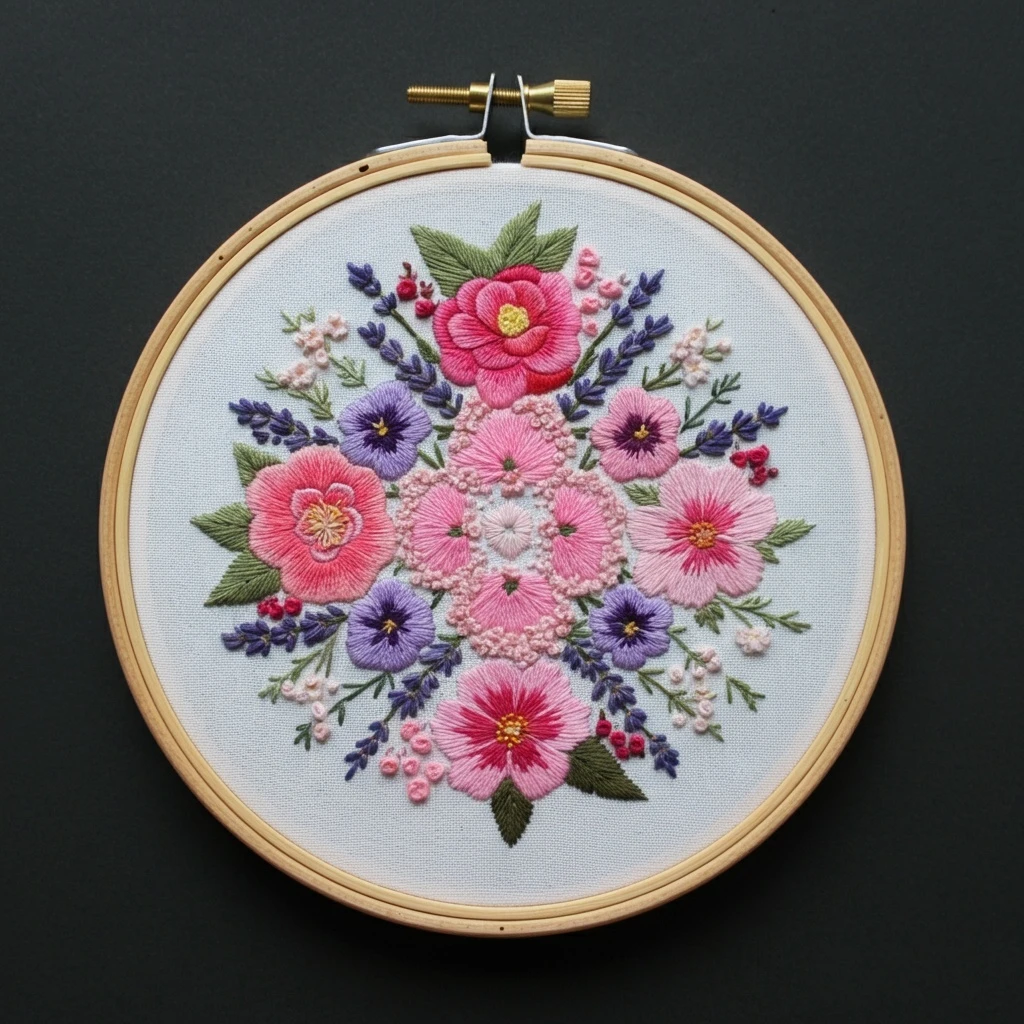
Springtime Bloom Pink Purple Floral Medallion
A polished DMC floss palette and stitch-planning guide for a circular spring bouquet with rosy statement blooms, purple pansy-like flowers, lavender sprigs, knot-textured bead flowers, red berry accents, and layered green foliage.
Likely DMC Color Palette
The design reads as a fresh rose-pink and violet medallion with strong green leaf structure. Use the brighter pinks for focal petals, the purples for contrast flowers and lavender sprigs, and the soft blush tones for the raised central ring and delicate filler blossoms.
Rose
Main deep pink for large bloom edges, darker petal bases, and saturated flower folds.
Rose Medium
Primary mid-pink petal fill for large flowers and rounded medallion petals.
Pink Medium
Soft highlights on petal tips, pale lower petals, and light flower transitions.
Mauve Light
Central knot ring, pale filler blossoms, and gentle blush shading around the medallion.
Blue Violet Medium
Purple flower petals and lighter violet strokes within pansy-like blooms.
Blue Violet Very Dark
Dark centers of purple flowers, lavender buds, and crisp contrast accents.
Blue Violet Dark
Shadowed lavender sprigs, petal bases, and small dark seed stitches.
Green Gray Medium
Main leaves, veins, and grounded foliage behind the flowers.
Pine Green Medium
Deep leaf shadows, lower leaf tips, and darker branch lines.
Yellow Green Medium
Fresh leaf highlights, small stems, and airy sprig tips.
Red
Berry clusters and the bold red-pink veins radiating from light flower centers.
Topaz Medium Light
Yellow flower centers, tiny pollen knots, and warm sparkle in blossom cores.
Stitching Suggestions
The medallion works best when the petals are smooth and directional, while the tiny blossoms, berries, and flower centers are more raised and tactile.
| Element | Stitch Type | Practical Notes |
|---|---|---|
| Large rose-pink blooms | Long and short stitch, satin stitch | Work from the petal edge toward the center. Blend DMC 776 into 899, then tuck 335 near folds and bases for rounded depth. |
| Pink daisy-style flowers | Straight stitch spokes, split stitch center line | Use long radial stitches from the outside inward. Add DMC 321 or 335 as fine single-strand vein stitches to create the vivid starburst effect. |
| Central medallion petals | Fishbone stitch or padded satin stitch | Keep each petal symmetrical and stitch toward a small green center. Use a lighter top layer so the circle stays delicate. |
| Raised blush blossom ring | French knots, colonial knots | Use DMC 3689 with one or two wraps. Space knots irregularly so the ring looks floral rather than beaded. |
| Purple pansy flowers | Long and short stitch with dark straight stitches | Fill petals in DMC 340, shade bases with 333, and add a few dark center strokes before placing the yellow knot. |
| Lavender sprigs | Detached chain, lazy daisy, small straight stitches | Stitch buds in pairs along a green stem. Alternate 333 and 3746 for a natural lavender silhouette. |
| Leaves | Fishbone stitch, leaf stitch | Use 3052 as the body, 3363 along one side for shadow, and 3347 on tips or central veins for freshness. |
| Thin stems and branches | Stem stitch, split backstitch | Use one strand for the finest sprigs and two strands for supporting branches behind the flowers. |
| Berry clusters | French knots or padded satin dots | Use DMC 321 with a touch of 335 for darker sides. Keep berries small so they remain accents. |
| Flower centers | French knots, seed stitch | Cluster DMC 725 knots in the center, then add one or two darker stitches if the center needs definition. |
Thread Count, Blending & Shading
Thread-count guidance
Use 2 strands for most petal fills, leaves, and medium stems. Switch to 1 strand for fine outlines, petal veins, tiny branch tips, and dark purple detail strokes. Use 3 strands only for very plush French-knot clusters.
Pink petal blending
For the focal flowers, blend one strand DMC 899 with one strand DMC 776 in transition areas. Move to two strands of 335 only where the petals tuck inward or overlap.
Purple contrast
Keep the purple blooms slightly darker than the pink flowers so they frame the medallion. Use DMC 333 sparingly; too much dark violet can overpower the spring softness.
Leaf dimension
Stitch leaves with the grain of the leaf. Place the darkest green on the underside or inner edge, then finish with one or two lighter green strokes at the tip.
Outlining details
Avoid heavy outlines around every petal. Use single-strand split stitch only on selected overlaps, flower centers, and a few outer contours to keep the embroidery airy.
Texture balance
Reserve the highest texture for knots: center pollen, blush ring blossoms, and berries. Smooth satin petals beside raised knots will make the whole medallion feel polished.
Where to Start
Begin with the largest pink blooms so the composition has its anchors. Add the central medallion next, then the purple flowers and lavender sprigs. Finish with foliage behind the flowers, followed by French knots, berries, and tiny highlight stitches.
- Transfer lightly: Use a fine water-soluble pen or pale transfer line so no marks show through the light pink petals.
- Fill focal flowers first: Complete large petals in directional long-and-short stitch before adding any raised centers.
- Build the round center carefully: Keep the medallion petals evenly spaced and rotate the hoop often to maintain a balanced circle.
- Add stems before buds: Stitch green stems first, then place lavender buds and berry knots on top for clean layering.
- Finish with texture: Add French knots last so they stay crisp and do not snag while surrounding areas are stitched.
Beginner-Friendly Practical Notes
- Hoop tension: Keep fabric drum-tight, especially while working satin and long-and-short petals.
- Needle choice: A size 7 or 8 embroidery needle works well for 2-strand fills; use a slightly larger needle for 3-strand knots.
- Knot control: Wrap French knots consistently and hold the thread snug until the needle passes through the fabric.
- Short lengths: Cut floss around 14–16 inches to reduce fuzzing in the pale pinks and purples.
- Clean backs: Travel under stitched areas when moving between small blossoms so dark thread does not shadow through the fabric.
- Final press: Press face-down on a folded towel after the piece is fully dry, avoiding direct pressure on raised knots.