
DMC palette & stitching guide
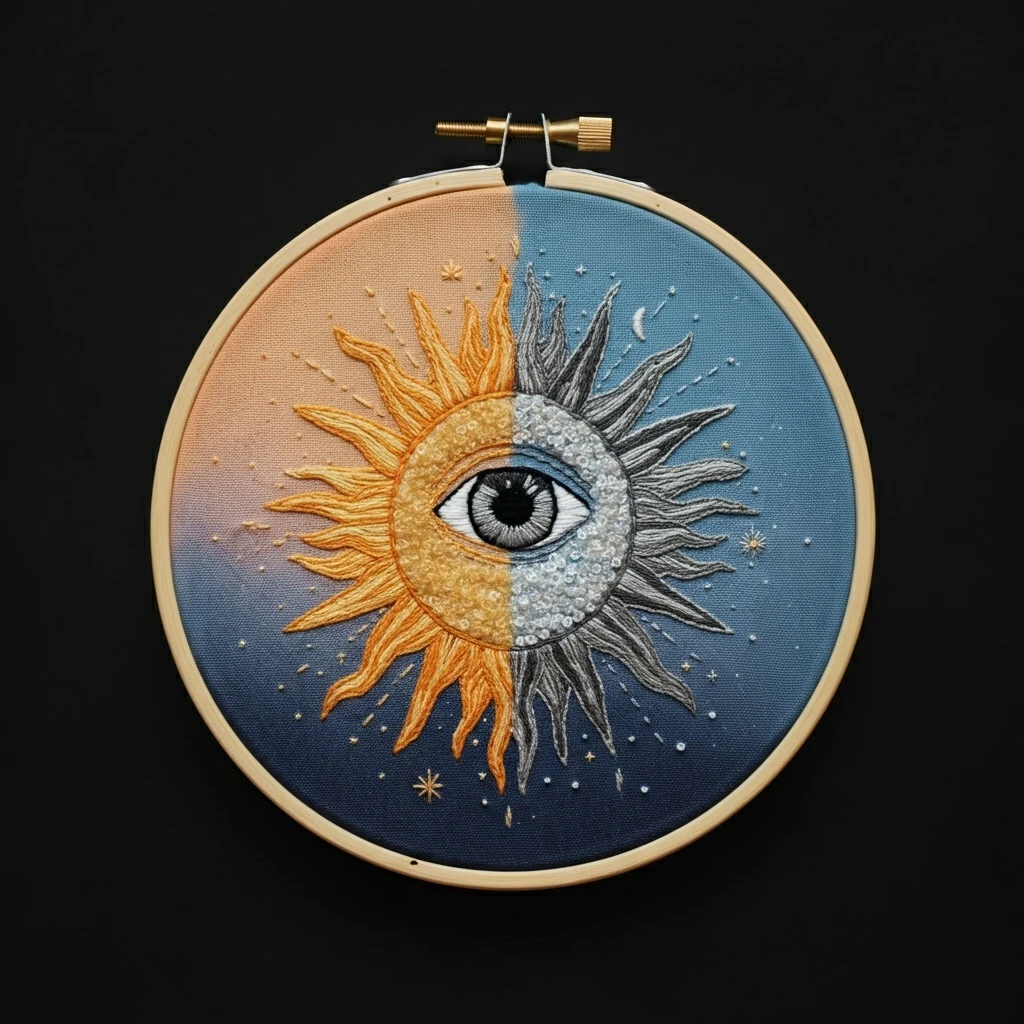
Sun Moon Duality Eye
A mystical celestial hoop built around a central all-seeing eye, warm sun rays, cool crescent-moon shadows, tiny stars, and ornamental linework. The palette balances antique gold and copper with moonlit blue, soft gray, cream highlights, and dramatic dark outlines.
Suggested DMC Color Palette
The design reads best with a strong warm-versus-cool contrast: glowing yellows and antique oranges for the sun side, pale silver and blue for the moon side, and a deep brown-black outline to keep the eye and celestial symbols crisp.
Cream
Base fabric-friendly highlight for the eye whites, fine glints on stars, and tiny open spaces between rays.
Straw Light
Soft golden fill for sun rays and gentle glow around small star accents.
Topaz Medium
Main golden-orange shade for bold sun sections, iris warmth, and thicker decorative accents.
Copper Medium
Warm shadow at ray bases, lower eyelid accents, and earthy contrast around the sun half.
Copper
Deepest copper details for dimensional sun points, tiny ornamental drops, and transition shadows.
Pearl Gray
Pale moon fill, eyelid highlights, and soft separators between cool celestial shapes.
Steel Gray Light
Mid-tone moon shading, crescent contour, and quiet gray transitions around the eye.
Antique Blue Very Dark
Deep moon-side shading, iris contrast, and small cool shadows in the decorative motifs.
Antique Violet Dark
Mystical purple bridge tone for the iris, teardrops, and subtle transitions between gold and blue areas.
Black Brown
Main outline for eye shape, lashes, rays, moon edge, star points, and final definition.
Black
Pupil center and the deepest tiny anchor points; use sparingly so the linework does not look heavy.
Old Gold Very Light
Fine sparkle stitches, eyelid glow, and blending with 3822 for a soft celestial halo.
Stitch Map by Design Area
This pattern depends on clean symmetry and deliberate direction. Stitch the large celestial shapes first, then add the eye details and the tiny stars last so the small accents stay sharp.
Thread Count, Blending & Shading
Blending Ideas
- Blend one strand 3822 with one strand 783 for a bright golden sun fill.
- Blend one strand 783 with one strand 920 to create coppery warmth at the ray bases.
- Blend one strand 762 with one strand 318 for a soft silver moon gradient.
- Blend one strand 3740 with one strand 3750 for a mysterious violet-blue iris shadow.
Shading Guidance
- Keep the sun side brighter and warmer; use copper only near overlaps and inner corners.
- Keep the moon side cooler and quieter; too much dark blue can overpower the crescent.
- Put the strongest contrast in the eye: dark pupil, colored iris, pale catchlight.
- Add the final 3371 outline after fills are finished so the edges look clean and graphic.
Outlining & Texture Suggestions
Clean Celestial Outlines
Use one strand of 3371 for most outlines and switch to 310 only for the pupil or the absolute darkest points. For curves around the eye and crescent, stem stitch looks smoother than back stitch; for short straight ray edges, back stitch is easier to control.
Texture Without Clutter
Let satin stitches create the shine on rays and moon shapes, then keep decorative knots and stars small. The design already has strong symbolism, so a few precise accents will look more polished than dense filler texture.
Practical Embroidery Tips
Fabric & Hoop
Natural cotton, cream linen, or pale oatmeal fabric will support both gold and blue tones. Keep the hoop drum-tight because the rays and crescent include long satin stitches that can loosen fabric tension.
Needle & Tension
A size 7 or 8 embroidery needle works well for two strands. For the eye outline, shorten your stitch length around curves to avoid angular corners.
Symmetry Check
Pause after stitching the main outlines and compare left/right ray lengths, moon curve thickness, and eyelid height. Small corrections are easiest before dense fill stitches are added.
Finishing Touches
Steam from the back over a folded towel. Do not crush French knots or satin-filled rays; the slight raised texture makes the sun, moon, and eye feel dimensional.