
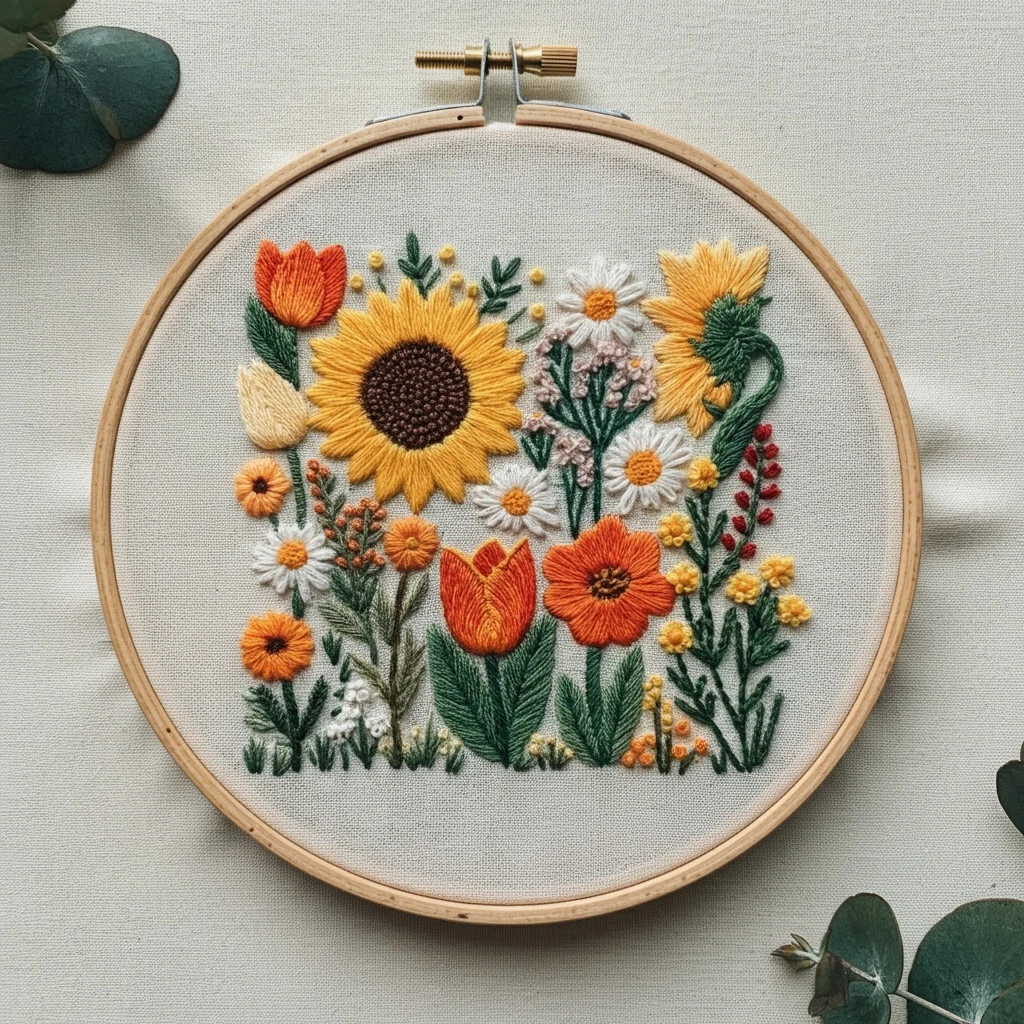
Sunlit Garden Floral
A cheerful floral hoop with a sunflower focal point, bright orange tulips and poppy-like blooms, white daisies, soft blush filler flowers, airy greenery, and tiny red berry accents. The palette below is estimated from the visible embroidery preview and matched to close DMC floss shades for a practical stitching plan.
Likely DMC Color Palette
This design leans on warm sunflower golds, vivid orange petals, crisp whites, layered greens, and a few tiny accent shades. Coverage percentages are visual estimates for planning only, not exact skein counts.
| DMC | Thread Name | Coverage | Where It Appears | Practical Use Notes |
|---|---|---|---|---|
| 3363 | Pine Green Medium | 15% | Main stems, strong leaf shadows, darker ferny growth, grounding foliage | Use for the deepest greenery so the flowers stay bright and defined. |
| 3052 | Green Gray Medium | 12% | Muted leaves, soft greenery transitions, dusty foliage behind blooms | Excellent bridge shade between deep green and lighter sage tones. |
| 3347 | Yellow Green Medium | 8% | Leaf highlights, fresh spring tips, lighter grass and filler sprigs | Add sparingly on outer edges and leaf ridges for a sunlit effect. |
| 725 | Topaz Medium Light | 13% | Sunflower petals, yellow blossoms, warm flower highlights | This is the main sunny yellow—keep it dominant on the brightest petal planes. |
| 782 | Topaz Ultra Very Dark | 7% | Golden petal shadows, flower centers, deeper yellow accents | Blend inward from 725 to shape petal bases and deepen clustered buds. |
| 742 | Tangerine Light | 8% | Bright orange tulip highlights, poppy highlights, warm petal edges | Ideal for the lit side of orange petals and small marigold-like flowers. |
| 741 | Tangerine Medium | 9% | Deeper orange petals, inner folds of tulips, richer floral contrast | Use at petal bases and in overlap areas to create depth without going too dark. |
| 3865 | Winter White | 8% | Daisy petals, pale blossoms, tiny white filler flowers | Pair with very light beige shadow stitches if you want the whites to read more clearly on pale fabric. |
| 3716 | Dusty Rose Medium | 5% | Blush filler flowers near the upper center and soft transitional accents | Use lightly—these blossoms are delicate and should not overpower the main flowers. |
| 801 | Coffee Brown Dark | 5% | Sunflower center texture, dark inner seed ring, tiny warm shadow notes | Mix with French knots or dense seed stitching for a raised central texture. |
| 3371 | Black Brown | 4% | Deepest center shadows, tiny line accents, darkest interior flower details | Use in moderation to sharpen contrast and keep the sunflower center dimensional. |
| 321 | Christmas Red | 2% | Small berry sprigs on the right side and occasional tiny accent dots | A tiny amount goes a long way—save it for the final pass. |
Optional extras: DMC 307 (Lemon) or 3822 (Straw Light) for tiny golden pollen dots, and DMC 762 (Pearl Gray Very Light) for whisper-soft shading under white petals.
Suggested Stitch Types
The design works best when you combine smooth directional fills with a few raised accents and airy foliage textures.
| Element | Stitch Type | Notes |
|---|---|---|
| Sunflower petals | Long and short stitch or satin stitch | Fan each petal outward from the base; use 782 near the base and 725 toward the tip. |
| Sunflower center | French knots, seed stitch, or dense colonial knots | Layer 801 over a darker 3371 shadow ring for a plump, textured disk. |
| Orange tulips & bold blooms | Long and short stitch | Blend 741 into 742 to show curved petals and overlapping folds. |
| Daisies | Lazy daisy or straight stitch | Keep petals narrow and crisp; add a tiny warm knot center in 725 or 782. |
| Fine filler blossoms | Detached chain, tiny satin stitch, or straight stitch | Perfect for the blush cluster near the top center. |
| Leaves | Fishbone stitch, satin stitch, or long and short stitch | Use directional stitching to emphasize leaf shape and central veins. |
| Ferny greenery & grasses | Stem stitch plus straight stitch | Work from stem outward with varied stitch lengths for a natural garden feel. |
| Berries & pollen dots | French knots | Use one or two wraps only; cluster loosely so the accents stay lively. |
| Fine outlines & veins | Split stitch or backstitch | Best added after filling to sharpen shapes without making the piece heavy. |
Thread Count & Needle Guidance
This piece looks best with a slightly layered finish, especially in the sunflower and larger foreground flowers.
2 strands for most fills
Use 2 strands for flower petals, most leaves, and visible fill areas. It gives good coverage while still allowing soft shading.
1 strand for fine details
Use 1 strand for stems, leaf veins, dainty outlines, and wispy greenery so those lines stay elegant rather than chunky.
3 strands for raised texture
If you want extra loft, use 3 strands selectively in the sunflower center or for pronounced French knots in small berry clusters.
Needle suggestions
A crewel needle #7–9 handles most stitching comfortably. Use a slightly larger eye if you switch to 3 strands for knot-heavy sections.
Blending, Outlining & Shading Ideas
Good embroidery depth in this design comes from gentle transitions rather than overly dramatic shading.
Petal blending
- Blend 741 into 742 in the orange flowers by alternating stitch lengths at the transition line.
- Blend 782 into 725 on sunflower petals, keeping the darkest shade closest to the flower center.
- For white petals, add only the faintest hint of gray or beige shadow at the base if your fabric is very pale.
Outlining details
- Outline only the areas that need extra definition: petal overlaps, leaf edges, or dark seed centers.
- Use split stitch in matching thread colors instead of stark black for a softer botanical finish.
- Reserve 3371 for the deepest interior shadows rather than outlining every shape.
Texture suggestions
- Make the sunflower center visibly raised with knots or dense seed stitches.
- Work leafy sections directionally so each leaf has a natural central flow.
- Use varied straight-stitch lengths in grasses and filler greens to keep the garden loose and lively.
Recommended Stitching Order
Starting in the right sequence helps keep overlap clean and makes the composition easier to balance.
- Stitch the main central flowers first, especially the sunflower and the larger orange blooms.
- Add the large foreground leaves beneath and around those flowers.
- Work the daisies and smaller secondary flowers next.
- Fill in background greenery, ferny stems, and grasses around the lower edge.
- Finish with flower centers, berries, pollen dots, and any fine outlines or veins.
If you are new to long and short stitch, test your yellow-to-gold blending on a scrap before committing to the sunflower petals.
Beginner-Friendly Practical Tips
This design is approachable if you treat it as a series of small floral studies rather than one large complicated piece.
- Use shorter stitches on tight curves, especially around tulip tips and daisy petals.
- Do not overfill every gap—small open spaces help the composition feel airy and tidy.
- Park bright reds and dark browns until the end so they remain crisp and clean.
- Keep your greens slightly varied; mixing deep pine with muted green-gray prevents the foliage from looking flat.
- For a neat finish, secure knot-heavy threads well on the back and avoid long travel floats between isolated accents.
Helpful Finish
Sunlit Garden Floral really shines when the textures are layered: smooth petal shading, a plush sunflower center, delicate daisy petals, and loose garden greenery. Build the strong focal flowers first, then let the smaller stems and accents support them. The result should feel warm, bright, and gently abundant—like a sunny meadow gathered inside a hoop.