
Swan On The Water
A calm hoop design built around a graceful white swan, cool rippled water, soft sky reflections, and quiet bankside greenery. The embroidery works best when the swan stays luminous and smooth while the water carries fine horizontal texture and gentle tonal movement.
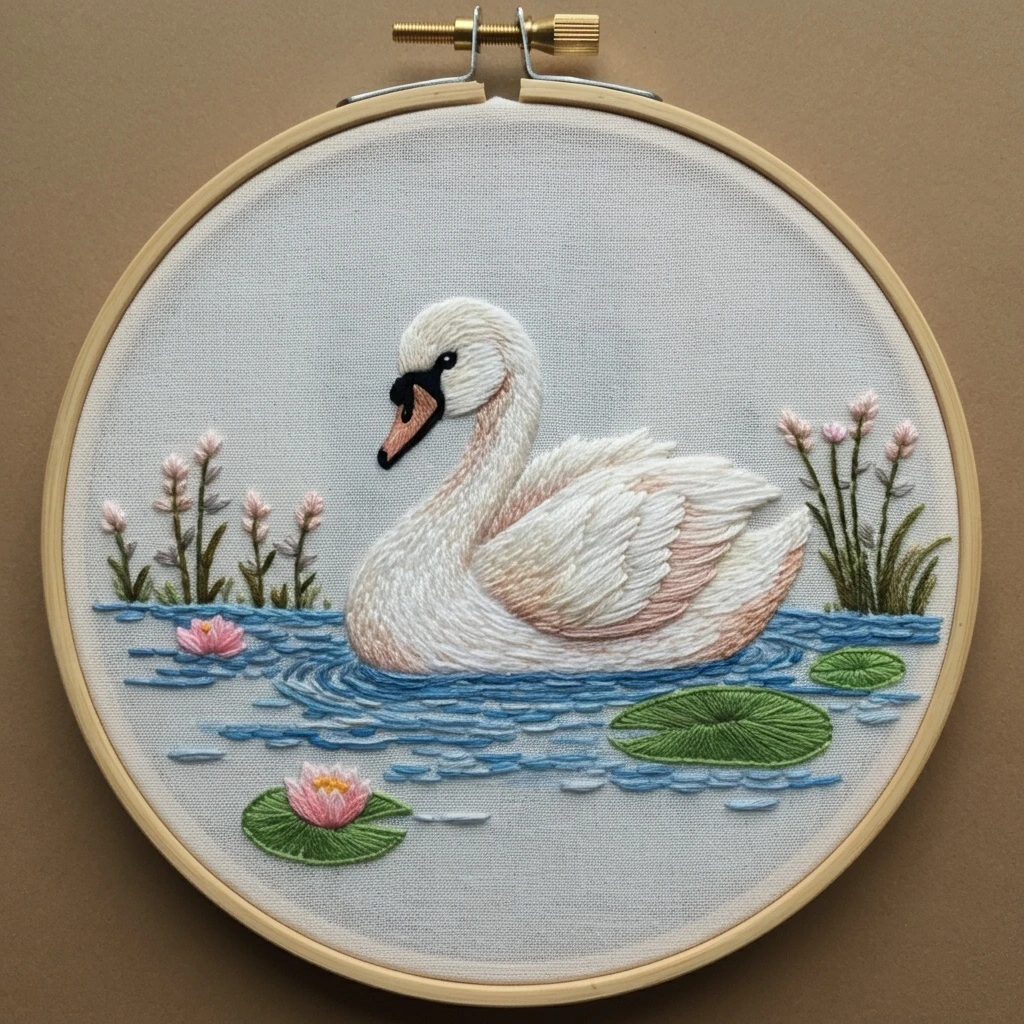
Design Color Read
The reference image has a serene, airy palette: bright swan whites, blue-gray feather shadows, aqua and teal water bands, tiny orange-black beak accents, and natural reed greens. Keep the contrast controlled; the beauty of the piece comes from clean outlines, smooth satin areas, and subtle water stitching rather than heavy fill everywhere.
Stitch Plan by Area
Smooth, luminous feathers
- Use long-and-short stitch with 2 strands of Blanc, adding 762 and 415 only in the lower body and wing overlap.
- Keep stitch direction following the curve of the body: horizontal through the belly, slightly upward at the wing.
- Add a few 1-strand split-stitch feather hints after the fill is complete.
Clean curved silhouette
- Outline the neck first with 1 strand split stitch in Blanc or 762 so the edge stays graceful.
- Fill the neck with short satin or long-and-short stitches, turning gradually around the curve.
- Use 310 as one tiny eye stitch and for the black base near the beak.
Horizontal ripples and reflection
- Work broken running stitch, back stitch, and tiny seed stitches in 3841, 598, 3810, and 3765.
- Leave open fabric between ripple lines; negative space keeps the water sparkling.
- Place the darkest water directly under the swan to anchor it without making the scene heavy.
Natural vertical texture
- Use straight stitch for tall reeds and fly stitch for small leafy tips.
- Mix 3012 and 3011 in the needle for a soft variegated reed effect.
- Let a few stems overlap the water edge, but keep them thinner than the swan outline.
Thread Count & Blending Guide
1 strand
Best for eye, beak separation, feather lines, fine water ripples, and any final outline corrections.
2 strands
Use for most swan filling, water rows, reeds, and medium outlines. This gives clean coverage without bulk.
3 strands
Reserve for bold lower water bands or thicker foreground reeds only. Too many strands can overwhelm the calm design.
Suggested Stitching Order
Beginner-Friendly Practical Tips
Keep the white clean
Wash hands before stitching, use shorter thread lengths, and stitch the swan before darker greens or blues to prevent fuzz transfer.
Avoid bulky water
Do not fill every water shape. Sparse horizontal stitches look more like reflections than solid blocks of blue thread.
Control the beak
The beak is small, so use short satin stitches with 1 strand of 922. Add the black base with a single tiny straight stitch.
Press from the back
After finishing, place the embroidery face down on a towel and press lightly from the back so raised stitches keep their texture.