
Textured Autumn Forest And River
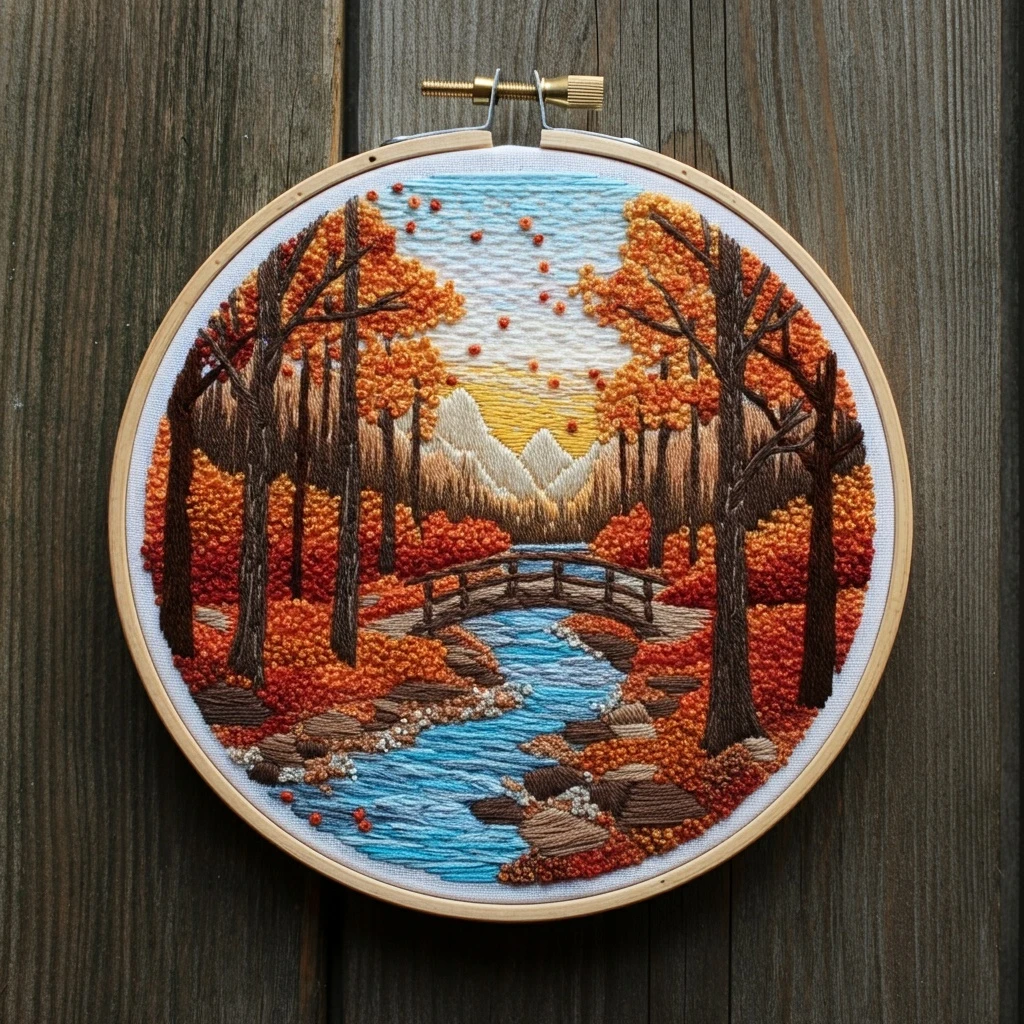
This design combines a glowing sunset, pale mountains, a cool blue river, a rustic bridge, and richly textured autumn foliage. The strongest visual story comes from the contrast between warm oranges and deep bark browns against cool blue water and a softly lit sky. The suggestions below are matched to the visible preview and chosen to keep the finished embroidery dimensional, balanced, and beginner-friendly.
Likely DMC Color Palette
The palette centers on burnt orange foliage, dark woodland browns, pale mountain neutrals, and clear turquoise-blue water. These shades are intentionally chosen to stitch well together rather than to chase exact pixel matching.
| Swatch | DMC | Thread name | Practical use notes |
|---|---|---|---|
| 3756 | Baby Blue Ultra Very Light | Upper sky highlights and the palest reflected light above the mountain line. Useful for keeping the background airy without overpowering the warm foreground. | |
| 3844 | Bright Turquoise Dark | Main river color and stronger ripples. Also works well for the cooler bands of water nearest the bridge and foreground bends. | |
| 996 | Electric Blue Medium | Blend with 3844 for sparkling water transitions and the soft blue cast in the sky. Ideal for long-and-short stitched water movement. | |
| 728 | Topaz | Golden sunset glow at the horizon and the warm light just behind the mountains. Use sparingly so it reads as concentrated sunlight. | |
| 3865 | Winter White | Brightest highlights on the mountain peaks, small river sparkles, and tiny accent stitches along stones and foam. | |
| 842 | Beige Brown Very Light | Soft taupe mountains, pale pathway areas, and warm stone highlights. Helps bridge the contrast between white peaks and dark trunks. | |
| 801 | Coffee Brown Dark | Bridge rails, branches, tree bark shadows, and rocky ground forms. A dependable structural brown for crisp definition. | |
| 839 | Beaver Brown Dark | Mid-tone bark, bridge planks, path shading, and earthy transitions between light rocks and the darkest outlines. | |
| 3371 | Black Brown | Deepest tree trunks, branch outlines, and the most dramatic shadow accents. Best used in controlled lines to preserve depth. | |
| 970 | Pumpkin Light | Bright autumn foliage, leaf clusters, and lighter orange ground cover. A cheerful top layer for textured French knots or seed stitch. | |
| 921 | Copper | Mid-tone orange foliage and transition areas between bright pumpkin and deep rust. Good for mixed leaf masses. | |
| 300 | Mahogany Very Dark | Deep rust-red accents in shadowed leaf clusters, lower shrubs, and the richest autumn pockets near the edges of the hoop. |
Stitching Suggestions
| Element | Recommended stitch | Why it works |
|---|---|---|
| Sky | Horizontal straight stitch or long-and-short stitch | Keep stitches relaxed and mostly horizontal to create a calm sky. Blend Baby Blue and Winter White loosely so the background stays soft. |
| Sunset band | Satin stitch or close long-and-short stitch | Work the golden horizon in short, tidy stitches so the glow looks concentrated behind the mountains. |
| Mountain peaks | Long-and-short stitch with split-stitch edge | Use Winter White and Beige Brown Very Light, blending from pale peaks into slightly warmer foothills for gentle depth. |
| Tree trunks and branches | Stem stitch, split stitch, or whipped backstitch | Stitch trunks vertically with dark browns. Add a few lighter bark lines on top to keep them from looking flat. |
| Autumn leaf masses | French knots, colonial knots, seed stitch, and tiny detached chain stitches | The preview has strong texture, so clustered knots are ideal. Mix Pumpkin Light, Copper, and Mahogany for a naturally varied canopy. |
| River | Long-and-short stitch with directional straight stitches | Follow the flow of the stream. Use darker turquoise in the center and lighter blue at edges and highlight bands. |
| Bridge | Backstitch plus satin or long-and-short fill | Outline the bridge first, then fill planks and rails with medium and dark browns. A few lighter stitches suggest worn wood. |
| Rocks and banks | Satin stitch, split stitch, or brick stitch | Angle the stitches to match each rock shape. Add Winter White specks for crisp highlights and textured edges. |
| Fallen leaves and tiny accents | French knots and single straight stitches | Scatter a few brighter knots above and around the scene to echo drifting leaves and add movement. |
Blending & Shading Ideas
Foliage
Blend 970 + 921 for the brighter outer leaf areas, then tuck in 300 where the foliage turns inward or sits behind the trunks. This keeps the trees vivid without becoming flat or too uniformly orange.
River
Use 3844 in the central channel and curves, then soften into 996 and tiny touches of 3865 for glints. If you want extra movement, alternate stitch direction slightly where the stream narrows.
Mountains & distance
Blend 3865 into 842 with short overlapping stitches. Keep the most contrast near the peak edges and reduce detail as the mountains recede so the foreground forest remains dominant.
Bark & bridge
Layer 839 under 801, then add selective strokes of 3371 for the darkest cuts, branch joints, and shadow undersides. A few lighter top stitches prevent the wood from reading as a flat silhouette.
Beginner-Friendly Practical Tips
- Complete the river first if you want an easy confidence boost—it is forgiving and clearly directional.
- When stitching the trees, work from back to front: distant trunks first, nearest trunks last.
- Do a small test cluster of French knots before committing to the canopy so you can decide whether you prefer tighter or fluffier leaf texture.
- If the bridge feels intimidating, stitch the outline first and fill each plank section one at a time rather than treating it as one large object.
- Leave the brightest white highlights until the end. They make the whole scene look fresher once all darker colors are in place.
- Try not to overfill the background sky; the open lighter area is important for contrast and gives the scene breathing room.
Suggested Stitch Order
- Map the background: stitch the sky glow and mountain shapes first so the distant horizon is established early.
- Lay in the river: work the full water path from top to bottom, keeping stitch direction aligned with the flow.
- Add the bridge and rocks: these help anchor the middle ground and make later foliage placement easier.
- Stitch tree trunks and major branches: place the darkest structural lines before the dense leaf texture begins.
- Build foliage in layers: start with mid-tone orange, add brighter pumpkin highlights, then finish with deep rust shadows.
- Finish with tiny accents: drifting leaf knots, white river sparkles, and final branch clean-up give the design its polished look.
Helpful Notes
Texture suggestions
- French knots give the canopy the closest match to the preview’s pebble-like texture.
- Use occasional detached chain stitches to break up large knot fields and make the leaves feel less uniform.
- Short straight stitches along the river banks help transition from water to land naturally.
Finishing thoughts
The charm of this pattern comes from contrast: cool water, warm foliage, and dark vertical trees framing a bright center.
Keep the center opening a little lighter and cleaner than the edges, and the design will naturally draw the eye toward the mountains and sunset. Even a simple version with restrained shading can look beautiful if you keep the stitch direction consistent and let the textured leaf clusters do most of the visual work.