
DMC palette & hand embroidery notes
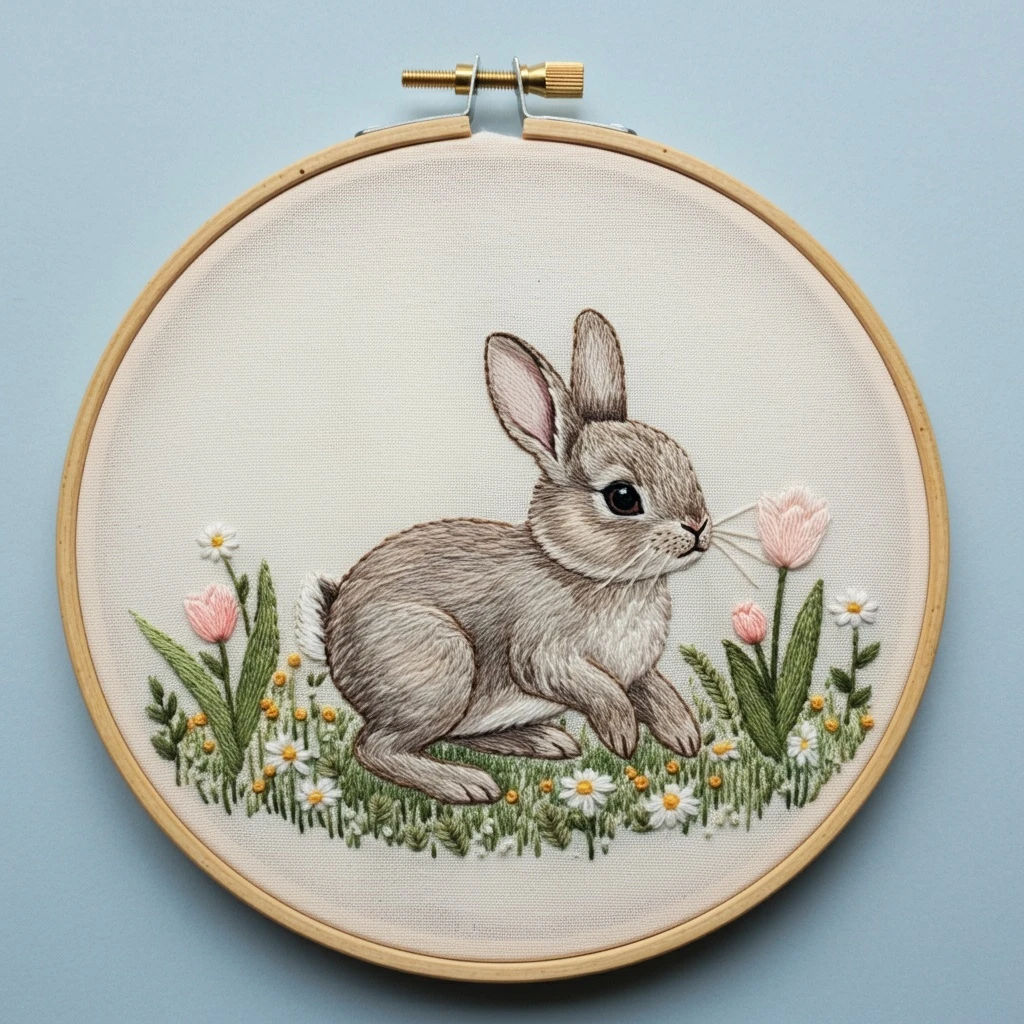
The Gentle Grazer
A soft meadow rabbit worked in natural taupes, warm browns, mossy greens, daisy whites, buttery yellow knots, and pale pink blossoms. The design relies on delicate directional fur stitches and small raised garden details, so the palette should stay gentle, layered, and slightly textured rather than flat.
Likely DMC Color Palette
Colors are estimated from the visible hoop preview and matched to close DMC six-strand cotton shades. Coverage percentages are visual estimates, not exact thread usage.
Main rabbit fur base, soft cheek transitions, pale body highlights, and the lighter curve of the haunch.
Mid-tone fur strokes across the back, ears, face planes, and legs; useful for blending between cream and brown.
Rabbit outlines, ear edges, nose line, paw separations, and darker directional fur around the eye and shoulder.
Eye pupil, strongest facial accents, deepest whisker roots, and tiny shadow touches under the body.
Daisy petals, rabbit chest glints, tail brightness, and small sparkle stitches in the eye.
Inner ears and soft tulip-like flower petals; blend sparingly so the pink stays delicate.
Petal bases, deeper inner-ear shadows, and subtle rose shading near folded blossom edges.
Tall grass blades, darker stems, ferny sprigs, and foreground meadow depth around the rabbit.
Mid green leaves and grass layers; bridges the darker pine green with softer leafy highlights.
Lighter leaf tips, wispy meadow texture, and small lifted grass strokes behind the flowers.
Daisy centers, yellow meadow buds, and the brightest French knots scattered near the lower edge.
Warm shadow side of flower centers and tiny golden seed accents for depth.
Stitching Suggestions
| Element | Recommended stitch | Practical notes |
|---|---|---|
| Rabbit fur | Long and short stitch, single-strand straight stitch | Follow the natural growth direction: short strokes on the face, longer sweeping strokes across the back and haunch. Alternate DMC 842, 841, and 839 so the coat looks fluffy rather than striped. |
| Face and muzzle | Split stitch, tiny straight stitch, backstitch | Use one strand for the nose, mouth, cheek marks, and eyelid curves. Keep the muzzle lighter with 3865 and 842, then add only a few 839 strokes for definition. |
| Eye | Satin stitch with a single highlight stitch | Work the eye in 3371, outline lightly, and place one tiny 3865 stitch or knot at the top edge for a glossy, gentle expression. |
| Ears | Long and short stitch with split-stitch edging | Shade inner ears with 948 and a touch of 3722, then feather beige-brown fur over the rim so the pink sits naturally inside the ear. |
| Tall grass | Straight stitch, fishbone stitch, stem stitch | Use 1 strand for fine background blades and 2 strands for the strongest foreground grass. Vary stitch height so the meadow does not form a hard straight line. |
| Daisies | Lazy daisy stitch or detached chain | Make each petal in 3865 with small, open loops. Add one- or two-wrap French knots in 725/782 for the centers. |
| Pink blossoms | Satin stitch, long and short stitch, gathered straight stitches | Radiate pale peach stitches from the base of each bud, then place 3722 at the lower fold or inside edge to suggest cupped petals. |
| Meadow dots and seeds | French knots and colonial knots | Save knots for the last pass. Use yellow knots for buds and occasional pale knots near daisies to keep the lower border lively. |
| Whiskers | Very fine straight stitch or couching | Use one strand of 3865, light beige, or pale gray-brown. Keep whiskers long, smooth, and minimal; too many can distract from the soft face. |
Thread Count, Blending & Shading Guidance
Thread-count plan
- 1 strand: facial details, whiskers, fur direction lines, delicate stems, and final definition around paws.
- 2 strands: most flower petals, visible grass blades, rabbit base-fill sections, and stronger meadow stems.
- 3 strands: only for a few raised knots or extra-plump flower centers; avoid using it on the rabbit body or the fur may look bulky.
Blending ideas
- For the rabbit body, blend one strand DMC 842 with one strand DMC 841 to create a soft mid-tone that matches the natural taupe fur.
- For darker contour strokes, blend one strand DMC 841 with one strand DMC 839 instead of jumping directly to the darkest brown.
- For pale blossoms, blend DMC 948 with 3865 at the petal tips and use DMC 3722 only near the base or fold.
Outlining and detail control
Use split stitch rather than heavy backstitch for most rabbit outlines. The sample has a soft illustrated quality, so edges should be visible but not cartoon-thick. Reserve the darkest brown and black-brown for the eye, nose, mouth, and deepest creases only.
Shading order
Begin with the palest rabbit fur and establish the large body shapes first. Add mid-tone fur strokes second, then place dark contour stitches last. For the meadow, stitch background stems and grass before flowers, then finish with daisy centers, yellow knots, and small foreground blades.
Texture Suggestions
Beginner-Friendly Practical Tips
- Work from the rabbit outward: body and face first, then grass, then flowers and knots.
- Use a sharp embroidery needle for fur strokes so single strands pass through the fabric cleanly.
- Do not carry dark thread behind pale daisy petals or the white stitches may appear shadowed.
- Keep the fabric drum-tight in the hoop; loose fabric makes long fur stitches harder to control.
- Trim thread tails often behind the eye and muzzle area so tiny details stay crisp.
- When in doubt, add fewer dark stitches. You can always deepen shadows after the soft base is finished.
Encouraging Finish
This design is most charming when the rabbit remains soft and quiet while the meadow adds small textured sparkle. Build gentle taupe layers for the fur, keep the blossoms fresh and pale, and let the yellow knots and white daisies provide the final cheerful detail.