
Trailing Blossoms

Trailing Blossoms — DMC Palette & Stitching Suggestions
Floral embroidery guide · DMC palette & practical tips

Trailing Blossoms

Colors estimated from the visible hoop preview and matched to close DMC embroidery floss shades. This guide focuses on the swirling rose shapes, trailing twig sprays, raised white blossoms, and the warm-to-cool color movement across the bouquet.
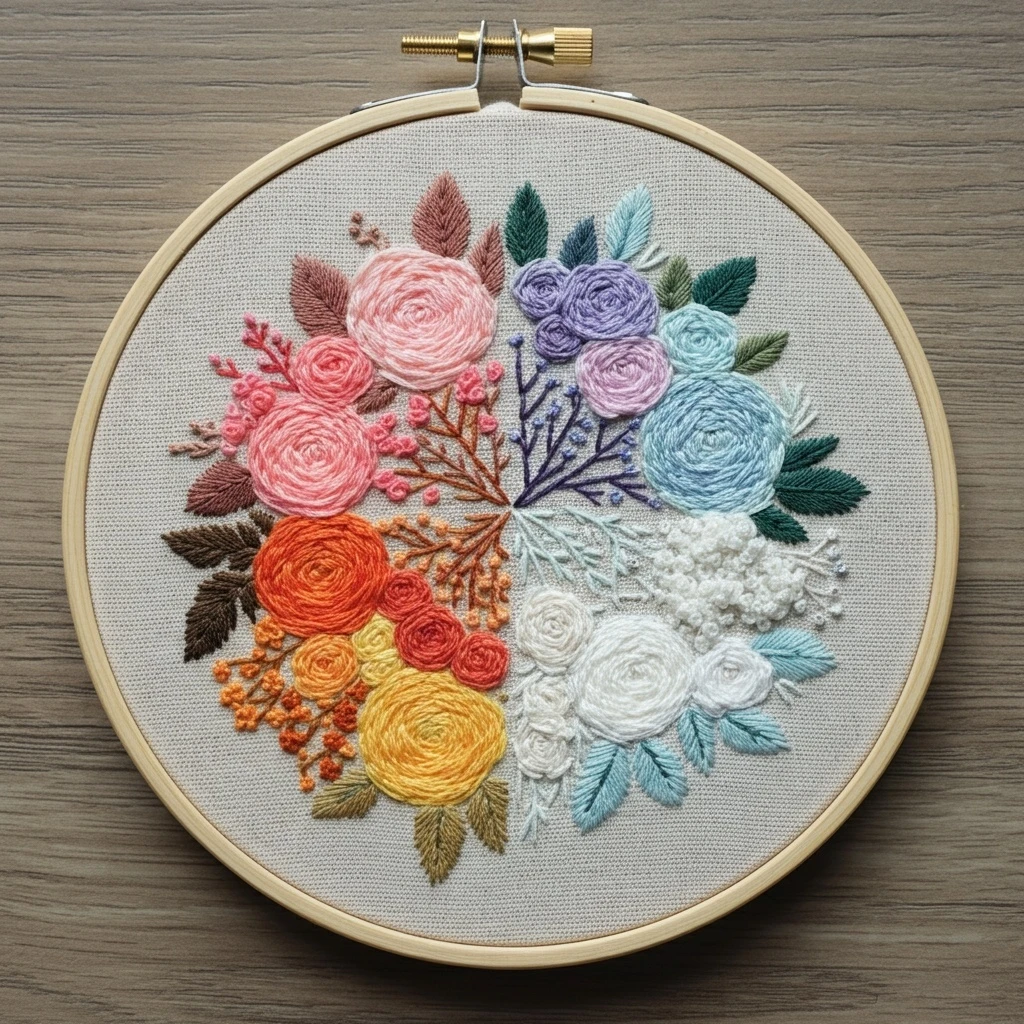
Trailing Blossoms Embroidery

Design notes from the preview

The composition is a compact circular floral cluster with trailing stems radiating from the center. The left side is warm and fruity with coral, salmon, orange, red, yellow, rust, and brown foliage. The right side turns cooler with lavender roses, pale aqua-blue blooms, teal leaves, and a soft white cluster with raised texture.

The flowers appear as spiral-wrapped rosettes rather than flat petals, so the stitching should emphasize circular direction, layered color, and slightly raised centers. Fine branch lines and berry knots keep the design airy while dark leaves add contrast behind the blooms.

spiral rosettes trailing twig sprays French-knot berries fishbone leaves raised white texture warm-to-cool palette

Likely DMC Color Palette

Use the full palette if you want a rich, dimensional version. For a simpler beginner version, choose one light, one medium, and one dark shade for each color family.

DMC 761 · Salmon Light
Pale pink rosette highlights, soft outer spiral stitches, delicate petal tips.
DMC 760 · Salmon
Main salmon-pink flowers on the upper and left cluster; blend into 761 for soft roses.
DMC 352 · Coral Light
Stronger coral rosettes and warm midtone curves in the large pink blooms.
DMC 3777 · Terra Cotta Very Dark
Deep red-orange flower shadows, small red rosettes, and warm definition near centers.
DMC 741 · Tangerine Medium
Large orange blossom, orange berry clusters, and bright warm accents.
DMC 720 · Orange Spice Dark
Darker spiral lines in the orange rose and shadowed berry dots.
DMC 742 · Tangerine Light
Golden yellow flower body, small yellow rosettes, and sunny highlights.
DMC 3821 · Straw
Light yellow tips and soft transitions in the lower golden flower.
DMC 3012 · Khaki Green Medium
Olive leaves around the yellow flower and muted warm foliage.
DMC 3011 · Khaki Green Dark
Darker olive leaf veins and undersides near the lower warm section.
DMC 938 · Coffee Brown Ultra Dark
Deep brown leaves on the lower left and the darkest twig accents.
DMC 433 · Brown Medium
Central branching stems, warm twig sprays, and natural outlines.
DMC 316 · Antique Mauve Medium
Dusty rose-lavender transition flower and muted cool petal shadows.
DMC 211 · Lavender Light
Pale lavender rosettes and soft outer rings on the upper-right flowers.
DMC 210 · Lavender Medium
Main purple rosette tone and visible spiral ridges.
DMC 208 · Lavender Very Dark
Purple flower centers, shadow lines, and fine dark stems on the cool side.
DMC 747 · Sky Blue Very Light
Pale aqua rosette highlights and cool white-blue transitions.
DMC 3761 · Sky Blue Light
Large blue flower, cool petals, and lower-right leaf highlights.
DMC 3810 · Turquoise Dark
Blue-green leaf shadows and definition around cool blossoms.
DMC 3847 · Teal Green Dark
Dark teal leaves behind the blue and purple flowers; strong contrast points.
DMC 3865 · Winter White
Large white roses, raised white blossom cluster, and brightest highlight knots.
DMC 746 · Off White
Creamy white shadows so the white flowers do not disappear on linen.

Stitching Suggestions

Design elementStitch typePractical notes
Large spiral rosettesWoven wheel, whipped backstitch spiral, or tight stem-stitch spiralBegin at the center and spiral outward. Use darker thread in the center and mid-spiral grooves, then lighter thread near the outside edge for a rounded rose effect.
Small rosettesCast-on rose, woven wheel, or small whipped spiralKeep these slightly raised so they sit in front of leaves and sprays. One or two color changes are enough.
Trailing branch spraysStem stitch, split stitch, or backstitchWork the main stems with one strand for fine lines; switch to two strands only where the central branches need more weight.
Berry clusters and tiny budsFrench knots or colonial knotsUse one wrap for tiny buds and two wraps for fuller berries. Scatter color values rather than making every knot identical.
Dark and olive leavesFishbone stitch, closed fly stitch, or satin stitch with a center veinAngle the stitches toward the leaf tip. Add a dark center vein after filling to sharpen the leaf shape.
Aqua-blue leavesFishbone stitch or long straight stitchesUse 3761 on the upper side of the leaf and 3810 near the base for a cool, dimensional finish.
Raised white flower clusterFrench knots, turkey work loops, or clustered colonial knotsBuild this section last. Mix 3865 and 746 so the cluster has soft cream shadows instead of a flat white patch.
Fine purple stemsBackstitch or stem stitchUse a single strand of 208 for the thinnest branching lines. Keep the stitches short around curves.
Outlines and definitionSplit stitch, couching, or selective backstitchOutline only the areas that need clarity: spiral centers, leaf veins, and twig intersections. Avoid outlining every petal, which can make the bouquet look stiff.

Thread Count, Blending & Shading

Thread countUse 2 strands for most rosettes, leaves, and branch lines. Use 1 strand for delicate veins, thin purple stems, and final definition. Use 3 strands only for raised knots or areas that need extra plush texture.
Blended needle ideasFor soft roses, blend one strand 761 with one strand 760. For coral depth, blend 760 with 352. For icy blue roses, blend 747 with 3761. For white flowers, blend 3865 with 746 to keep the whites visible against neutral fabric.
Shading directionShade the spiral flowers from dark centers to lighter outer rims. Shade leaves from dark bases to lighter tips. Keep the stems slightly darker than surrounding petals so the trailing structure remains readable.

Recommended color families

  • Warm pink family: 761, 760, 352, 3777 for the salmon and coral blooms.
  • Sunset family: 3821, 742, 741, 720 for yellow, orange, and small fiery rosettes.
  • Cool floral family: 211, 210, 208, 747, 3761 for lavender and aqua blossoms.
  • Foliage family: 3847, 3810, 3012, 3011, 938, 433 for teal, olive, brown leaves, and twigs.

Where to Start

  1. Transfer the main flower circles, central branching point, and leaf positions lightly. The spirals can be stitched freehand if the outer circle is marked.
  2. Stitch the largest rosettes first: pink, orange, yellow, aqua, lavender, and white. This establishes the color balance and gives you clear anchors.
  3. Add the central branch sprays with 433, 208, and pale aqua/cream threads. Keep these stitches fine so they trail between the flowers instead of covering them.
  4. Fill the dark leaves and olive leaves behind the flowers. Let some leaves tuck under rosettes for depth.
  5. Finish with French-knot berries, white texture clusters, tiny buds, and selective outlining.

Beginner-Friendly Practical Tips

Keep spiral roses evenRotate the hoop as you stitch so your hand always follows the curve comfortably. Shorter curved stitches look smoother than long stretched stitches.
Avoid bulky backsEnd threads frequently when jumping between flowers. Long carried threads can shadow through pale linen and make the hoop harder to finish cleanly.
Build texture graduallyDo the flat stitched flowers first, then raised knots. Raised work catches thread easily, so saving it for last prevents snagging.
Use a sharp contrast sparinglyThe darkest greens, browns, and purples should be accents. Too much dark outlining can flatten the soft botanical look.
Test white on fabricIf 3865 blends into the background, add a touch of 746 or a single shadow line in pale blue-gray near the underside of the white roses.
Press from the backWhen finished, place the embroidery face down on a fluffy towel and press from the back only. This protects the rosettes and French knots.

Leave a Reply

Your email address will not be published. Required fields are marked *