
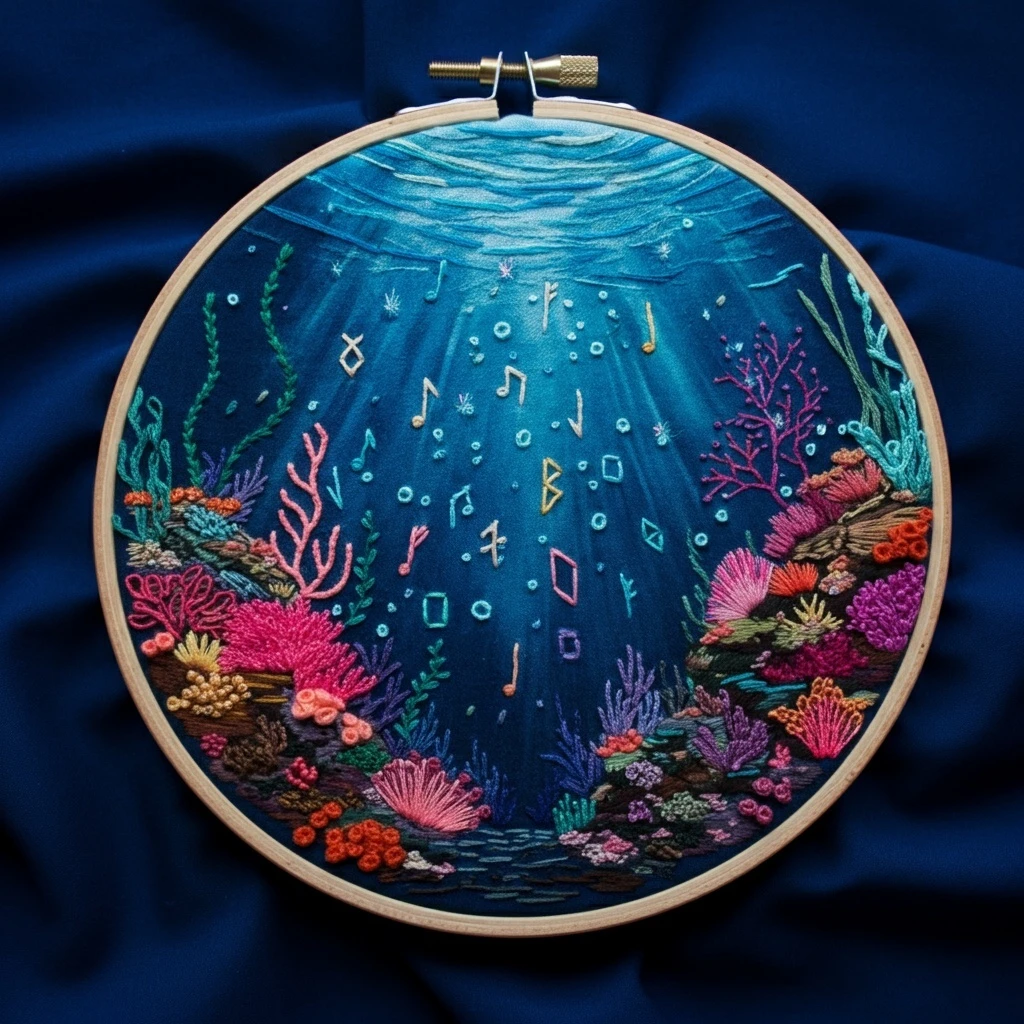
Underwater Music Coral Reef
A luminous ocean-hoop design with deep teal water, rippling surface light, floating musical notes, bubbles, and a richly textured coral reef along the lower edges. The palette below is estimated from the visible preview and matched to practical DMC floss choices for hand embroidery.
Likely DMC Color Palette
The design reads as a dramatic underwater scene: deep blue fabric/negative space, turquoise light shafts, pale bubbles, warm coral branches, magenta anemones, orange reef clusters, purple sea plants, and tiny golden musical accents.
Deep water shadows, darkest lower background touches, and contrast beside bright reef elements.
Main ocean body, shaded water columns, and blue transitions around floating notes.
Sunbeams, mid-water glow, wave lines, and brighter blue streaks through the center.
Surface highlights, bubble rings, tiny sparkle stitches, and music-note accents.
Foamy water glints, small bubbles, and the brightest edges of ripples near the top.
Pink coral branches, shell fans, and lively warm coral details in the reef border.
Hot magenta anemones, dense reef tufts, and shadow lines on pink sea plants.
Purple coral, distant seaweed, and jewel-toned shadows in clustered reef texture.
Orange sponge clusters, tiny reef berries, and bright warm accents near the rocks.
Golden music notes, small starbursts, and warm highlights on sand-colored coral.
Kelp stems, dark teal sea plants, and cooler reef foliage along the sides.
Rock ledges, muted shell bases, and neutral grounding under bright coral.
Stitching Suggestions
| Element | Best stitches | Practical notes |
|---|---|---|
| Surface ripples | Split stitch, stem stitch, short straight stitch | Use 1 strand of 747 and 3846. Keep lines broken and curved so the top looks like shimmering water rather than stripes. |
| Light shafts | Long straight stitches, couching, or very light long-and-short | Work downward from the surface with 1 strand of 3844 blended occasionally with 3846. Let fabric show between rays for a transparent effect. |
| Musical notes | Backstitch, whipped backstitch, tiny satin stitch | Use 1 strand for stems and 2 strands for note heads. Alternate turquoise, pale blue, pink, and gold to make the notes feel suspended in water. |
| Bubbles | Detached chain, backstitch rings, French knots | Small bubbles can be single French knots; larger bubbles look best as loose rings with a tiny white-blue highlight on the upper left. |
| Branching coral | Stem stitch, coral stitch, couching | Use 956 for the base and add 602 on one side of branches for dimension. Taper tips with single-strand straight stitches. |
| Anemones and fan coral | Turkey work loops, straight stitch fans, satin stitch | Radiate stitches from a low center point. For fluffy anemones, clip loops only after surrounding details are complete. |
| Reef rocks | Long-and-short stitch, seed stitch, split stitch | Layer 642 with 823 and muted teal. Irregular edges will make the reef look more natural than a smooth outline. |
Thread Count Guide
For a very realistic finish, avoid filling the entire water area. The dark blue ground works as shadow; embroidery should add light, movement, and reef texture.
Use short lengthsWork from background to foregroundSave knots for last
Blending Ideas
- Water glow: combine one strand 3844 with one strand 3846 for bright teal rays that are visible on dark fabric.
- Deep water: blend 3765 with 823 when stitching darker lower ripples or shadows between reef clusters.
- Pink coral: use 956 at the branch tips and 602 at branch bases to create a naturally shaded coral structure.
- Purple reef: pair 550 with small touches of 3846 or 747 nearby so violet details do not disappear into the blue background.
Outlining Details
- Outline only the major coral silhouettes; too much dark outlining can flatten the lively reef.
- Use whipped backstitch for the most important music notes so they look smooth and readable.
- For bubbles, outline the circle with pale blue and add a tiny single white-blue stitch as the highlight instead of fully filling them.
- Keep seaweed outlines slim: one strand is enough for graceful underwater stems.
Texture Suggestions
- Use French knots in orange, magenta, and pale blue for sponge clusters, flower-like coral, and bubble foam.
- Mix straight stitches of uneven length in fan corals to create a soft bristled edge.
- Add seed stitch in dark teal around rocks for mottled reef texture.
- Use couching for long, graceful kelp curves if you want smooth stems without puckering.
Beginner-Friendly Stitch Order
Light comes from the water surface at the top center, so keep your brightest stitches there and soften them as they descend.
Add surface ripples, then the long teal rays, then a few darker lower-water lines. Stop early; negative space is part of the design.
Work notes with clean backstitch and place bubbles around them, varying size so the center feels airy and moving.
Stitch neutral rock bases, then large coral shapes, then small knots, shells, seaweed, and bright accents on top.
Add tiny pale blue and topaz marks last. These final accents make the underwater music motif feel magical without overcrowding it.
Shading Guidance
Keep the highest contrast near the reef border and the top water glow. Coral should be brightest on upper edges facing the light, with darker cranberry, violet, navy, or beige-gray tucked below. For the water, use long broken strokes rather than solid fills; the dark fabric becomes the deepest ocean tone.
Practical Tips
- Use a sharp needle for dense coral areas and a slightly larger eye for blended two-strand sections.
- Do not pull bubble rings too tight; relaxed tension keeps them round.
- Rotate the hoop when stitching fan coral so each stitch radiates comfortably from the center.
- Test bright turquoise on your chosen fabric first; dark fabric may need two strands for visibility.