
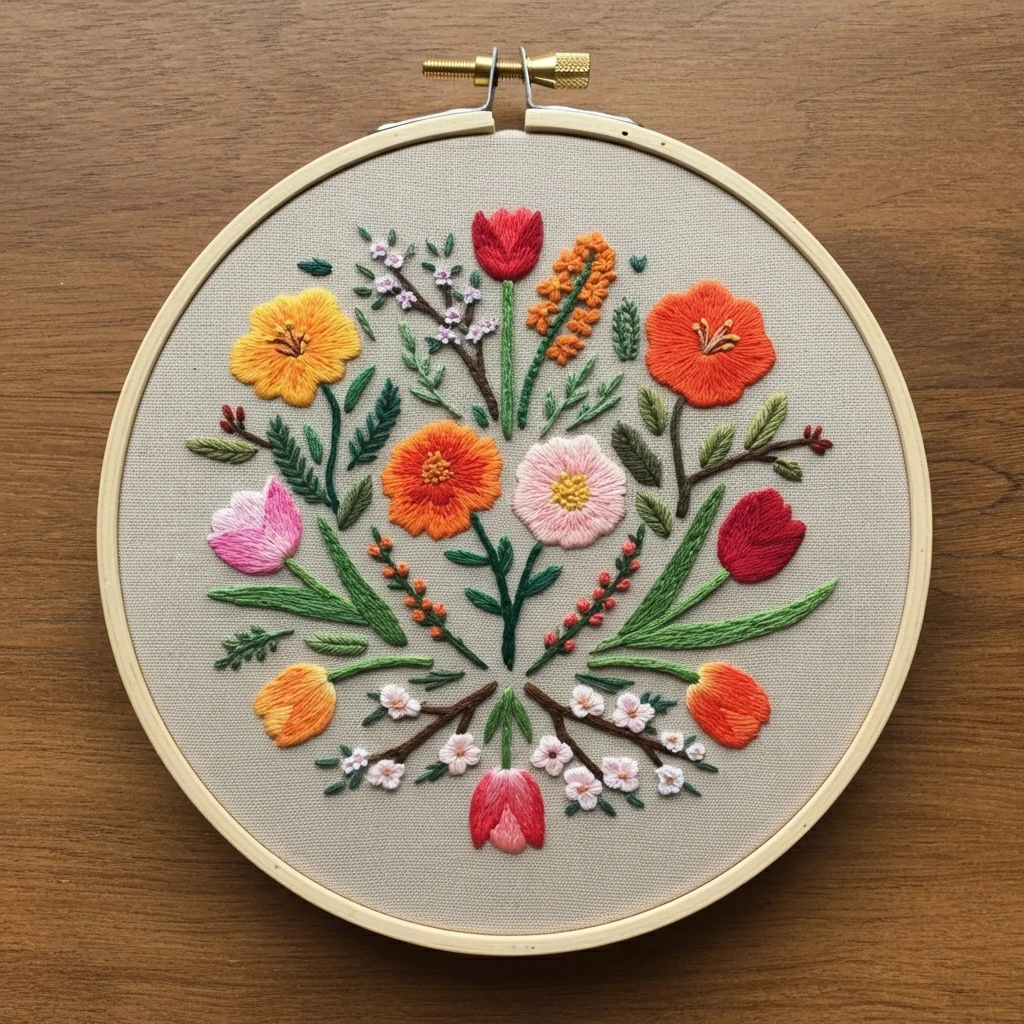
Vibrant Circular Spring Bouquet
A cheerful round bouquet stitched on neutral linen: red and coral tulips, yellow and orange open blooms, pale pink blossoms, white sprigs, dark branching stems, and layered spring greens arranged in a balanced hoop composition.
Likely DMC Color Palette
Colors are visual approximations matched to common DMC six-strand cotton shades. Coverage percentages are practical planning estimates, not exact thread consumption.
Main red tulip petals, deep rose accents, and stronger warm petal shadows.
Inner tulip folds, darkest red edges, and tiny berry shadows.
Orange blossom petals, bright coral tulip areas, and lively warm highlights.
Petal bases, orange flower shadows, and saturated punched-up centers.
Yellow flower petals, raised centers, pollen dots, and sunny petal tips.
Golden shadows near flower centers and the warm side of French knots.
Soft pink bloom petals, tulip highlights, and blush-toned small blossoms.
Bright pink tulip side petals and stronger magenta accents.
White cherry-like blossoms and glints on petal tips; outline lightly if needed.
Subtle shading in white blossoms and pale-pink flower transitions.
Dark stems, central leaf veins, dense fern sprigs, and grounding greenery.
Most leaves and stems; a strong natural mid green for the bouquet structure.
Leaf highlights, young shoots, and lighter edges on long satin leaves.
Muted olive leaves that sit behind brighter flowers without competing.
Branching stems, twig outlines, flower-center spokes, and natural shadows.
Stitching Suggestions by Element
| Element | Recommended stitch | Practical notes |
|---|---|---|
| Large red and coral tulips | Long and short stitch, satin stitch accents | Work from the petal tip toward the base so the stitches follow the tulip cup. Use 2 strands for filling; add 1-strand dark red split stitches inside the folds. |
| Round yellow, orange, and pink flowers | Long and short stitch or padded satin | Radiate stitches from the center outward. Blend lighter tips into deeper bases by alternating single stitches of adjacent colors rather than changing in hard bands. |
| Flower centers | French knots, colonial knots, short straight stitches | Use 1-2 wraps for small dots and 2-3 wraps for the central flower cluster. Mix 725 and 782 for a textured pollen effect. |
| White blossom sprigs | Lazy daisy petals with French-knot centers | Keep these airy: one strand of 3865 for petals, a touch of 818 at the base, and tiny brown or yellow knots for centers. |
| Long leaves | Fishbone stitch, satin stitch, split-stitch vein | Use darker green down the center and lighter green at the edges. Keep the angle consistent so leaves look smooth and botanical. |
| Fern sprigs and small leaf clusters | Straight stitch, detached chain, fly stitch | Use 1 strand for small fronds. Alternate 3363, 367, and 3052 so background greenery has depth without becoming heavy. |
| Brown branches | Stem stitch or split backstitch | Stitch branches before the blossoms, then place pale petals over them. A few 3371 or 801 stitches at junctions make the twigs look dimensional. |
| Red-orange berries | French knots or tiny satin dots | Scatter knots unevenly along the stems; a darker knot on the underside gives each berry a rounded look. |
Thread-count guidance
- 1 strand: fine stems, inner outlines, petal veins, small blossom petals, and delicate leaf tips.
- 2 strands: most flower fills, medium leaves, tulip bodies, and visible branch work.
- 3 strands: only for bold flower centers, chunky berry knots, or raised accent areas where the pattern allows space.
- Use shorter thread lengths, about 12-15 inches, to keep bright reds and greens from fuzzing.
Blending and shading ideas
- Blend coral flowers with one strand 741 plus one strand 740 for a saturated orange-red transition.
- For red tulips, blend 321 with 816 at the lower folds and reserve plain 321 for the outer light-catching surfaces.
- For pale pink blooms, combine 605 and 818 in alternating long-and-short stitches to avoid flat cotton-candy blocks.
- For leaves, run 3363 along the vein, 367 through the body, and 470 on sunlit tips.
Suggested Stitch Order
Outlining and detail
Use very restrained outlining so the bouquet stays soft and spring-like. A 1-strand split stitch in 816 can define red tulip folds; 801 can sharpen the twig stems; 3363 can add leaf veins. Avoid outlining every petal in dark thread, because the design relies on fresh color and rounded satin texture.
Texture suggestions
Contrast smooth satin petals with raised French-knot centers, airy detached-chain leaves, and slim stem-stitched branches. This mix keeps the circular bouquet from looking flat while still remaining approachable for beginners.