
DMC palette & stitching guide
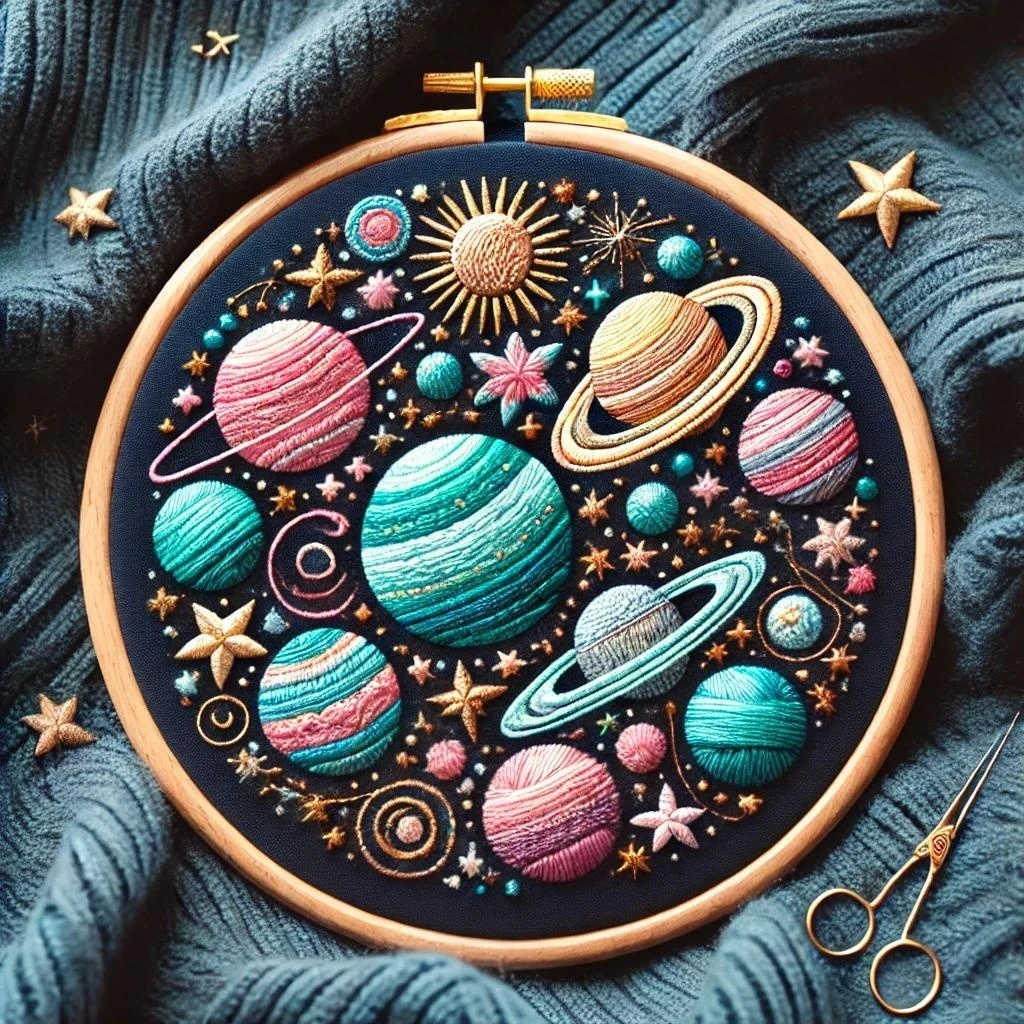
Vibrant Cosmic Solar System
A richly textured hoop with a deep navy space field, glowing sunbursts, teal and aqua planets, rose-pink striped worlds, creamy Saturn rings, tiny gold stars, orbit curls, and bead-like constellations. The palette below is matched to the visible preview and designed for practical hand embroidery.
Likely DMC Color Palette
Use the dark background as negative space and let the brighter floss colors create the planet volume. Coverage percentages are visual estimates from the preview, not exact thread usage.
Stitching Suggestions
The design works best when the planets are built with curved, directional stitches and the tiny stars are saved for the final pass.
| Element | Recommended stitch | Practical notes |
|---|---|---|
| Large teal center planet | Long and short stitch, split stitch bands | Follow the curve of the sphere. Blend DMC 3846 with 3847, then add thin 747 lines for glow and depth. |
| Pink striped planets | Curved satin stitch with backstitched bands | Lay satin stitches in horizontal arcs, alternating 3716 and 3806. Keep bands slightly uneven so the planets feel round, not flat. |
| Saturn body and rings | Padded satin, split stitch, couching | Pad the planet lightly with 1 strand first. Couch ring outlines with 677 and shade the underside with 3852 and 436. |
| Sun and sun rays | Woven wheel center, straight stitch rays | Use 677 for the first pass, then add 3852 and 436 in the center for a warm, raised solar texture. |
| Tiny stars and constellations | French knots, star stitch, seed stitch | Scatter B5200, 677, and 3847 knots at different sizes. Use one-wrap knots for distant stars and two-wrap knots for brighter points. |
| Orbit curls and trails | Stem stitch, whipped backstitch, couching | Use 1 strand for clean curves. Whip selected orbit lines with pale pink or gold to make them look luminous. |
| Small moons and dots | Satin dots or colonial knots | Use 3847, 747, 3716, and 677. Keep each small body simple so the composition stays readable. |
| Dark outlines | Split backstitch or one-strand backstitch | Use 939 only where extra separation is needed, especially around overlapping rings and planet edges. |
Thread Count & Blending Plan
Planet fills
Use 2 strands for most satin and long-and-short areas. Switch to 1 strand for final curved bands, tiny highlight lines, and smooth edge corrections.
Raised texture
Use 3 strands only for select padded planet centers, large star knots, and the sun center. Too much bulk can crowd the smaller planets.
Blended colors
Try one strand 3846 + one strand 3847 for teal transitions, or one strand 3716 + one strand 3806 for rosy planet shading.
Where to Start
Mark only the essential planet edges, rings, orbit lines, and largest stars. Avoid drawing every dot so the final sparkle placement can stay flexible.
Begin with the teal center planet, pink striped planet, and Saturn. These anchor the design and set the direction of the curves.
This keeps ring lines crisp and prevents them from disappearing under satin stitches.
Place bright knots last so they remain raised and clean against the dark background.
Beginner-Friendly Practical Tips
- Use a sharp needle for dense planets. It slips between existing stitches more easily when adding late highlight bands.
- Keep satin stitches short. For larger planets, break the fill into curved bands instead of trying to span the whole shape.
- Rotate the hoop often. Curved planet stitches are easier when your hand follows the arc naturally.
- Test French knots on scrap fabric. The star field looks best with varied knot sizes, but consistent tension matters.
- Use dark outlines sparingly. Too much navy backstitch can flatten the planets; place it only where contrast is needed.
- Save the brightest white for the end. A few B5200 stitches will feel like stars if they are not overused.