
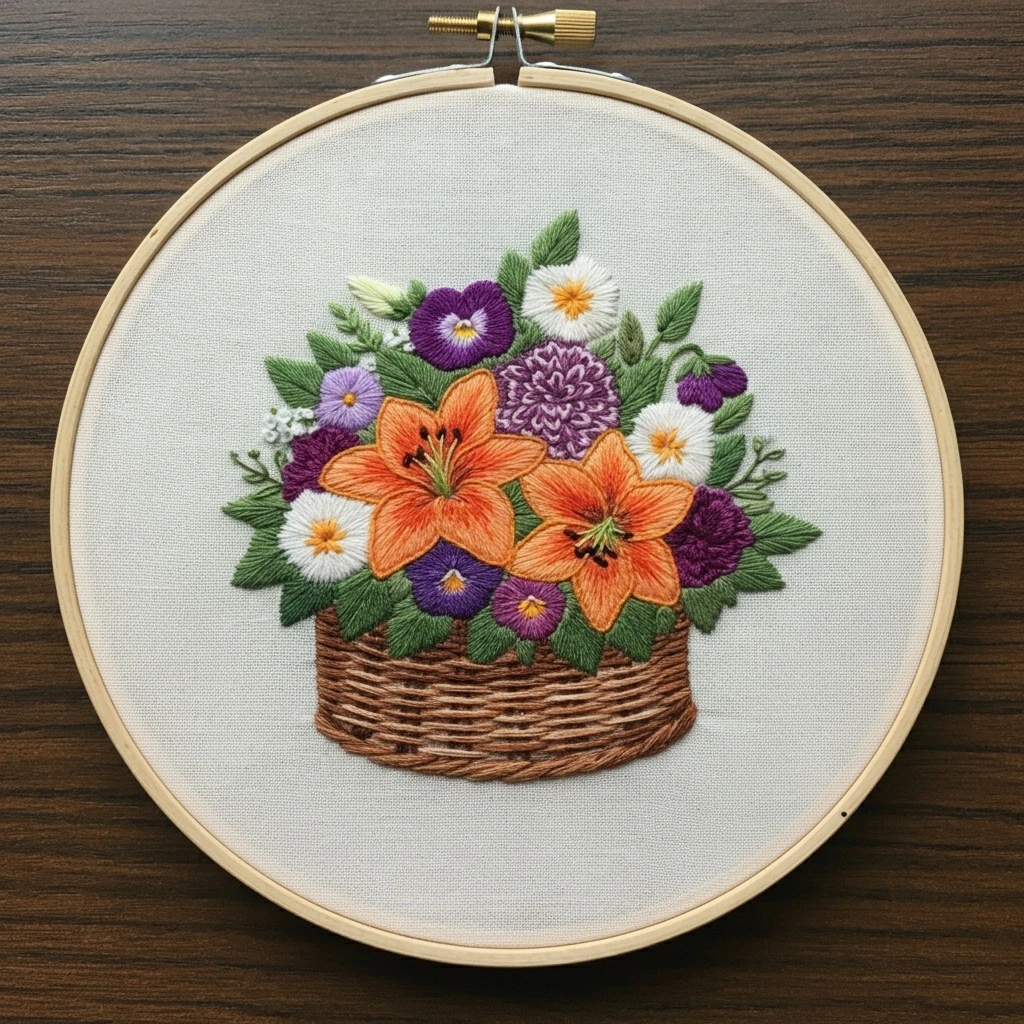
DMC palette & hand embroidery notes
Vibrant Floral Basket Arrangement
A polished floss guide for a full basket of orange lilies, white daisies, purple pansies, clustered blossoms, leafy greens, and a warm woven wicker base. Colors are estimated from the visible hoop preview and matched to practical DMC shades for dimensional stitching.
Likely DMC Color Palette
Use this as a practical shopping and stitching palette. The design benefits from saturated florals balanced with several greens and three basket browns.
Primary orange lily petal body; ideal for bold satin or long-and-short fills.
Petal highlights and warm transitions on the lily tips and upper ridges.
Lily veining, petal bases, and deeper orange shadow accents.
Deep pansies, purple flower shadows, and rich outer petal edges.
Mid-purple petals and chrysanthemum-like layered bloom details.
Soft violet flower highlights and small side blossoms.
White daisy petals; keep mostly clean with minimal shadow at bases.
Daisy centers, lily throat highlights, and tiny pollen details.
Dark leaves behind flowers and shadowed foliage under the basket rim.
Main leaf fills, stems, and the deeper sides of ribbed leaves.
Leaf highlights, small sprigs, and fresh growth near bloom tips.
Basket midtone wicker strands and warm woven base layers.
Basket shadows, lower rim, and recessed weave gaps.
Basket highlights and top weave lines catching the light.
Fine outlines, lily stamens, basket creases, and the deepest accents.
Very light petal shadowing and optional fabric-neutral transition stitches.
Stitching Suggestions
The preview has a realistic stitched look, so use directional stitches and layer details after each base shape is filled.
| Element | Recommended stitches | Practical notes |
|---|---|---|
| Orange lilies | Long-and-short stitch; satin stitch for smaller petal areas | Work from petal tip toward the throat. Blend 741 into 740, then add 921 in thin directional lines for veins. |
| Lily centers and stamens | Straight stitch, French knots, tiny backstitch | Use 725 for pollen highlights and 3371 for dark anthers. Keep these details raised but small so they do not overpower the petals. |
| Purple pansies and round blooms | Padded satin, long-and-short, split stitch outline | Use 550 at the bases and edges, 3837 through the middle, and 209 sparingly for lifted highlights. |
| White daisies | Lazy daisy, straight stitch, or narrow satin stitch | Leave the petals bright with 3865. Add only a few 642 stitches at petal bases for definition, then dot centers with 725. |
| Layered purple chrysanthemum | Detached chain, fishbone-style short stitches, or overlapping straight stitches | Build from the outside inward, alternating 3837 and 550 so the flower reads like many folded petals. |
| Leaves and stems | Fishbone stitch for leaves; stem stitch for stems; straight stitch for small sprigs | Use 890 under the flowers, 3345 for main leaves, and 470 on tips and center veins. Change stitch angle to show each leaf direction. |
| Woven basket | Horizontal long-and-short base with whipped backstitch or couching over the top | Fill the basket with 975 and 434, then add 801 and 3371 weave shadows. Let some lines be slightly uneven for natural wicker texture. |
| Fine outlines | Split stitch, backstitch, or one-strand stem stitch | Outline only the key petal edges, basket rim, and deepest leaf separations. Too much outlining can make the bouquet feel cartoonish. |
Thread Count & Blending Guide
General strand plan
- Use 2 strands for most petals, leaves, and basket fills.
- Use 1 strand for petal veins, tiny stems, outlines, stamens, and small shading marks.
- Use 3 strands only for raised basket rim accents or chunky flower centers.
Blended needle ideas
- Lily glow: 1 strand 740 + 1 strand 741.
- Lily shadow: 1 strand 740 + 1 strand 921.
- Deep violet transition: 1 strand 550 + 1 strand 3837.
- Natural foliage: 1 strand 3345 + 1 strand 470.
Shading approach
Place the darkest values where petals overlap, under the central flowers, and at the basket base. Save the brightest colors for petal tips, daisy centers, and top leaf ridges.
Texture approach
Use smooth long-and-short stitches for the lilies, more clustered stitches for purple blooms, ribbed fishbone leaves, and uneven whipped lines for the basket weave.
Suggested Stitching Order
Anchor the basket first
Fill the basket base, rim, and side shadows before adding flowers. This sets the scale and keeps the bouquet grounded.
Add the main lilies
Stitch the two large orange blooms next because they are the visual focus. Finish their veins and centers before surrounding flowers crowd the area.
Work the large background leaves
Use greens behind and between the flowers. Directional fishbone stitches will make the leaves look layered rather than flat.
Fill purple and white blossoms
Alternate purple blooms and daisies around the lilies to keep color balance even across the bouquet.
Finish with tiny details
Add French knots, stamens, small white buds, one-strand outlines, and final basket weave shadows only after all filled areas are complete.
Beginner-Friendly Practical Tips
Keep the fabric clean
The design sits on light fabric, so wash hands before stitching and avoid carrying dark purple or brown threads across open background areas.
Use shorter thread lengths
Cut floss about 14–16 inches long. Deep purples and browns can fuzz if pulled through the fabric too many times.
Test the basket weave
Practice a few horizontal lines on scrap fabric. The basket looks best when the base fill is smooth and the top weave is added with confident, separate lines.
Do not overpack the petals
Leave each petal edge readable. If stitches become crowded, switch to one strand for the final veins and outlines.