
DMC palette & stitching suggestions
Vibrant Floral Bouquet
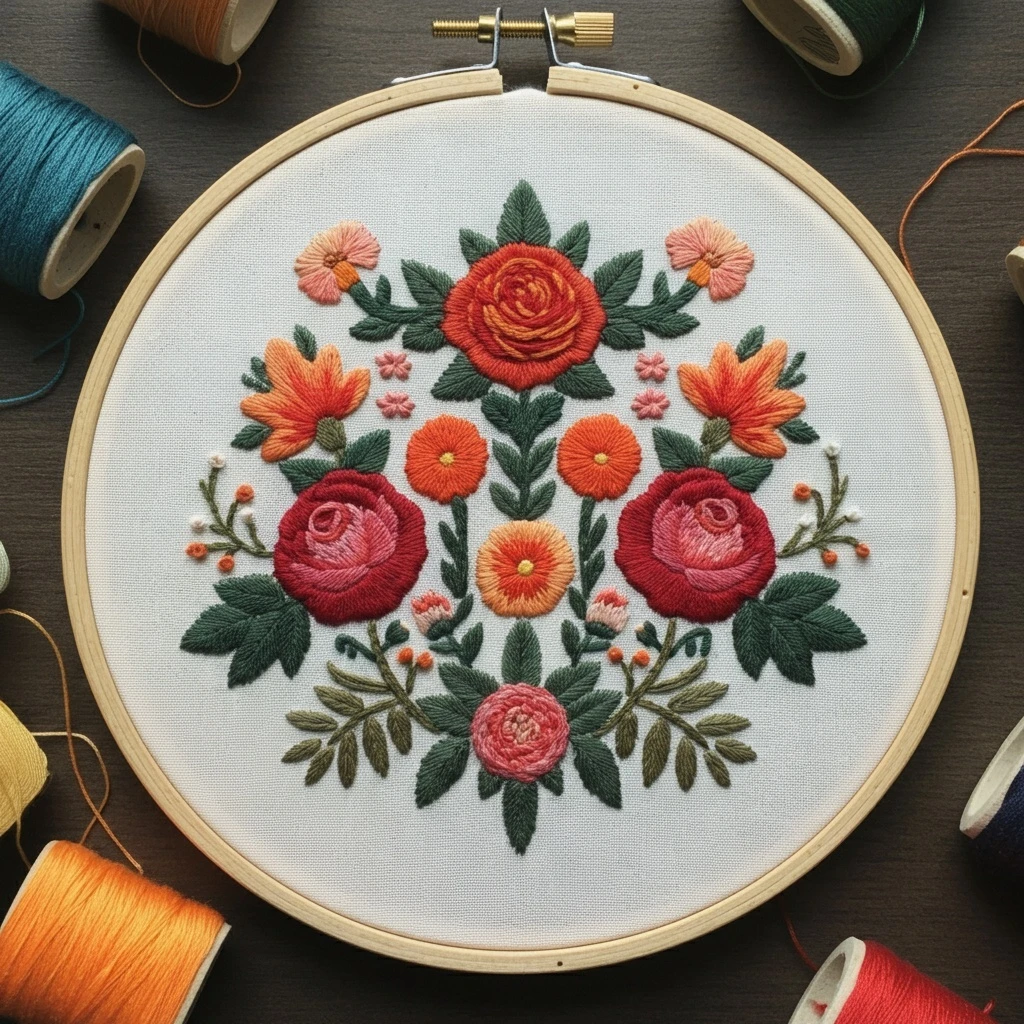
A polished hand-embroidery guide for a symmetrical hoop bouquet with red roses, coral-pink blossoms, orange daisy blooms, peach petals, deep leafy greenery, tiny buds, and soft linen negative space.
Design read
The artwork is built around a bold central rose, two larger side roses, orange-and-gold daisy forms, peach fan petals, small pink filler flowers, berry-like buds, and dense green leaf sprays. The strongest visual contrast comes from velvety reds against cool dark greens, with warm orange flowers bringing the bouquet forward.
natural linen, cotton-linen, or evenweave in ivory/oatmeal.
smooth satin petals, ribbed leaves, raised knots, and fine stem lines.
confident beginner to intermediate; repeatable floral shapes.
2 strands for most motifs, 1 strand for detail, 3 strands for plush centers.
Likely DMC Color Palette
Colors are practical close matches chosen from the visible bouquet: saturated rose reds, coral-pinks, bright oranges, golden flower centers, and layered botanical greens. Percentages are visual estimates, not exact floss usage.
Stitching Suggestions
Work from the largest shapes to the smallest details so the bouquet stays balanced and the negative space remains clean.
Large roses
- Use long and short stitch for outer petals and padded satin stitch for curled inner petals.
- Follow the spiral direction of each rose; rotate the hoop often so the stitches radiate naturally.
- Use 814 or 777 in the deepest folds, then graduate to 321, 347, 3706, and 3713 on lifted edges.
Orange flowers
- Use satin stitch or fishbone-style petal wedges from the center outward.
- Blend 741 with 3825 near the tips for a warm glowing look.
- Add DMC 725 French knots in the centers after petal stitching is complete.
Peach fan blossoms
- Use straight stitches that fan out from the lower center of each flower.
- Alternate 3713 and 3825 for soft peach dimension.
- Place a small orange satin stitch or knot at each throat.
Leaves
- Fishbone stitch is ideal for the pointed leaves because it creates a central vein automatically.
- Use 500 at the base and 3362 toward the tip; add 3051 for muted side sprigs.
- Keep leaf stitches slightly angled, never horizontal, for natural growth direction.
Stems and tendrils
- Use 1 strand of 3362 or 3051 in stem stitch for curving stems.
- For very thin offshoots, use backstitch with small stitches so curves do not become angular.
- Stitch stems before French-knot buds so the knots sit cleanly on top.
Tiny buds and fillers
- Use French knots, colonial knots, or small detached chain stitches.
- Use 741 for orange buds, 3713/3706 for pink fillers, and 3865 for tiny white blossoms.
- Vary knot wraps to keep the filler flowers lively rather than uniform.
Thread Count & Blending Guide
Recommended strand counts
| Area | Strands | Why |
|---|---|---|
| Rose petals | 2 strands | Smooth enough for curves while still giving the roses rich coverage. |
| Rose centers | 1–2 strands | Use 1 strand for tight spiral detail; 2 strands for padded curl edges. |
| Leaves | 2 strands | Creates a full, ribbed texture that contrasts nicely with smooth petals. |
| Fine stems | 1 strand | Keeps vines graceful and prevents the bouquet from looking heavy. |
| Flower centers & buds | 2–3 strands | More strands make raised knots that stand out against satin petals. |
Easy blending combinations
- Velvet red rose: 1 strand 814 + 1 strand 321 for the shaded outer petals.
- Warm rose highlight: 1 strand 321 + 1 strand 347 to bridge red and coral.
- Pink rose curl: 1 strand 3706 + 1 strand 3713 for lifted inner spirals.
- Glowing orange flower: 1 strand 741 + 1 strand 3825 for sunny petal tips.
- Dimensional leaf: 1 strand 500 + 1 strand 3362 for darker leaf bases.
Suggested Stitching Order
Anchor the bouquet
Stitch the central rose first, then the two large side roses. These set the scale, symmetry, and color strength.
Add bright blooms
Work the orange and peach flowers next, keeping stitch direction radial so each bloom feels open and sunny.
Build greenery
Fill the main leaves behind the flowers with fishbone stitch. Add muted olive sprigs after the darker leaves are complete.
Finish details
Add stems, buds, knots, flower centers, and any fine outlines last so they remain crisp and sit above the filled areas.
Outlining, Shading & Texture Notes
- Outlining: Use split stitch in a matching darker shade around roses only where the edge needs definition. Avoid outlining every petal; selective edges look more natural.
- Petal shading: Place darker stitches at the petal base and under overlaps. Keep lighter stitches on tips, curled edges, and upper-facing petals.
- Leaf texture: For a crisp botanical look, stitch each half of a leaf separately toward the center vein. A single straight stitch down the middle can sharpen the vein if needed.
- Raised accents: French knots and colonial knots should be saved for the final pass so they do not catch while nearby satin stitches are being worked.
- Clean negative space: Since the design depends on open fabric around the bouquet, carry threads carefully on the back and avoid long dark jumps between separate motifs.
- Hoop tension: Keep fabric drum-tight before satin stitching. Loose fabric makes rose petals pucker and can distort the circular arrangement.
Beginner-Friendly Practical Tips
Before stitching
Separate all six floss strands first, then recombine only the number needed. This makes satin stitches smoother and reduces twisting.
Needle choice
Use a size 7–9 embroidery needle for two strands. Switch to a finer needle for 1-strand stems and tight rose centers.
Thread length
Cut floss about 14–18 inches long. Shorter lengths help bright reds and greens stay glossy rather than fuzzy.
Symmetry check
After each major flower, step back and compare left and right sides. Adjust filler leaves and buds to restore balance.
Color control
Use the deepest reds and greens sparingly. Too much dark thread can flatten the bouquet; let coral and orange highlights breathe.
Finishing
Press the finished embroidery face-down on a towel with gentle steam. Do not press directly over raised knots.